QUESTION IMAGE
Question
equivalent experience_ma.912.ar.5.6
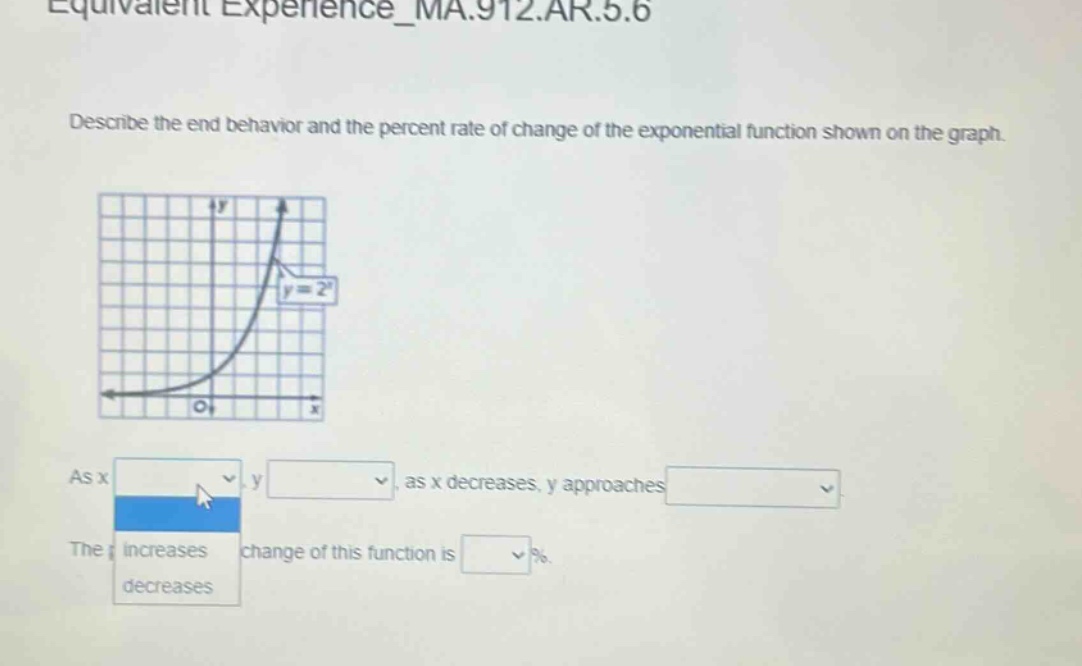
describe the end behavior and the percent rate of change of the exponential function shown on the graph.
as x ▼, y ▼, as x decreases, y approaches ▼.
the ▼ change of this function is ▼ %.
Step1: Analyze End Behavior (x increases)
For the exponential function \( y = 2^x \), as \( x \) increases, we evaluate the trend. Since the base \( 2>1 \), the function is exponential growth. So as \( x \) increases, \( y \) increases without bound (approaches \( \infty \)).
Step2: Analyze End Behavior (x decreases)
As \( x \) decreases (goes to \( -\infty \)), we calculate \( \lim_{x
ightarrow -\infty} 2^x \). Using the property of exponential functions, \( 2^x=\frac{1}{2^{-x}} \), and as \( x
ightarrow -\infty \), \( -x
ightarrow \infty \), so \( 2^{-x}
ightarrow \infty \), hence \( \frac{1}{2^{-x}}
ightarrow 0 \). So as \( x \) decreases, \( y \) approaches \( 0 \).
Step3: Find Percent Rate of Change
The general form of an exponential function is \( y = a(1 + r)^x \), where \( r \) is the percent rate of change. For \( y = 2^x \), we can write it as \( y = 1(1 + 1)^x \) (since \( 2=1 + 1 \)). So \( r = 1 \), which is \( 100\% \) when converted to a percentage.

Snap & solve any problem in the app
Get step-by-step solutions on Sovi AI
Photo-based solutions with guided steps
Explore more problems and detailed explanations
As \( x \) \(\boldsymbol{\text{increases}}\), \( y \) \(\boldsymbol{\text{increases without bound}}\); as \( x \) decreases, \( y \) approaches \(\boldsymbol{0}\). The percent rate of change of this function is \(\boldsymbol{100}\%\).