QUESTION IMAGE
Question
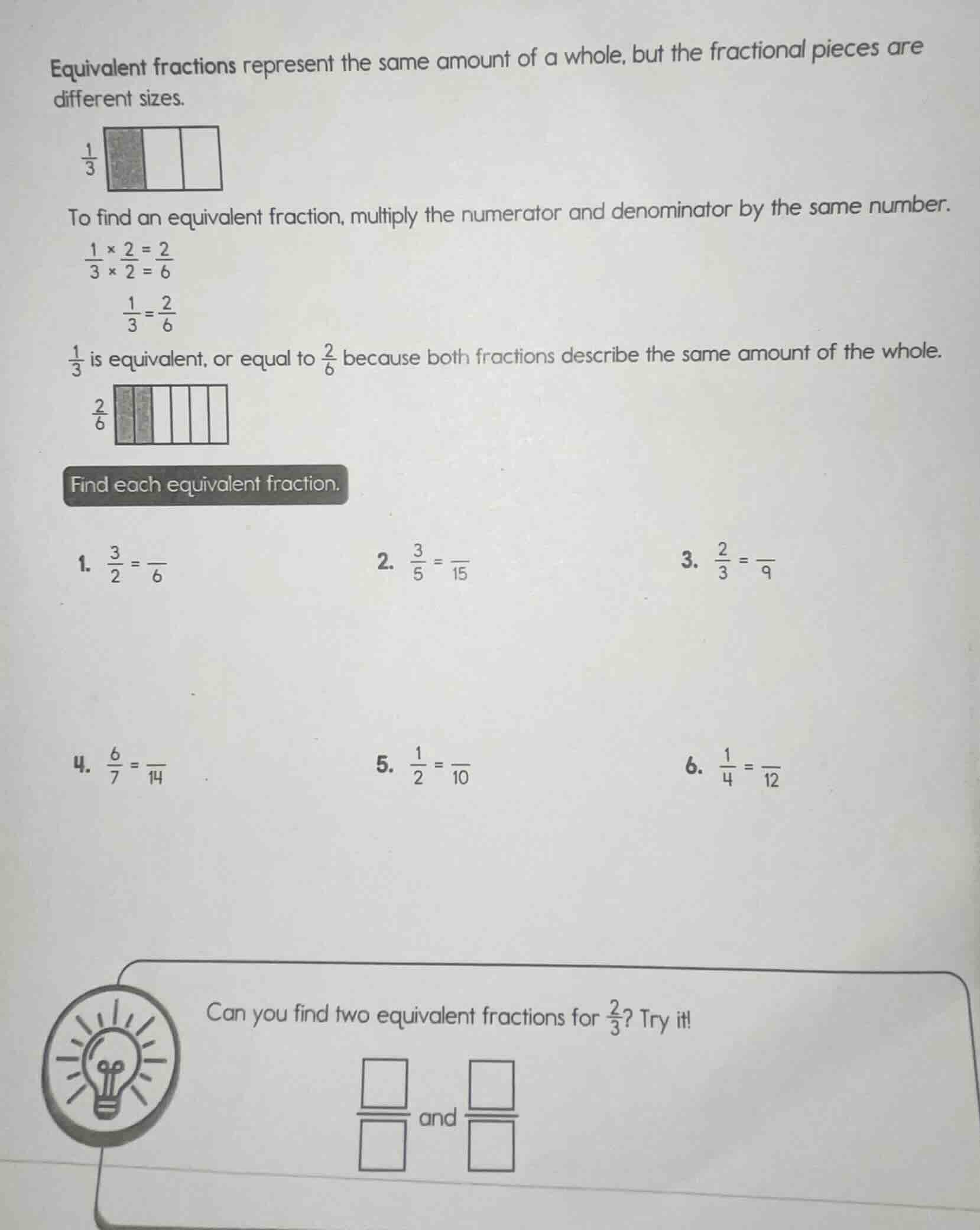
equivalent fractions represent the same amount of a whole, but the fractional pieces are different sizes.
to find an equivalent fraction, multiply the numerator and denominator by the same number.
\\(\frac{1}{3} \times \frac{2}{2} = \frac{2}{6}\\)
\\(\frac{1}{3} = \frac{2}{6}\\)
\\(\frac{1}{3}\\) is equivalent, or equal to \\(\frac{2}{6}\\) because both fractions describe the same amount of the whole.
find each equivalent fraction.
- \\(\frac{3}{2} = \frac{\quad}{6}\\)
- \\(\frac{3}{5} = \frac{\quad}{15}\\)
- \\(\frac{2}{3} = \frac{\quad}{9}\\)
- \\(\frac{6}{7} = \frac{\quad}{14}\\)
- \\(\frac{1}{2} = \frac{\quad}{10}\\)
- \\(\frac{1}{4} = \frac{\quad}{12}\\)
can you find two equivalent fractions for \\(\frac{2}{3}\\)? try it!
\\(\frac{\square}{\square}\\) and \\(\frac{\square}{\square}\\)
Problem 1: $\boldsymbol{\frac{3}{2} = \frac{}{6}}$
Step1: Find the multiplier
The denominator changes from 2 to 6. Calculate the multiplier: $6 \div 2 = 3$.
Step2: Multiply numerator by 3
Multiply the numerator 3 by 3: $3 \times 3 = 9$. So $\frac{3}{2} = \frac{9}{6}$.
Step1: Find the multiplier
Denominator changes from 5 to 15. Multiplier: $15 \div 5 = 3$.
Step2: Multiply numerator by 3
Multiply 3 by 3: $3 \times 3 = 9$. So $\frac{3}{5} = \frac{9}{15}$.
Step1: Find the multiplier
Denominator changes from 3 to 9. Multiplier: $9 \div 3 = 3$.
Step2: Multiply numerator by 3
Multiply 2 by 3: $2 \times 3 = 6$. So $\frac{2}{3} = \frac{6}{9}$.

Snap & solve any problem in the app
Get step-by-step solutions on Sovi AI
Photo-based solutions with guided steps
Explore more problems and detailed explanations
9