QUESTION IMAGE
Question
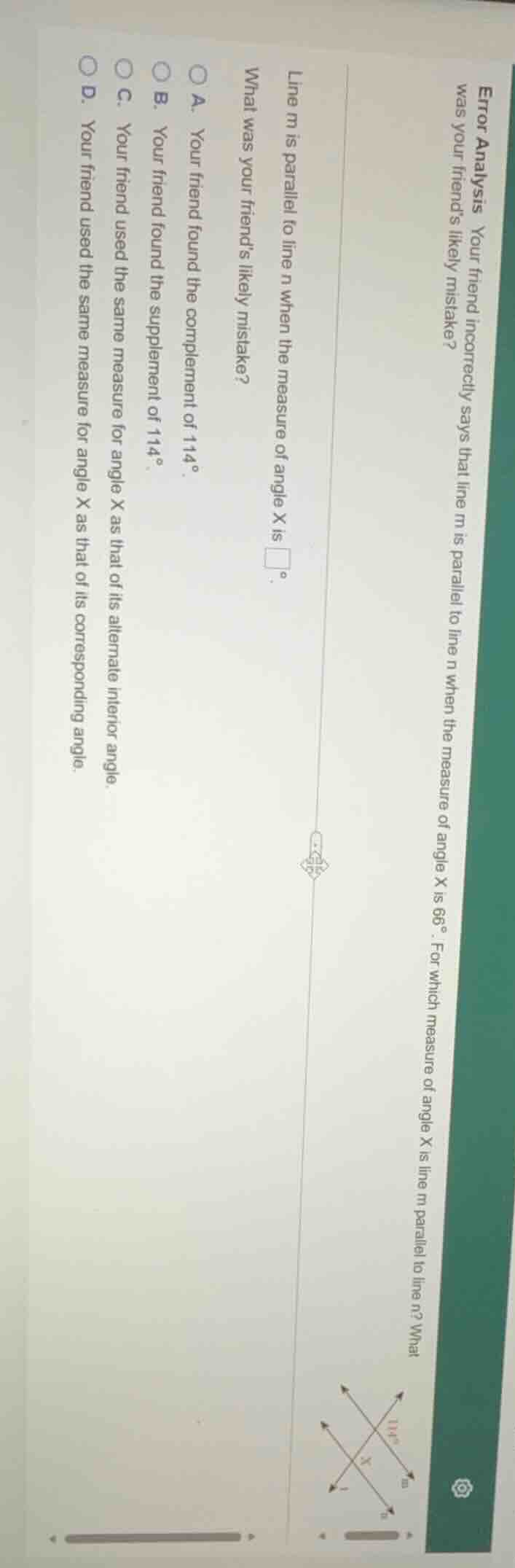
error analysis your friend incorrectly says that line m is parallel to line n when the measure of angle x is 66°. for which measure of angle x is line m parallel to line n? what was your friend’s likely mistake? line m is parallel to line n when the measure of angle x is \\(\square\\)°. what was your friend’s likely mistake? a. your friend found the complement of 114°. b. your friend found the supplement of 114°. c. your friend used the same measure for angle x as that of its alternate interior angle. d. your friend used the same measure for angle x as that of its corresponding angle.
To determine when lines \( m \) and \( n \) are parallel, we use the concept of supplementary angles (same - side interior angles are supplementary when lines are parallel) or vertical/alternate interior angles. The given angle is \( 114^{\circ} \). If we consider the relationship for parallel lines, angle \( X \) and \( 114^{\circ} \) should be supplementary (since they are same - side interior angles). So \( \angle X=180 - 114=66^{\circ} \) is wrong for non - parallel, but when parallel, same - side interior angles are supplementary. Wait, the friend's mistake: when the friend thought \( \angle X = 66^{\circ} \) implies parallel, but actually, if we look at the options, the friend likely used the same measure as the corresponding angle (option D) or maybe confused with alternate interior, but let's re - evaluate. Wait, the angle given is \( 114^{\circ} \). The supplement of \( 114^{\circ} \) is \( 66^{\circ} \), but the mistake: if the friend used the same measure as the corresponding angle (which would be equal for parallel lines, but here the angle is \( 114^{\circ} \), so if the friend took \( 66^{\circ} \) as equal to a corresponding angle (but that's not correct). Wait, the options: Option B says the friend found the supplement of \( 114^{\circ} \) (which is \( 66^{\circ} \)) and thought that makes lines parallel, but the mistake is that the friend should have used the correct angle relationship. Wait, the question is about the likely mistake. Let's analyze the options:
- Option A: Complement of \( 114^{\circ} \) is negative, so not possible.
- Option B: Supplement of \( 114^{\circ} \) is \( 66^{\circ} \), but the mistake is if the friend thought that \( 66^{\circ} \) (supplement) is the angle for parallel, but actually, when lines are parallel, same - side interior angles are supplementary. Wait, no, the friend's mistake: when the friend says line \( m \) is parallel when \( \angle X = 66^{\circ} \), the likely mistake is that the friend used the same measure as the corresponding angle (option D) or found the supplement (option B). Wait, the angle given in the diagram is \( 114^{\circ} \). If \( \angle X \) and \( 114^{\circ} \) are same - side interior angles, for lines to be parallel, they should be supplementary (\( \angle X+114 = 180\Rightarrow\angle X = 66 \)). But if the friend incorrectly used the measure of the corresponding angle (which would be equal to \( 114^{\circ} \) if they are corresponding, but that's not the case here). Wait, no, the options:
Wait, the first part: "Your friend incorrectly says that line m is parallel to line n when the measure of angle X is 66°. For which measure of angle X is line m parallel to line n? What was your friend’s likely mistake?"
First, find the measure of angle X when \( m\parallel n \). The angle adjacent to \( 114^{\circ} \) (let's assume they are same - side interior angles) should be supplementary. So \( \angle X+114 = 180\Rightarrow\angle X = 66^{\circ} \)? Wait, no, that can't be. Wait, maybe the angle \( 114^{\circ} \) and angle X are vertical angles or alternate interior. Wait, the diagram: two lines \( m \) and \( n \), and a transversal, with an angle of \( 114^{\circ} \) and angle X.
Wait, maybe the correct measure when \( m\parallel n \) is \( 114^{\circ} \) (corresponding angles), and the friend found the supplement (66°) instead. So the friend's mistake is finding the supplement of \( 114^{\circ} \) (option B) and the measure of angle X when \( m\parallel n \) is \( 114^{\circ} \).
Wait, let's re - structure:
- Find the measure of angle X when \( m\parallel…

Snap & solve any problem in the app
Get step-by-step solutions on Sovi AI
Photo-based solutions with guided steps
Explore more problems and detailed explanations
The measure of angle X when line \( m \) is parallel to line \( n \) is \( \boldsymbol{114^{\circ}} \). The friend’s likely mistake is option B (Your friend found the supplement of \( 114^{\circ} \)).