QUESTION IMAGE
Question
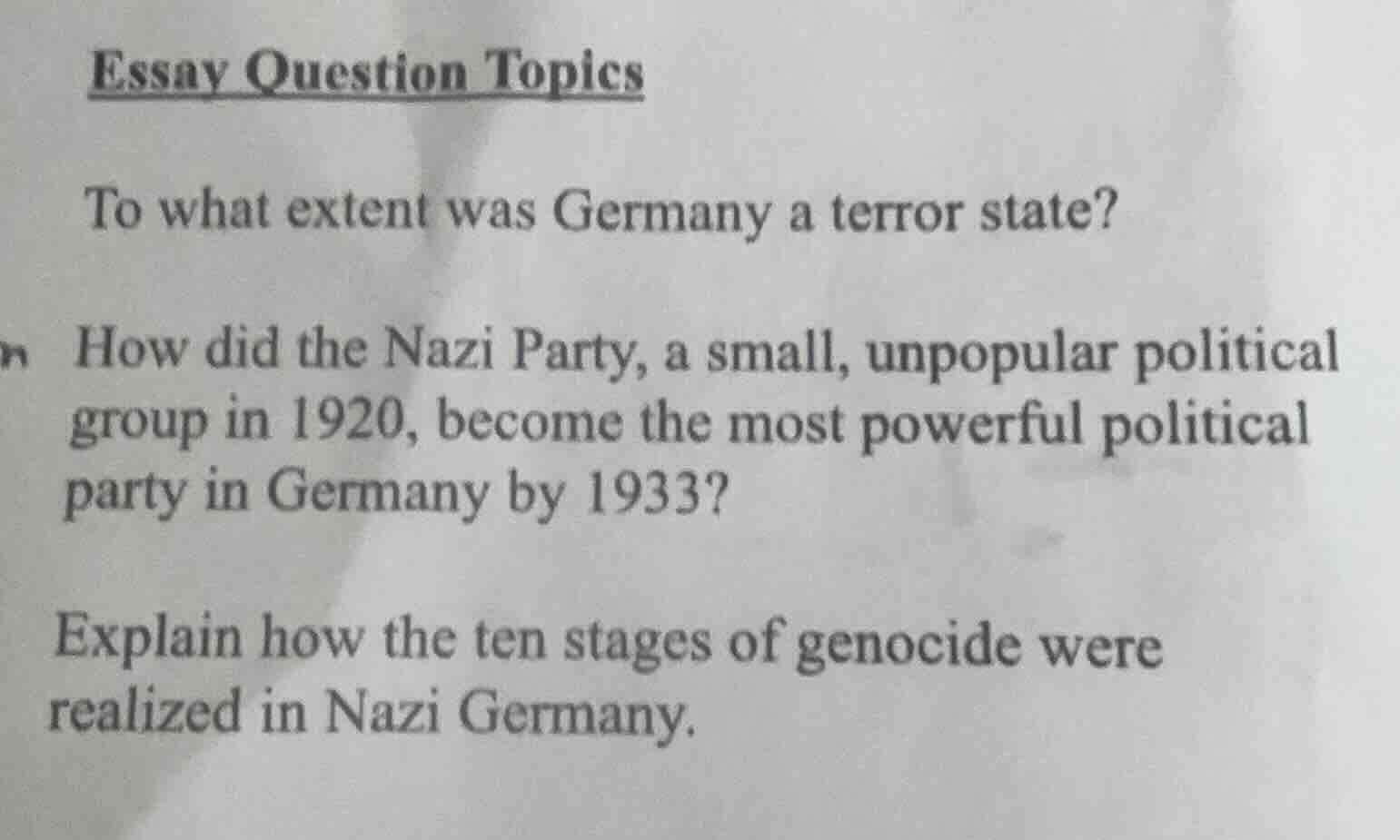
essay question topics
to what extent was germany a terror state?
how did the nazi party, a small, unpopular political group in 1920, become the most powerful political party in germany by 1933?
explain how the ten stages of genocide were realized in nazi germany.
- For "To what extent was Germany a terror state?":
This requires analyzing the coercive apparatus of Nazi Germany (e.g., Gestapo, SS, concentration camps) alongside popular support, legal frameworks, and the limited pushback against regime terror. The answer balances evidence of state-sponsored violence, repression of political opponents, and persecution of marginalized groups with factors that complicate the "terror state" label, like widespread complicity or selective enforcement.
- For "How did the Nazi Party, a small, unpopular political group in 1920, become the most powerful political party in Germany by 1933?":
Key factors include the failure of the Weimar Republic (economic crisis from hyperinflation and the Great Depression, political instability), Nazi propaganda (utilizing media and charismatic leadership of Hitler), appeal to nationalist and anti-communist sentiment, electoral strategy, and elite political deals (like the appointment of Hitler as Chancellor in 1933).
- For "Explain how the ten stages of genocide were realized in Nazi Germany.":
Each stage (Classification, Symbolization, Dehumanization, Organization, Polarization, Preparation, Persecution, Extermination, Denial, alongside lesser-known stages like Discrimination) is mapped to Nazi policies: e.g., Classification via racial laws, Dehumanization through anti-Semitic propaganda, Extermination via the Final Solution, and post-war Denial of atrocities.

Snap & solve any problem in the app
Get step-by-step solutions on Sovi AI
Photo-based solutions with guided steps
Explore more problems and detailed explanations
- Nazi Germany functioned as a terror state to a high degree: it maintained a pervasive coercive apparatus (Gestapo, SS, concentration camps) that violently repressed political opponents, persecuted Jewish people, Roma, disabled individuals, and other marginalized groups. However, widespread popular complicity, the integration of terror into formal legal structures, and the regime's ability to deliver economic recovery in its early years mean the label is not absolute, as terror was targeted rather than applied uniformly to all citizens.
- The Nazi Party rose to power by exploiting the Weimar Republic's weaknesses: the 1920s hyperinflation and 1930s Great Depression shattered public trust in democratic governance. Hitler's charismatic leadership, the party's effective propaganda (via newspapers, rallies, and radio) that tapped into nationalist anger over the Treaty of Versailles and anti-communist sentiment, and elite political maneuvering (including President Hindenburg's 1933 appointment of Hitler as Chancellor) allowed the once-fringe group to win mass electoral support and seize total power.
- The ten stages of genocide were fully realized in Nazi Germany:
- Classification: Racial laws (e.g., Nuremberg Laws) divided "Aryans" from "non-Aryans"
- Symbolization: Yellow stars marked Jewish citizens
- Dehumanization: Anti-Semitic propaganda framed Jewish people as "parasites"
- Organization: The SS and Einsatzgruppen were tasked with mass murder
- Polarization: Propaganda and violence silenced moderate voices
- Preparation: Ghettos were established to segregate Jewish people
- Persecution: Property seizure, forced labor, and mass deportations began
- Extermination: The Final Solution killed 6 million Jewish people and millions of others
- Denial: Nazi officials destroyed evidence, and post-war perpetrators denied their roles
- Discrimination: Systematic exclusion of Jewish people from education, work, and public life preceded full-scale violence