QUESTION IMAGE
Question
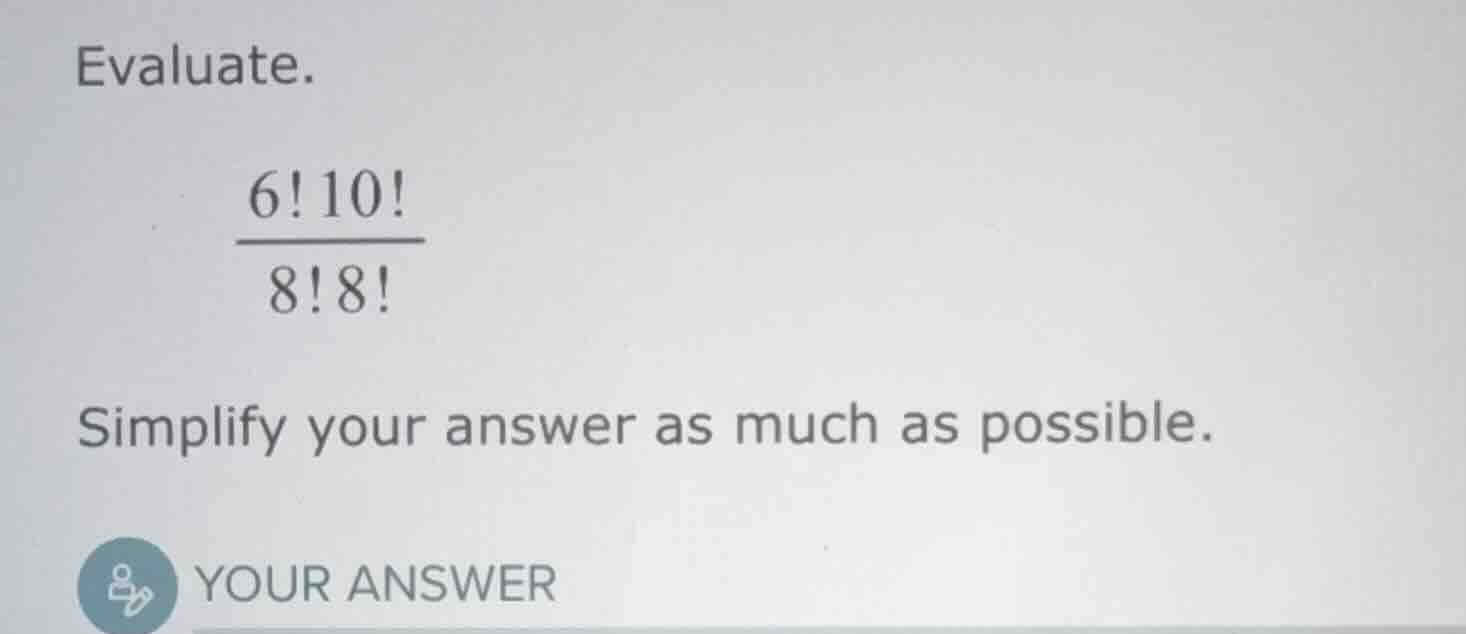
evaluate.
\\(\frac{6!10!}{8!8!}\\)
simplify your answer as much as possible.
your answer
Step1: Recall factorial definition
A factorial \( n! = n\times(n - 1)\times\cdots\times1 \). So we can rewrite \( 10! = 10\times9\times8! \) and \( 8! = 8\times7\times6! \) (wait, actually for simplification, let's handle numerator and denominator:
Numerator: \( 6! \times 10! = 6! \times 10\times9\times8! \)
Denominator: \( 8! \times 8! \)
So substitute these into the fraction:
\( \frac{6! \times 10\times9\times8!}{8! \times 8!} \)
Now, cancel out one \( 8! \) from numerator and denominator:
\( \frac{6! \times 10\times9}{8!} \)
But \( 8! = 8\times7\times6! \), so substitute that in:
\( \frac{6! \times 10\times9}{8\times7\times6!} \)
Now cancel out \( 6! \) from numerator and denominator:
\( \frac{10\times9}{8\times7} \)
Step2: Calculate the numerator and denominator
Numerator: \( 10\times9 = 90 \)
Denominator: \( 8\times7 = 56 \)
Now simplify the fraction \( \frac{90}{56} \). Both are divisible by 2:
\( \frac{90\div2}{56\div2} = \frac{45}{28} \)
Wait, wait, did I make a mistake? Wait, let's re-examine the original expression: \( \frac{6!10!}{8!8!} \)
Alternative approach:
\( 10! = 10\times9\times8\times7\times6! \)? No, \( 10! = 10\times9\times8! \), because \( 8! = 8\times7\times6\times5\times4\times3\times2\times1 \), so \( 10! = 10\times9\times8\times7\times6\times5\times4\times3\times2\times1 = 10\times9\times8! \)
Similarly, \( 8! = 8\times7\times6! \), because \( 6! = 6\times5\times\cdots\times1 \), so \( 8! = 8\times7\times6! \)
So let's rewrite the numerator and denominator with these:
Numerator: \( 6! \times 10! = 6! \times 10\times9\times8! \)
Denominator: \( 8! \times 8! = 8! \times 8\times7\times6! \)
Now substitute into the fraction:
\( \frac{6! \times 10\times9\times8!}{8! \times 8\times7\times6!} \)
Now, cancel \( 6! \) from numerator and denominator, cancel one \( 8! \) from numerator and denominator:
We get \( \frac{10\times9}{8\times7} \)
Calculate that: \( 10\times9 = 90 \), \( 8\times7 = 56 \), so \( \frac{90}{56} = \frac{45}{28} \). Wait, but let's check with actual factorial values:
\( 6! = 720 \), \( 10! = 3628800 \), \( 8! = 40320 \)
So numerator: \( 720 \times 3628800 = 720 \times 3628800 \)
Denominator: \( 40320 \times 40320 \)
Calculate numerator: \( 720 \times 3628800 = 720 \times 3.6288\times10^6 = 2.612736\times10^9 \)
Denominator: \( 40320 \times 40320 = (4.032\times10^4)^2 = 1.6257024\times10^9 \)
Now divide numerator by denominator: \( \frac{2.612736\times10^9}{1.6257024\times10^9} \approx 1.607 \), but \( \frac{45}{28} \approx 1.607 \), so that's correct. Wait, but let's do the fraction again:
Wait, \( 10! = 10\times9\times8! \), \( 8! = 8\times7\times6! \)
So:
\( \frac{6! \times 10\times9\times8!}{8! \times 8\times7\times6!} = \frac{10\times9}{8\times7} = \frac{90}{56} = \frac{45}{28} \)
Yes, that's correct. So the simplified fraction is \( \frac{45}{28} \) or as a mixed number \( 1\frac{17}{28} \), but as an improper fraction, \( \frac{45}{28} \) is simplified.
Wait, but let's check the steps again. Maybe I messed up the factorial expansion. Let's do it step by step:
\( 6! = 720 \)
\( 10! = 3628800 \)
\( 8! = 40320 \)
So numerator: \( 720 \times 3628800 = 720 \times 3628800 = 2612736000 \)
Denominator: \( 40320 \times 40320 = 1625702400 \)
Now divide 2612736000 by 1625702400:
Divide numerator and denominator by 1000: 2612736 / 1625702.4 → no, better to divide numerator and denominator by 4800 (wait, maybe GCD of 2612736000 and 1625702400). Let's find GCD of 2612736000 and 1625702400.
Divide 2612736000 by 1625702400: quotient 1, remainder 2612736000…

Snap & solve any problem in the app
Get step-by-step solutions on Sovi AI
Photo-based solutions with guided steps
Explore more problems and detailed explanations
\(\frac{45}{28}\)