QUESTION IMAGE
Question
evidence of evolution
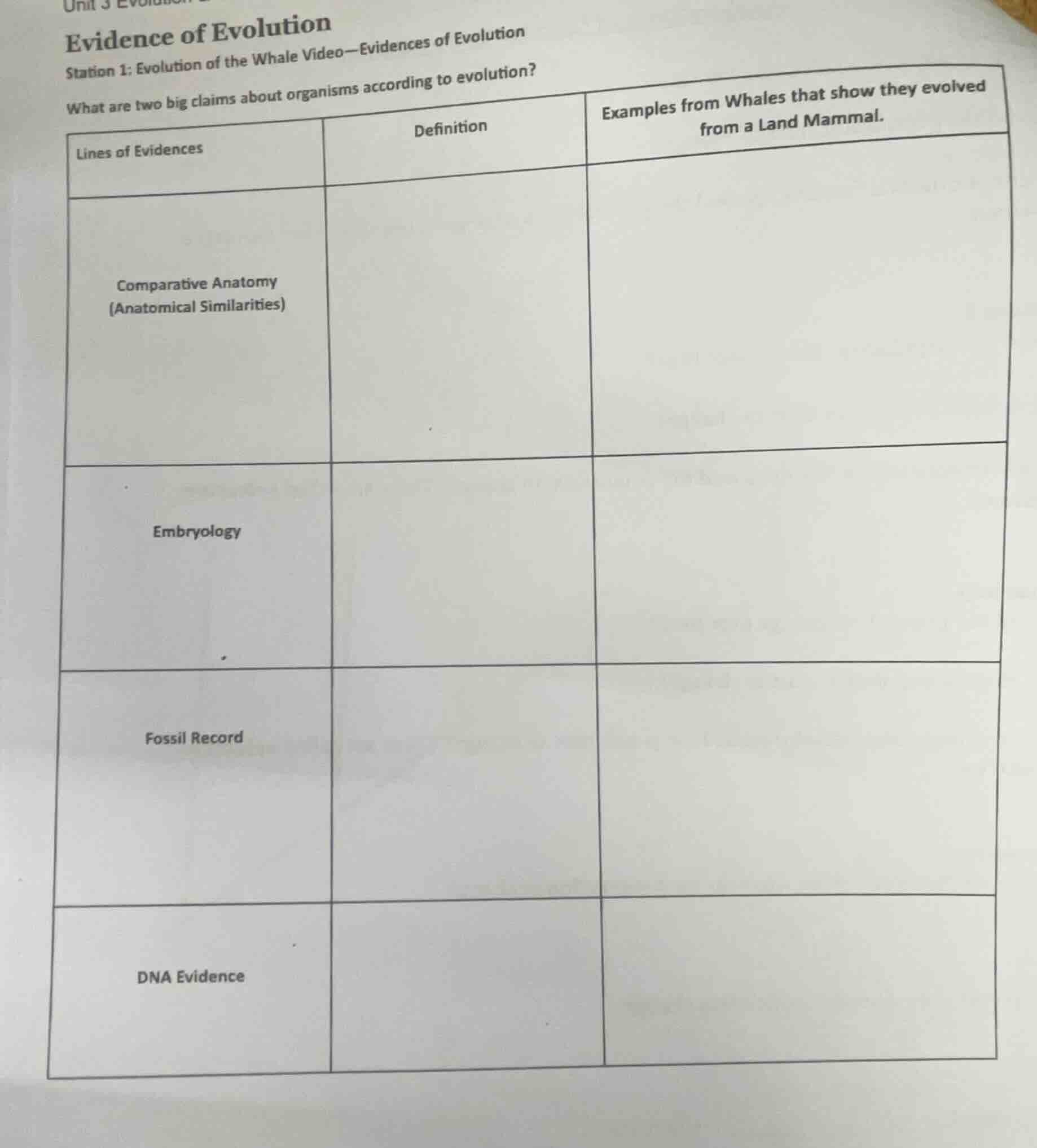
station 1: evolution of the whale video—evidences of evolution
what are two big claims about organisms according to evolution?
| lines of evidences | definition | examples from whales that show they evolved from a land mammal. | ---- | ---- | ---- | comparative anatomy (anatomical similarities) | embryology | fossil record | dna evidence |
Brief Explanations
First, address the core evolutionary claims: 1) All organisms share a common ancestor, 2) Populations change over time via natural selection. Then, define each evidence type and link whale-specific examples to their land mammal origins:
- Comparative Anatomy: Studies structural similarities across species. Whales have vestigial hind limb bones embedded in their body wall, leftover from their land-dwelling ancestors.
- Embryology: Analyzes early developmental stages. Whale embryos grow hind limb buds (which later regress) and have a tail with a distinct hip structure, mirroring land mammal embryo development.
- Fossil Record: Traces species changes via preserved remains. Fossils like Pakicetus (land-dwelling, wolf-like mammal) and Ambulocetus (semi-aquatic mammal) show a gradual transition to fully aquatic whales, with shrinking hind limbs and streamlined bodies.
- DNA Evidence: Compares genetic sequences across species. Whales share over 90% of their DNA with even-toed ungulates (e.g., cows, hippos), their closest living land mammal relatives.

Snap & solve any problem in the app
Get step-by-step solutions on Sovi AI
Photo-based solutions with guided steps
Explore more problems and detailed explanations
Core Evolutionary Claims:
- All living organisms share a common ancestral origin.
- Organism populations change and diversify over long periods via evolutionary mechanisms.
Completed Table:
| Lines of Evidences (Anatomical Similarities) | Definition | Examples from Whales that show they evolved from a Land Mammal. |
|---|---|---|
| Embryology | Analysis of early organism developmental stages | Whale embryos develop temporary hind limb buds that regress before birth; embryos have a nasal structure that shifts to the top of the head (blowhole) later in development, similar to land mammal embryo facial development |
| Fossil Record | Examination of preserved ancient organism remains | Transitional fossils like Pakicetus (land-dwelling, wolf-like ancestor), Ambulocetus (semi-aquatic, with functional hind limbs), and Basilosaurus (fully aquatic with reduced, non-functional hind limbs) show a gradual shift from land to water |
| DNA Evidence | Comparison of genetic sequences between species | Whales share high genetic homology (over 90% of core DNA) with even-toed ungulates (e.g., hippopotamuses), their closest living land mammal relatives |