QUESTION IMAGE
Question
exam lesson name: the united states constitution
exam number: 700109rr
exam guidelines
exam instructions
question 17 of 20 :
select the best answer for the question
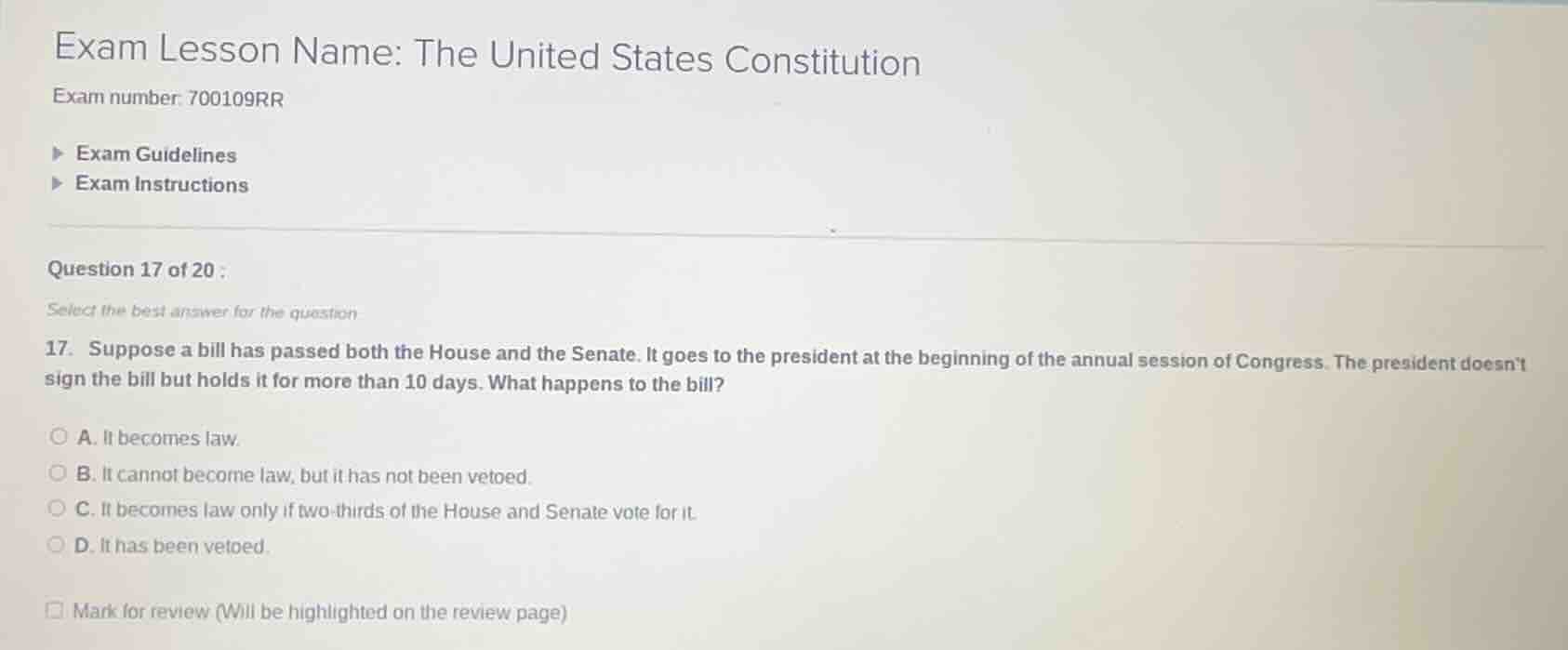
- suppose a bill has passed both the house and the senate. it goes to the president at the beginning of the annual session of congress. the president doesnt sign the bill but holds it for more than 10 days. what happens to the bill?
a. it becomes law.
b. it cannot become law, but it has not been vetoed.
c. it becomes law only if two - thirds of the house and senate vote for it.
d. it has been vetoed.
mark for review (will be highlighted on the review page)
To solve this, we refer to the U.S. Constitution's rules on presidential action regarding bills. If a bill is presented to the president at the start of a congressional session and the president neither signs nor vetoes it (pocket veto doesn't apply here as it's the start of the session) and holds it for over 10 days, the bill becomes law without the president's signature. Option A aligns with this rule. Option B is incorrect as it does become law. Option C is for overriding a veto, not this scenario. Option D is incorrect as a veto is an active rejection, not just holding the bill.

Snap & solve any problem in the app
Get step-by-step solutions on Sovi AI
Photo-based solutions with guided steps
Explore more problems and detailed explanations
A. It becomes law.