QUESTION IMAGE
Question
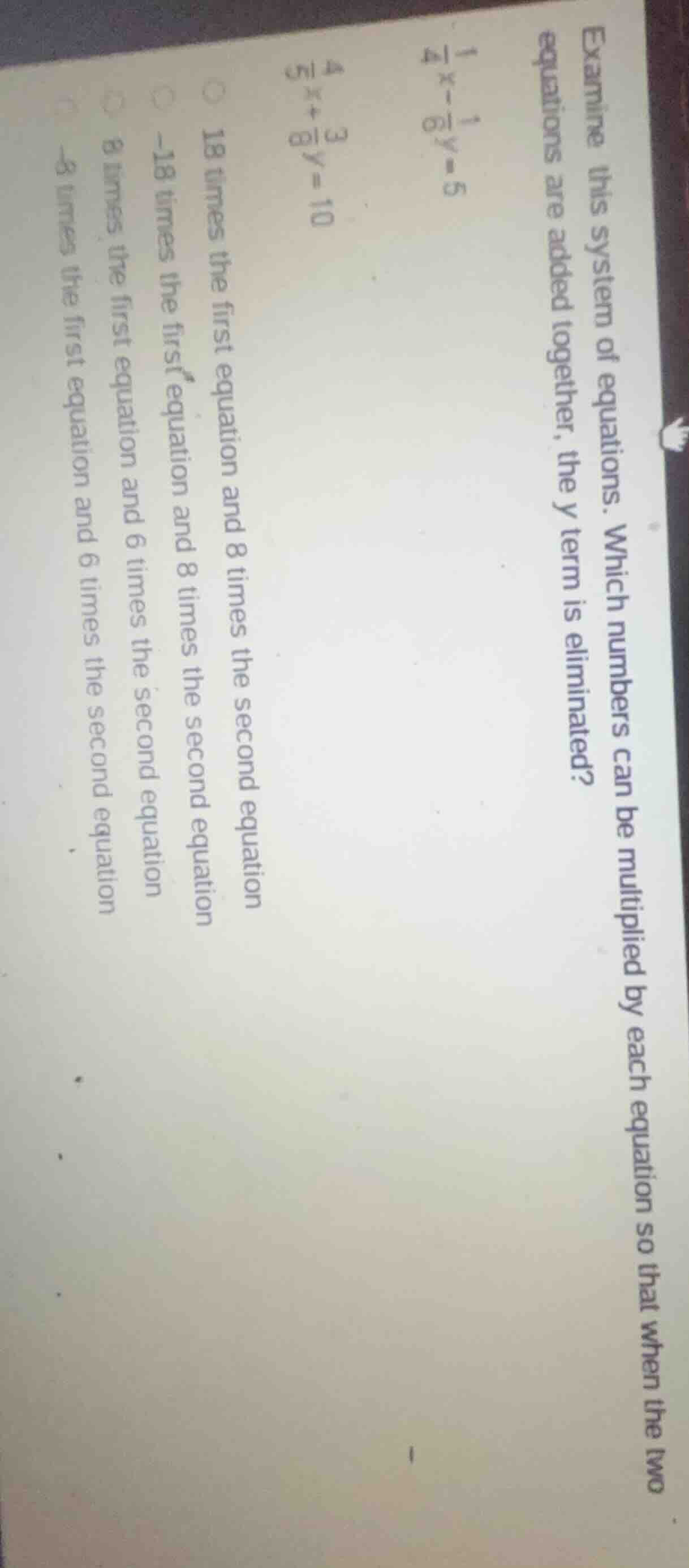
examine this system of equations. which numbers can be multiplied by each equation so that when the two equations are added together, the y term is eliminated? \\(\frac{1}{4}x - \frac{1}{6}y = 5\\) \\(\frac{4}{5}x + \frac{3}{8}y = 10\\) \\(\circ\\) 18 times the first equation and 8 times the second equation \\(\circ\\) -18 times the first equation and 8 times the second equation \\(\circ\\) 8 times the first equation and 6 times the second equation \\(\circ\\) -8 times the first equation and 6 times the second equation
Step1: Identify y coefficients
First equation y-term: $-\frac{1}{6}y$; Second equation y-term: $\frac{3}{8}y$
Step2: Find least common denominator
Denominators 6 and 8; LCD = 24
Step3: Calculate multipliers for y terms
For first equation: $\frac{24}{\frac{1}{6}} = 24 \times 6 = 144$? No, goal: make y terms opposites.
Wait, correct: Let multiplier for first eq = $m$, second eq = $n$. Need $m \times (-\frac{1}{6}) + n \times (\frac{3}{8}) = 0$
Simplify: $-\frac{m}{6} + \frac{3n}{8} = 0 \implies \frac{3n}{8} = \frac{m}{6} \implies 18n = 8m \implies 9n = 4m$
Test options:
Option 3: $m=-18$, $n=8$: $-18 \times (-\frac{1}{6}) + 8 \times (\frac{3}{8}) = 3 + 3 = 6$? No.
Option 2: $m=8$, $n=6$: $8 \times (-\frac{1}{6}) + 6 \times (\frac{3}{8}) = -\frac{4}{3} + \frac{9}{4} = \frac{-16+27}{12} = \frac{11}{12}
eq 0$
Option 1: $m=18$, $n=8$: $18 \times (-\frac{1}{6}) + 8 \times (\frac{3}{8}) = -3 + 3 = 0$
Step4: Verify the valid pair
$18 \times (\frac{1}{4}x - \frac{1}{6}y) + 8 \times (\frac{4}{5}x + \frac{3}{8}y) = 18 \times 5 + 8 \times 10$
Y-terms: $18 \times (-\frac{1}{6}y) + 8 \times (\frac{3}{8}y) = -3y + 3y = 0$, eliminated.

Snap & solve any problem in the app
Get step-by-step solutions on Sovi AI
Photo-based solutions with guided steps
Explore more problems and detailed explanations
18 times the first equation and 8 times the second equation