QUESTION IMAGE
Question
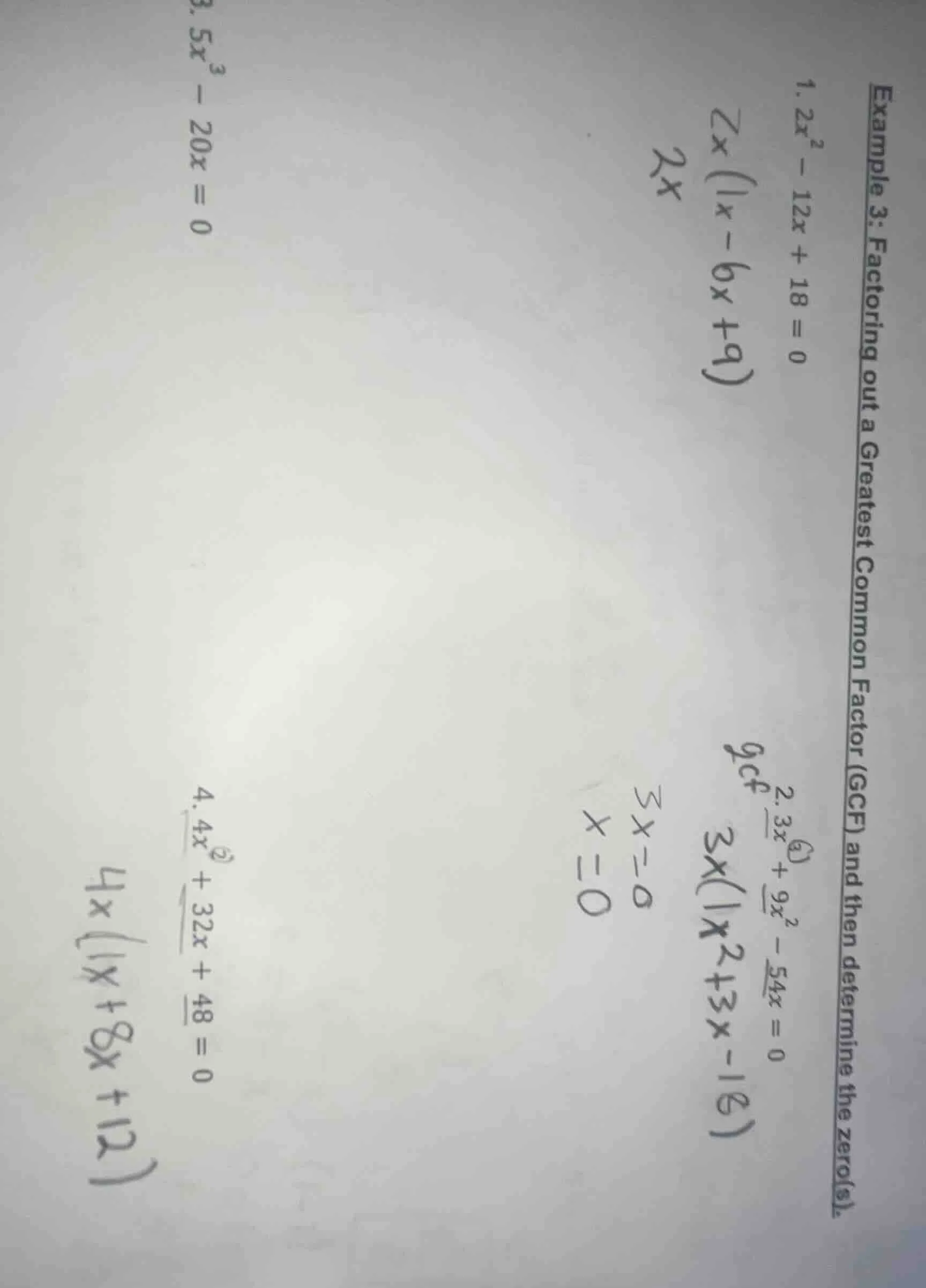
example 3: factoring out a greatest common factor (gcf) and then determine the zero(s).
- $2x^2 - 12x + 18 = 0$
- $3x + 9x^2 - 54x = 0$
- $5x^3 - 20x = 0$
- $4x^2 + 32x + 48 = 0$
Let's solve the equation \(5x^3 - 20x = 0\) (Problem 3) by factoring out the greatest common factor (GCF) and then finding the zeros.
Step 1: Factor out the GCF
First, identify the GCF of \(5x^3\) and \(-20x\). The GCF of the coefficients \(5\) and \(20\) is \(5\), and the GCF of the variable terms \(x^3\) and \(x\) is \(x\). So, the GCF is \(5x\).
Factor out \(5x\) from the left - hand side of the equation:
\(5x(x^2 - 4)=0\)
Step 2: Factor the difference of squares
Notice that \(x^2 - 4\) is a difference of squares, which can be factored using the formula \(a^2 - b^2=(a + b)(a - b)\), where \(a = x\) and \(b = 2\). So, \(x^2-4=(x + 2)(x - 2)\).
Substitute this back into the factored form:
\(5x(x + 2)(x - 2)=0\)
Step 3: Use the zero - product property
The zero - product property states that if \(ab = 0\), then either \(a = 0\) or \(b = 0\) (or both).
Set each factor equal to zero:
- For \(5x=0\), divide both sides by \(5\): \(x = 0\)
- For \(x + 2=0\), subtract \(2\) from both sides: \(x=-2\)
- For \(x - 2=0\), add \(2\) to both sides: \(x = 2\)

Snap & solve any problem in the app
Get step-by-step solutions on Sovi AI
Photo-based solutions with guided steps
Explore more problems and detailed explanations
The solutions (zeros) of the equation \(5x^3-20x = 0\) are \(x = 0\), \(x=-2\), and \(x = 2\).