QUESTION IMAGE
Question
example 2 using properties of a parallelogram
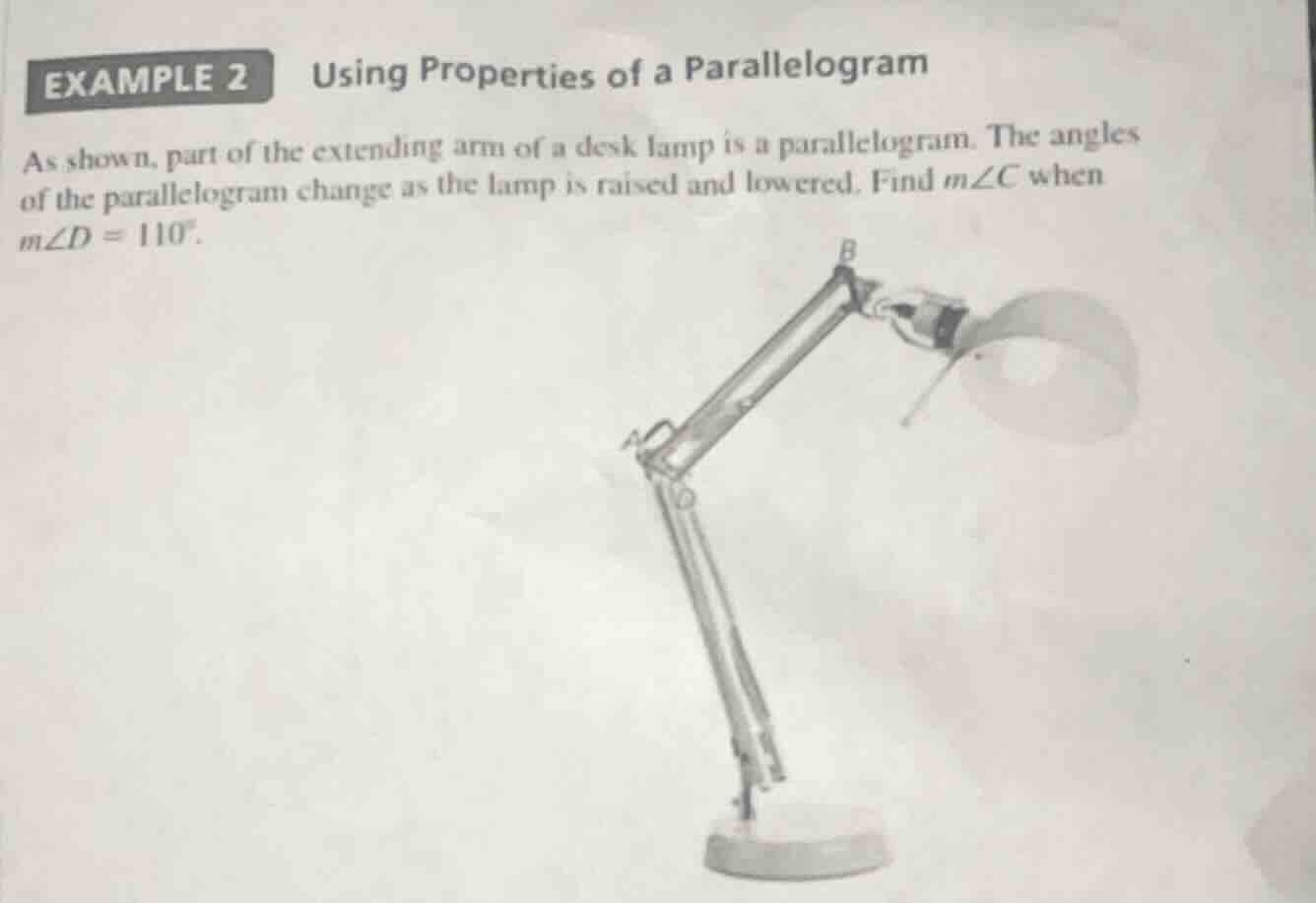
as shown, part of the extending arm of a desk lamp is a parallelogram. the angles
of the parallelogram change as the lamp is raised and lowered. find ( mangle c ) when
( mangle d = 110^circ ).
Step1: Recall properties of a parallelogram
In a parallelogram, consecutive angles are supplementary, meaning they add up to \(180^\circ\). So, \(\angle C\) and \(\angle D\) are consecutive angles in the parallelogram, so \(m\angle C + m\angle D = 180^\circ\).
Step2: Substitute the given value
We know that \(m\angle D = 110^\circ\). Substitute this into the equation from Step 1: \(m\angle C + 110^\circ = 180^\circ\).
Step3: Solve for \(m\angle C\)
Subtract \(110^\circ\) from both sides of the equation: \(m\angle C = 180^\circ - 110^\circ = 70^\circ\).

Snap & solve any problem in the app
Get step-by-step solutions on Sovi AI
Photo-based solutions with guided steps
Explore more problems and detailed explanations
\(70^\circ\)