QUESTION IMAGE
Question
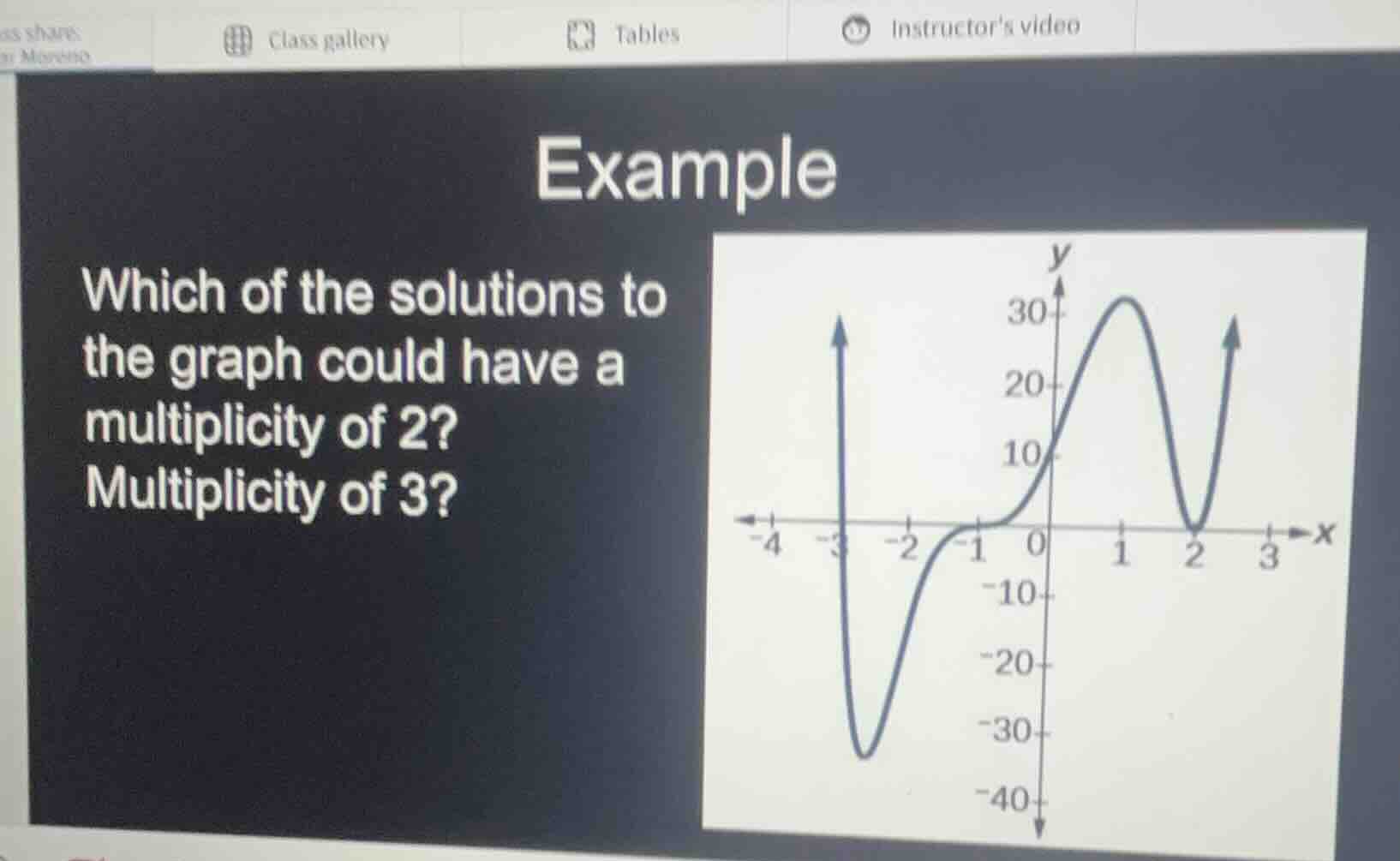
example which of the solutions to the graph could have a multiplicity of 2? multiplicity of 3?
Step1: Recall Multiplicity Rules
For a polynomial graph, when a root has an even multiplicity, the graph touches the x - axis (and turns around) at that root. When a root has an odd multiplicity (greater than 1), the graph crosses the x - axis at that root but with a "flatter" or more curved behavior. A multiplicity of 1 means the graph crosses the x - axis normally.
Step2: Analyze the Graph's Behavior at Each x - intercept
- At \(x = - 1\): The graph crosses the x - axis, but let's check the behavior. Wait, no, looking at the graph: at \(x = 2\), the graph touches the x - axis and turns around. This is the behavior of a root with even multiplicity. So \(x = 2\) could have a multiplicity of 2 (since 2 is even).
- At \(x=-1\): Wait, no, the graph near \(x = - 1\) - wait, actually, the graph at \(x=-1\) (wait, the x - intercepts are at \(x=-1\) (maybe? Wait, the graph: let's re - examine. The x - intercepts: one where the graph crosses from below to above (maybe \(x=-3\)?) Wait, no, the graph as shown: the x - intercepts are at \(x=-1\) (wait, no, the graph touches at \(x = 2\) (turns around) and crosses at \(x=-1\) (but with a different behavior) and maybe another? Wait, no, the key is:
- For multiplicity 2: The graph touches the x - axis (turns around). So the root at \(x = 2\) (where the graph touches the x - axis) has even multiplicity, so multiplicity 2 is possible for \(x = 2\).
- For multiplicity 3: A root with multiplicity 3 (odd, greater than 1) will have the graph cross the x - axis but with a more "curved" or flatter crossing. The root at \(x=-1\) (assuming the graph has a behavior where it crosses but with a flatter curve) could have a multiplicity of 3 (since 3 is odd and greater than 1). Wait, actually, the root at \(x=-1\) (wait, maybe I misread the x - intercepts). Wait, the graph: let's see the x - intercepts are at \(x=-1\) (where the graph just touches and then goes up? No, wait the graph: on the left, it comes from below, crosses at some point, then at \(x=-1\) (maybe) has a behavior, and at \(x = 2\) touches. Wait, the correct analysis:
- When a root has multiplicity 2: graph touches x - axis (turns around) → \(x = 2\) (since the graph touches at \(x = 2\)) → multiplicity 2.
- When a root has multiplicity 3: graph crosses x - axis with a "flatter" crossing (since 3 is odd and >1). The root at \(x=-1\) (where the graph crosses but with a more curved crossing) could have multiplicity 3.

Snap & solve any problem in the app
Get step-by-step solutions on Sovi AI
Photo-based solutions with guided steps
Explore more problems and detailed explanations
The solution (root) at \(x = 2\) could have a multiplicity of 2 (because the graph touches the x - axis at \(x = 2\), characteristic of even multiplicity). The solution (root) at \(x=-1\) (or the appropriate x - intercept with a flatter crossing) could have a multiplicity of 3 (because the graph crosses the x - axis with a behavior consistent with odd multiplicity greater than 1).
(If we assume the x - intercepts are \(x=-1\) (crossing, possible multiplicity 3) and \(x = 2\) (touching, possible multiplicity 2))