QUESTION IMAGE
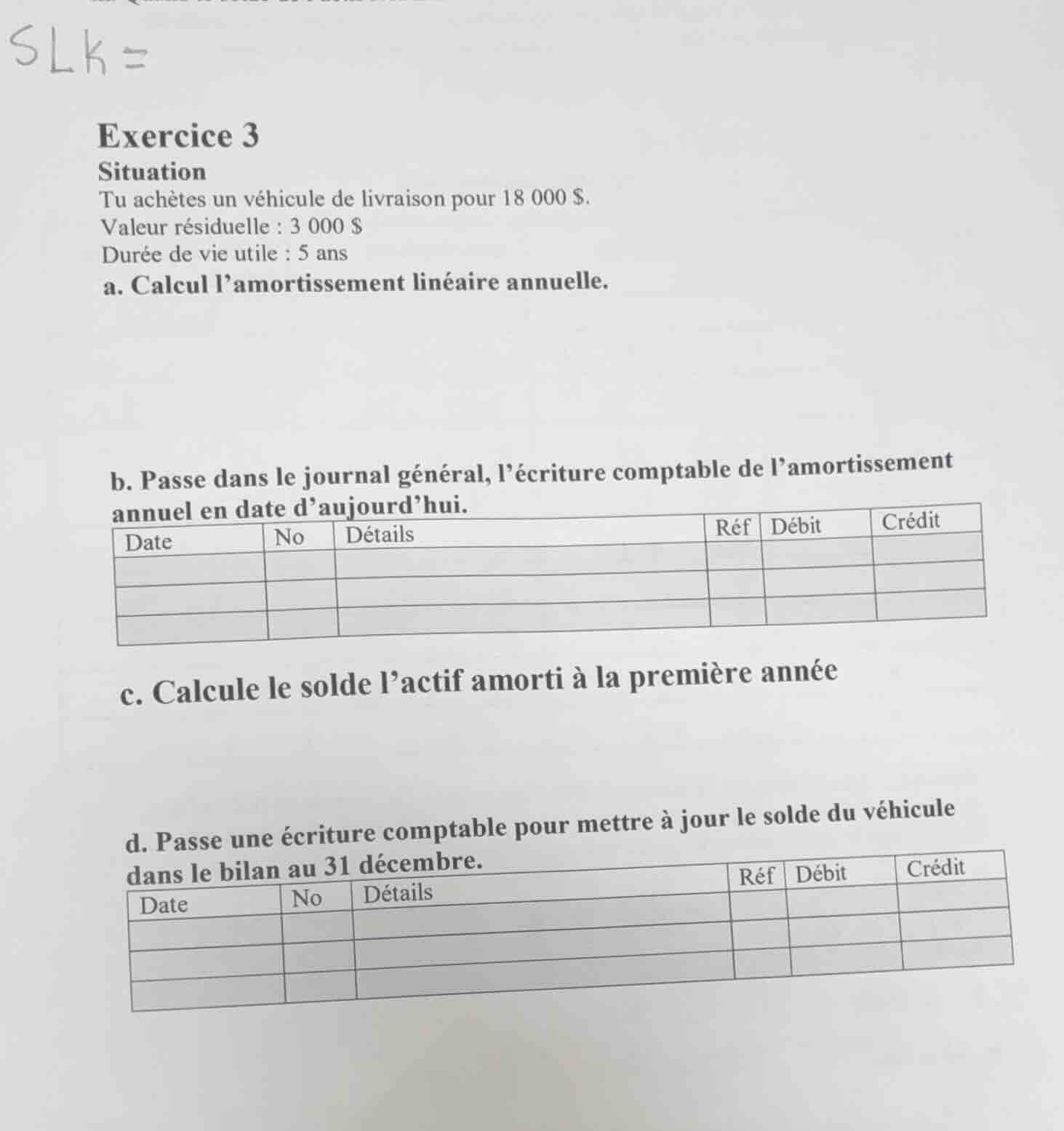
Question
exercice 3
situation
tu achètes un véhicule de livraison pour 18 000 $.
valeur résiduelle : 3 000 $
durée de vie utile : 5 ans
a. calcul l’amortissement linéaire annuelle.
b. passe dans le journal général, l’écriture comptable de l’amortissement annuel en date d’aujourd’hui.
| date | no | détails | réf | débit | crédit |
|---|---|---|---|---|---|
c. calcule le solde l’actif amorti à la première année
d. passe une écriture comptable pour mettre à jour le solde du véhicule dans le bilan au 31 décembre.
| date | no | détails | réf | débit | crédit |
|---|---|---|---|---|---|
Part a: Calculer l'amortissement linéaire annuelle
Step 1: Recall the formula for linear depreciation
The formula for annual linear depreciation is \( A=\frac{C - V_r}{n} \), where \( C \) is the cost of the asset, \( V_r \) is the residual value, and \( n \) is the useful life in years.
Here, \( C = 18000\$ \), \( V_r=3000\$ \), \( n = 5 \) years.
Step 2: Substitute the values into the formula
First, calculate the depreciable amount: \( C - V_r=18000 - 3000=15000\$ \)
Then, divide by the useful life: \( A=\frac{15000}{5} = 3000\$ \)
For the annual depreciation entry, we debit the "Amortissement" (Depreciation Expense) account and credit the "Amortissement accumulé - Véhicule de livraison" (Accumulated Depreciation - Delivery Vehicle) account. The amount is the annual depreciation calculated in part (a), which is \( 3000\$ \).
Step 1: Recall the formula for the net book value (solde de l'actif amorti)
The net book value after the first year is \( S = C - A\times1 \), where \( A \) is the annual depreciation.
We know \( C = 18000\$ \), \( A = 3000\$ \)
Step 2: Substitute the values
\( S=18000 - 3000\times1=15000\$ \)

Snap & solve any problem in the app
Get step-by-step solutions on Sovi AI
Photo-based solutions with guided steps
Explore more problems and detailed explanations
The annual linear depreciation is \( 3000\$ \)