QUESTION IMAGE
Question
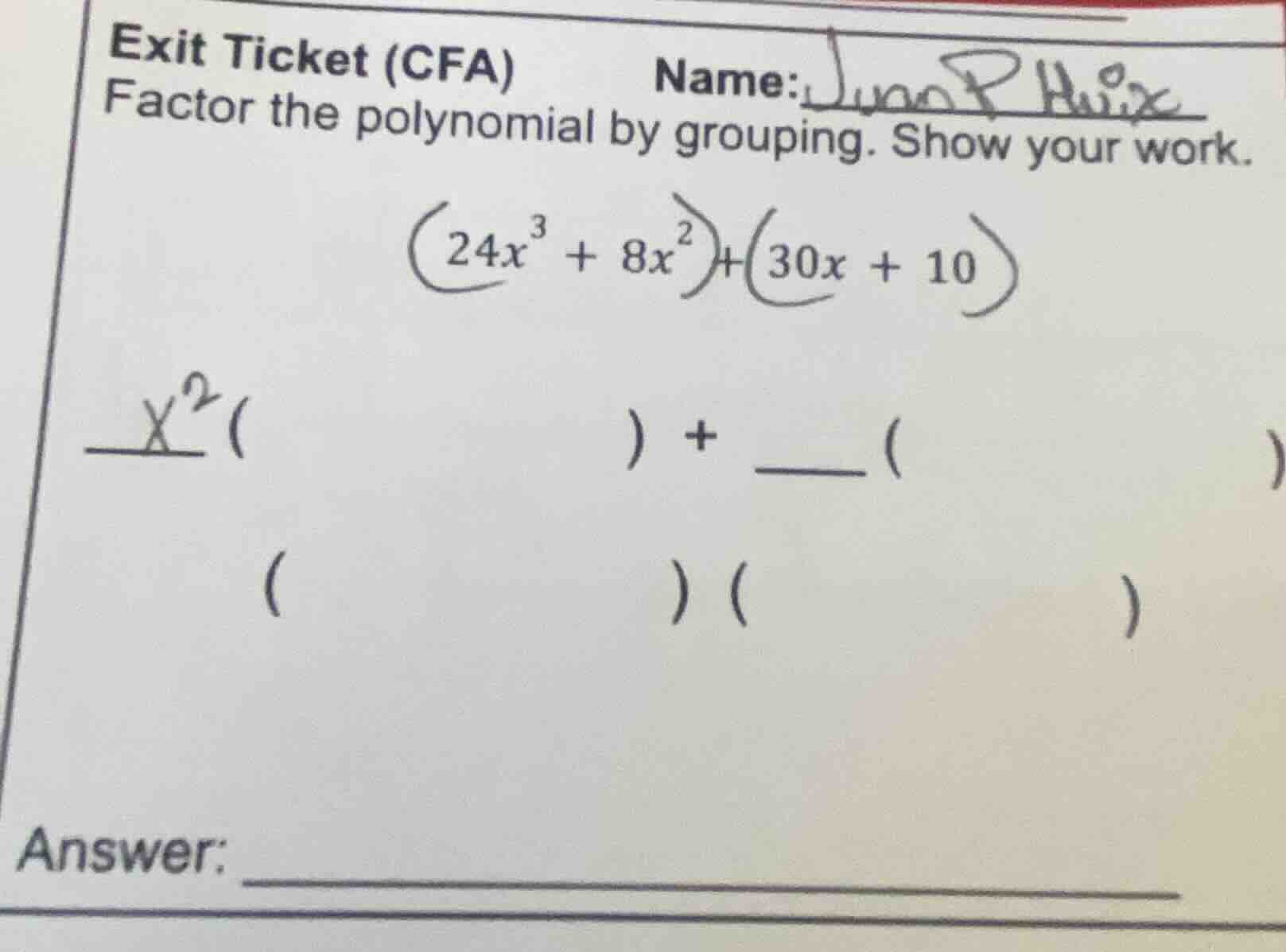
exit ticket (cfa) name: factor the polynomial by grouping. show your work. \\((24x^3 + 8x^2)+(30x + 10)\\) \\(\underline{x^2}(\quad) + \underline{\quad}(\quad)\\) \\((\quad)(\quad)\\) answer: \\(\underline{\quad}\\)
Step1: Factor first group
Factor out the GCF from \(24x^3 + 8x^2\). The GCF of \(24x^3\) and \(8x^2\) is \(8x^2\)? Wait, no, \(24\) and \(8\) have GCF \(8\), and \(x^3\) and \(x^2\) have GCF \(x^2\), so GCF is \(8x^2\)? Wait, \(24x^3\div8x^2 = 3x\), \(8x^2\div8x^2 = 1\), so \(24x^3 + 8x^2 = 8x^2(3x + 1)\). Wait, but the original first group is \((24x^3 + 8x^2)\), and the user wrote \(x^2(\quad)\), maybe there's a miscalculation. Wait, \(24x^3 + 8x^2\), GCF of \(24\) and \(8\) is \(8\), but if we take \(8x^2\), but maybe the intended GCF is \(8x^2\)? Wait, no, maybe the problem has a typo, or maybe I misread. Wait, the first blank is \(x^2(\quad)\), so \(24x^3 + 8x^2 = x^2(24x + 8)\). Then factor \(24x + 8\) by GCF \(8\), so \(x^2(8(3x + 1)) = 8x^2(3x + 1)\). Then the second group: \(30x + 10\), GCF is \(10\), so \(10(3x + 1)\). Then the polynomial becomes \(8x^2(3x + 1) + 10(3x + 1)\). Then factor out \((3x + 1)\), so \((3x + 1)(8x^2 + 10)\). Then factor \(8x^2 + 10\) by GCF \(2\), so \(2(4x^2 + 5)\). So overall, \(2(3x + 1)(4x^2 + 5)\). Wait, but let's follow the steps as per the given blanks.
First, factor \(24x^3 + 8x^2\) with \(x^2\) as the factor: \(24x^3 + 8x^2 = x^2(24x + 8)\). Then factor \(24x + 8\) by GCF \(8\): \(x^2(8(3x + 1)) = 8x^2(3x + 1)\). Then the second group: \(30x + 10\), factor out \(10\): \(10(3x + 1)\). So the expression is \(x^2(24x + 8) + 10(3x + 1)\), but \(24x + 8\) can be factored as \(8(3x + 1)\), so \(x^2(8(3x + 1)) + 10(3x + 1) = 8x^2(3x + 1) + 10(3x + 1)\). Then factor out \((3x + 1)\): \((3x + 1)(8x^2 + 10)\). Then factor \(8x^2 + 10\) by 2: \(2(4x^2 + 5)\). So the final factored form is \(2(3x + 1)(4x^2 + 5)\).
But let's do it step by step as per the given structure:
Step1: Factor first group with \(x^2\)
\(24x^3 + 8x^2 = x^2(24x + 8)\)
Step2: Factor second group
\(30x + 10 = 10(3x + 1)\) (Wait, but \(24x + 8\) can be factored to \(8(3x + 1)\), so \(x^2(8(3x + 1)) + 10(3x + 1) = 8x^2(3x + 1) + 10(3x + 1)\))
Step3: Factor out common binomial
Now, both terms have \((3x + 1)\), so factor that out: \((3x + 1)(8x^2 + 10)\)
Step4: Factor out GCF from \(8x^2 + 10\)
GCF of \(8\) and \(10\) is \(2\), so \(8x^2 + 10 = 2(4x^2 + 5)\). Thus, the fully factored form is \(2(3x + 1)(4x^2 + 5)\).
But let's check the initial steps as per the given blanks:
First blank: \(x^2(24x + 8)\) (since \(24x^3 + 8x^2 = x^2(24x + 8)\))
Second blank: \(10(3x + 1)\) (since \(30x + 10 = 10(3x + 1)\))
Then, factor \(24x + 8\) to \(8(3x + 1)\), so \(x^2(8(3x + 1)) + 10(3x + 1) = 8x^2(3x + 1) + 10(3x + 1)\)
Then factor out \((3x + 1)\): \((3x + 1)(8x^2 + 10)\)
Then factor \(8x^2 + 10\) to \(2(4x^2 + 5)\), so \((3x + 1)(2)(4x^2 + 5) = 2(3x + 1)(4x^2 + 5)\)

Snap & solve any problem in the app
Get step-by-step solutions on Sovi AI
Photo-based solutions with guided steps
Explore more problems and detailed explanations
The factored form of the polynomial \(24x^3 + 8x^2 + 30x + 10\) by grouping is \(\boxed{2(3x + 1)(4x^2 + 5)}\)