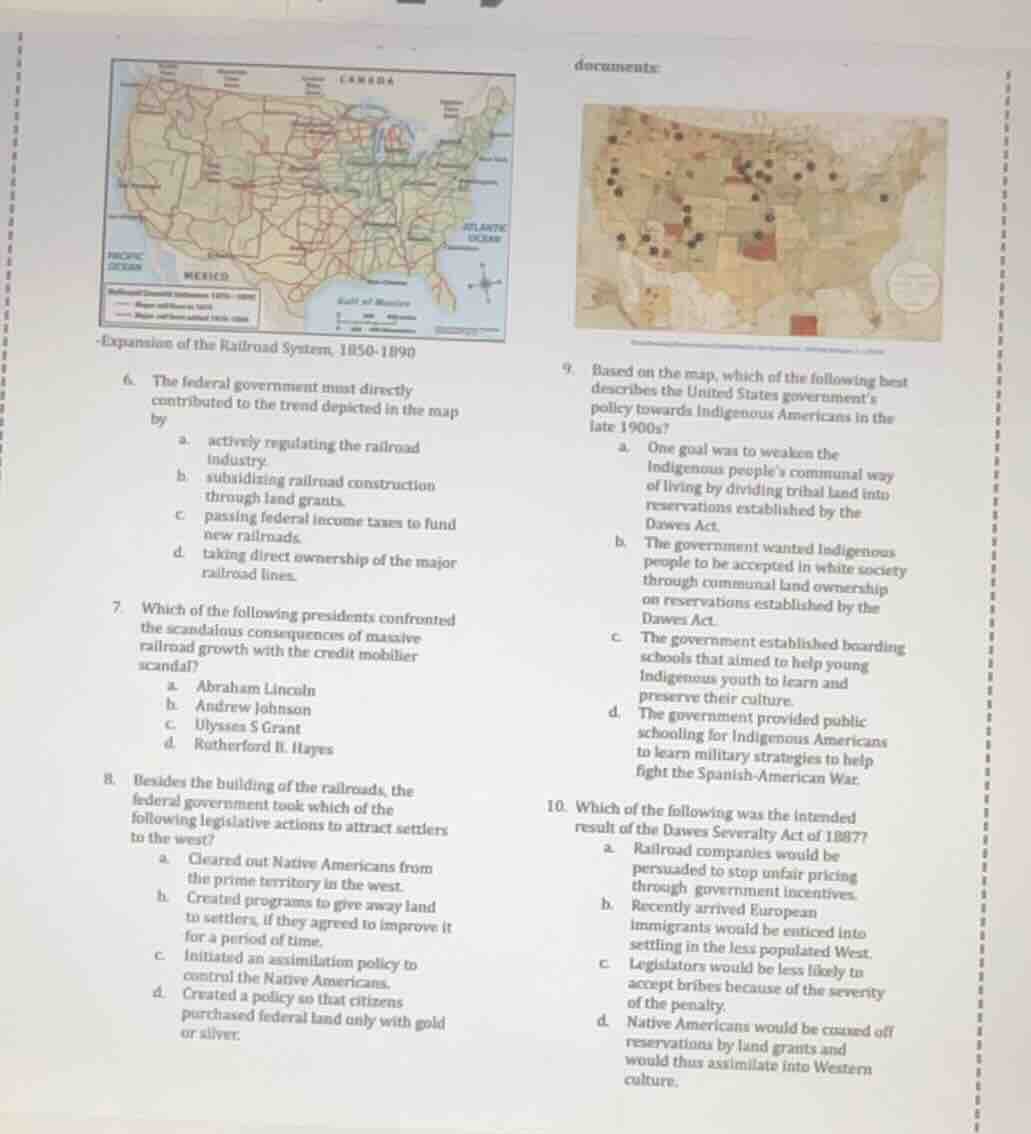
QUESTION IMAGE
Question
expansion of the railroad system, 1850 - 1890
- the federal government must directly contributed to the trend depicted in the map by
a. actively regulating the railroad industry
b. subsidizing railroad construction through land grants.
c. passing federal income taxes to fund new railroads
d. taking direct ownership of the major railroad lines.
- which of the following presidents confronted the scandalous consequences of massive railroad growth with the credit mobilier scandal?
a. abraham lincoln
b. andrew johnson
c. ulysses s grant
d. rutherford b. hayes
- besides the building of the railroads, the federal government took which of the following legislative actions to attract settlers to the west?
a. cleared out native americans from the prime territory in the west.
b. created programs to give away land to settlers, if they agreed to improve it for a period of time.
c. initiated an assimilation policy to control the native americans.
d. created a policy so that citizens purchased federal land only with gold or silver.
documents:
- based on the map, which of the following best describes the united states government’s policy towards indigenous americans in the late 1900s?
a. one goal was to weaken the indigenous people’s communal way of living by dividing tribal land into reservations established by the dawes act.
b. the government wanted indigenous people to be accepted in white society through communal land ownership on reservations established by the dawes act.
c. the government established boarding schools that aimed to help young indigenous youth to learn and preserve their culture.
d. the government provided public schooling for indigenous americans to learn military strategies to help fight the spanish - american war.
- which of the following was the intended result of the dawes severalty act of 1887?
a. railroad companies would be persuaded to stop unfair pricing through government incentives.
b. recently arrived european immigrants would be enticed into settling in the less populated west.
c. legislators would be less likely to accept bribes because of the severity of the penalty.
d. native americans would be chased off reservations by land grants and would thus assimilate into western culture.
Question 6
To solve this, we analyze each option:
- Option a: Active regulation of railroads doesn't directly contribute to expansion shown (map is 1850 - 1890 railroad expansion). Regulation is more about oversight, not expansion.
- Option b: The federal government subsidized railroad construction via land grants, which was a key way to encourage railroad building (giving land to railroads to build, which helped expand the system).
- Option c: Federal income tax was established later (16th Amendment, 1913), so not in 1850 - 1890.
- Option d: The government didn't take direct ownership of major railroad lines; railroads were private with government support.
So the correct answer is b.
The Credit Mobilier scandal was during Ulysses S. Grant's presidency. Abraham Lincoln (a) was before the scandal, Andrew Johnson (b) was after Lincoln but before Grant's full term in relation to this, and Rutherford B. Hayes (d) was after Grant. Grant's administration dealt with the consequences of the Credit Mobilier scandal from the railroad growth.
To attract settlers west (besides railroads):
- Option a: Clearing Native Americans was not a legislative action to attract settlers (more about removal, not attracting settlers).
- Option b: Programs like the Homestead Act gave away land to settlers if they improved it (this was a federal action to attract people west, by providing land).
- Option c: Assimilation policy for Native Americans is about Native Americans, not attracting settlers.
- Option d: Gold/silver purchase for land was not a way to attract settlers (made it harder, as cash was needed, while Homestead gave land for improvement).
So the correct answer is b.

Snap & solve any problem in the app
Get step-by-step solutions on Sovi AI
Photo-based solutions with guided steps
Explore more problems and detailed explanations
b. subsidizing railroad construction through land grants.