QUESTION IMAGE
Question
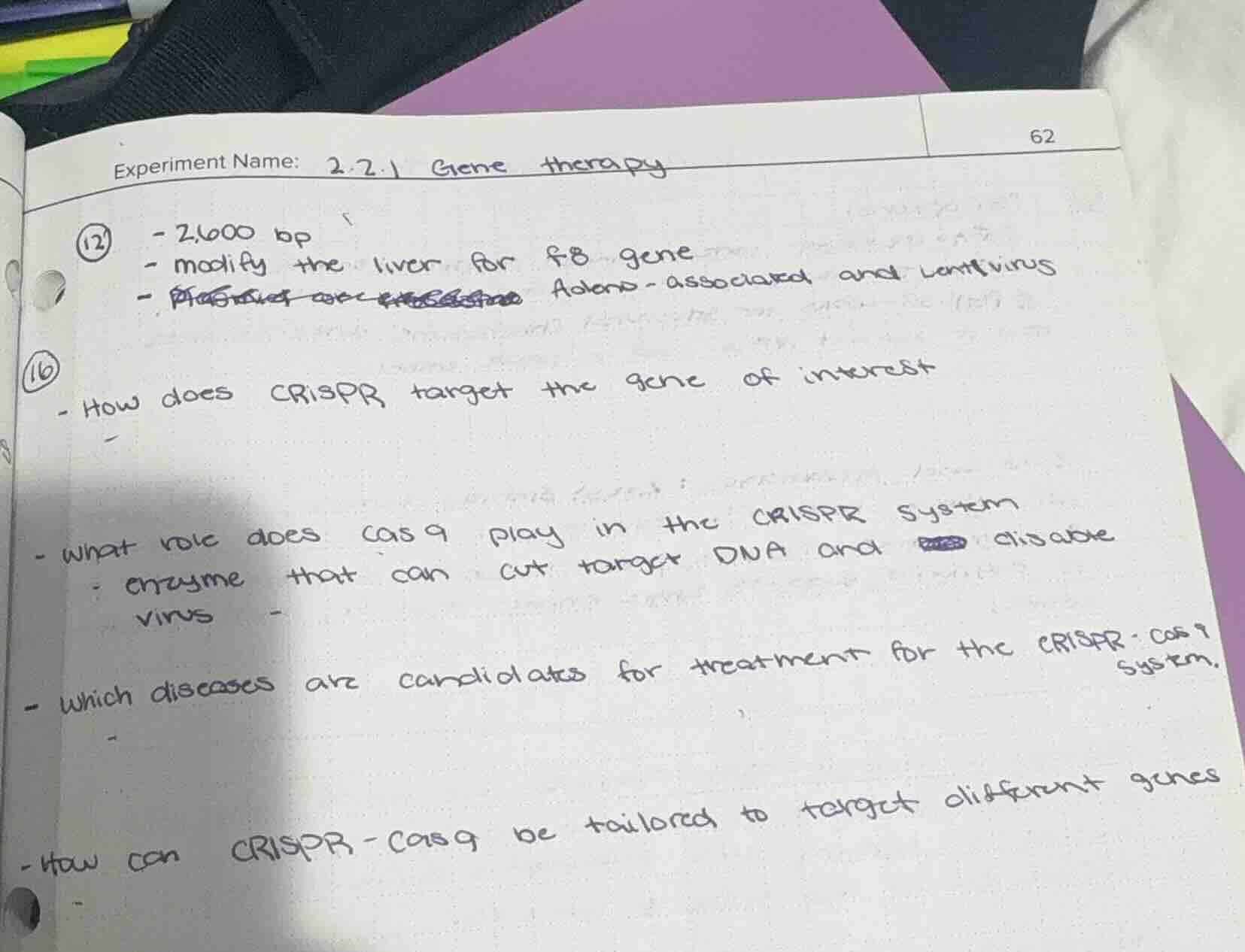
experiment name: 2.2.1 gene therapy
(12) - 2,600 bp
- modify the liver for f8 gene
- adono - associated and lentivirus
(16)
- how does crispr target the gene of interest
-
- what role does cas9 play in the crispr system
- enzyme that can cut target dna and disable virus
-
- which diseases are candidates for treatment for the crispr - cas9 system,
-
- how can crispr - cas9 be tailored to target different genes
To answer the question "How does CRISPR target the gene of interest", we can use the following explanation:
CRISPR targets the gene of interest through a guide RNA (gRNA) that is designed to be complementary to the specific DNA sequence of the target gene. The gRNA binds to the Cas9 enzyme, forming a complex. This complex then searches for the matching DNA sequence in the genome. Once the gRNA finds its complementary sequence on the target DNA (protospacer adjacent motif, PAM, is also required for Cas9 binding in many cases), the Cas9 enzyme can then cut the DNA at that specific location, allowing for gene editing (such as insertion, deletion, or replacement of genetic material).

Snap & solve any problem in the app
Get step-by-step solutions on Sovi AI
Photo-based solutions with guided steps
Explore more problems and detailed explanations
CRISPR targets the gene of interest via a guide RNA (gRNA) complementary to the target gene's DNA sequence. The gRNA - Cas9 complex binds to the target DNA (with a PAM sequence for Cas9 in many cases) and Cas9 cuts the DNA at the specific location for gene editing.