QUESTION IMAGE
Question
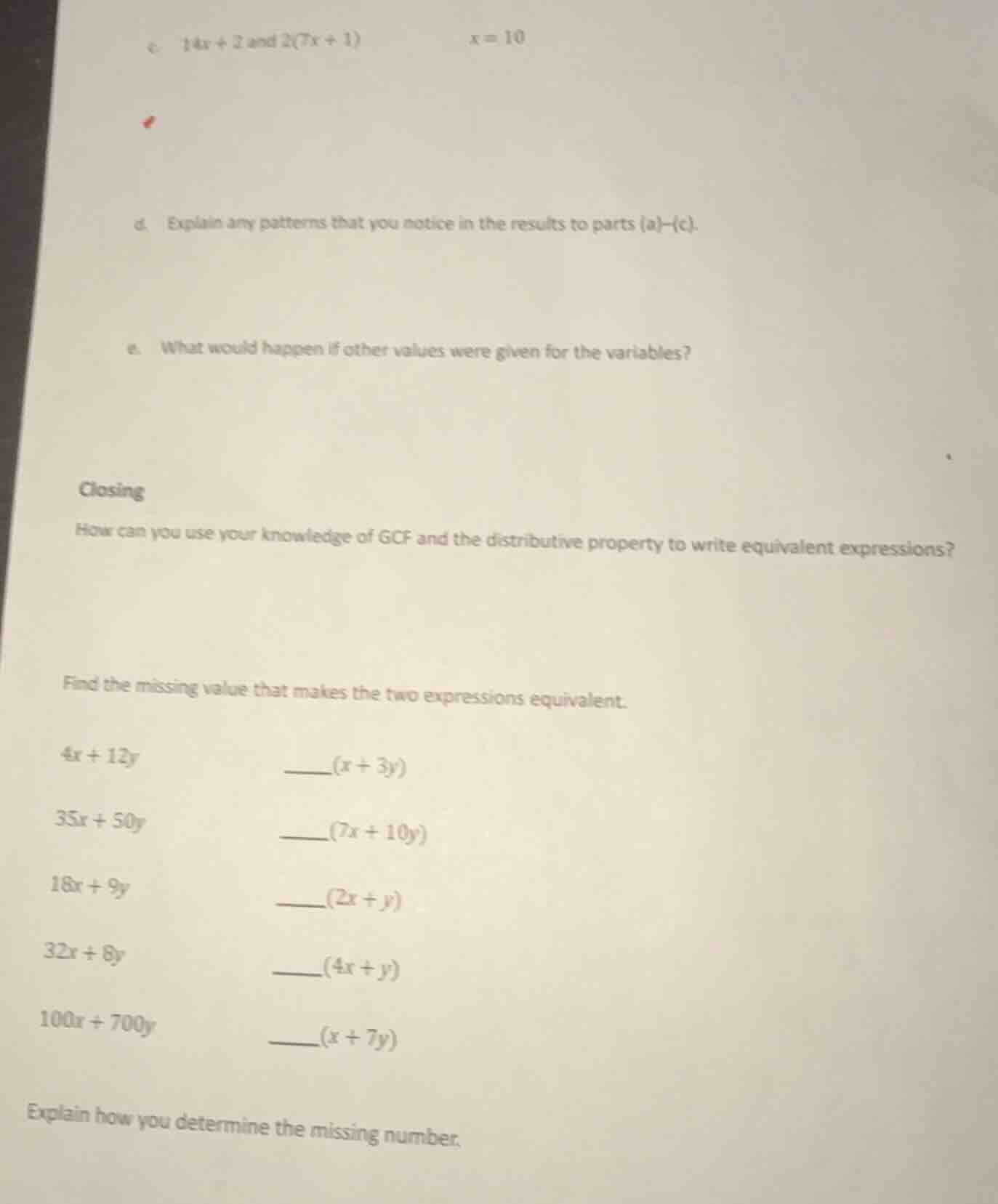
c. $14x + 2$ and $2(7x + 1)$ $x = 10$
d. explain any patterns that you notice in the results to parts (a)-(c).
e. what would happen if other values were given for the variables?
closing
how can you use your knowledge of gcf and the distributive property to write equivalent expressions?
find the missing value that makes the two expressions equivalent.
$4x + 12y$ ______$(x + 3y)$
$35x + 50y$ ______$(7x + 10y)$
$18x + 9y$ ______$(2x + y)$
$32x + 8y$ ______$(4x + y)$
$100x + 700y$ ______$(x + 7y)$
explain how you determine the missing number.
First, solving the missing value problems (Step-by-Step Format)
Step1: Find GCF of 4 and 12
GCF(4,12) = 4, so $\frac{4x+12y}{x+3y}=4$
Step2: Find GCF of 35 and 50
GCF(35,50) = 5, so $\frac{35x+50y}{7x+10y}=5$
Step3: Find GCF of 18 and 9
GCF(18,9) = 9, so $\frac{18x+9y}{2x+y}=9$
Step4: Find GCF of 32 and 8
GCF(32,8) = 8, so $\frac{32x+8y}{4x+y}=8$
Step5: Find GCF of 100 and 700
GCF(100,700) = 100, so $\frac{100x+700y}{x+7y}=100$
for determining the missing number (Answer-Explanation Format)
The missing number is the greatest common factor (GCF) of the coefficients of the terms in the original expression. Use the distributive property in reverse: factor out the GCF from each term of the left-hand expression, which leaves the expression in the parentheses. Divide each coefficient in the original expression by the corresponding coefficient in the parenthetical expression to find this GCF.

Snap & solve any problem in the app
Get step-by-step solutions on Sovi AI
Photo-based solutions with guided steps
Explore more problems and detailed explanations
- $4$
- $5$
- $9$
- $8$
- $100$
---