QUESTION IMAGE
Question
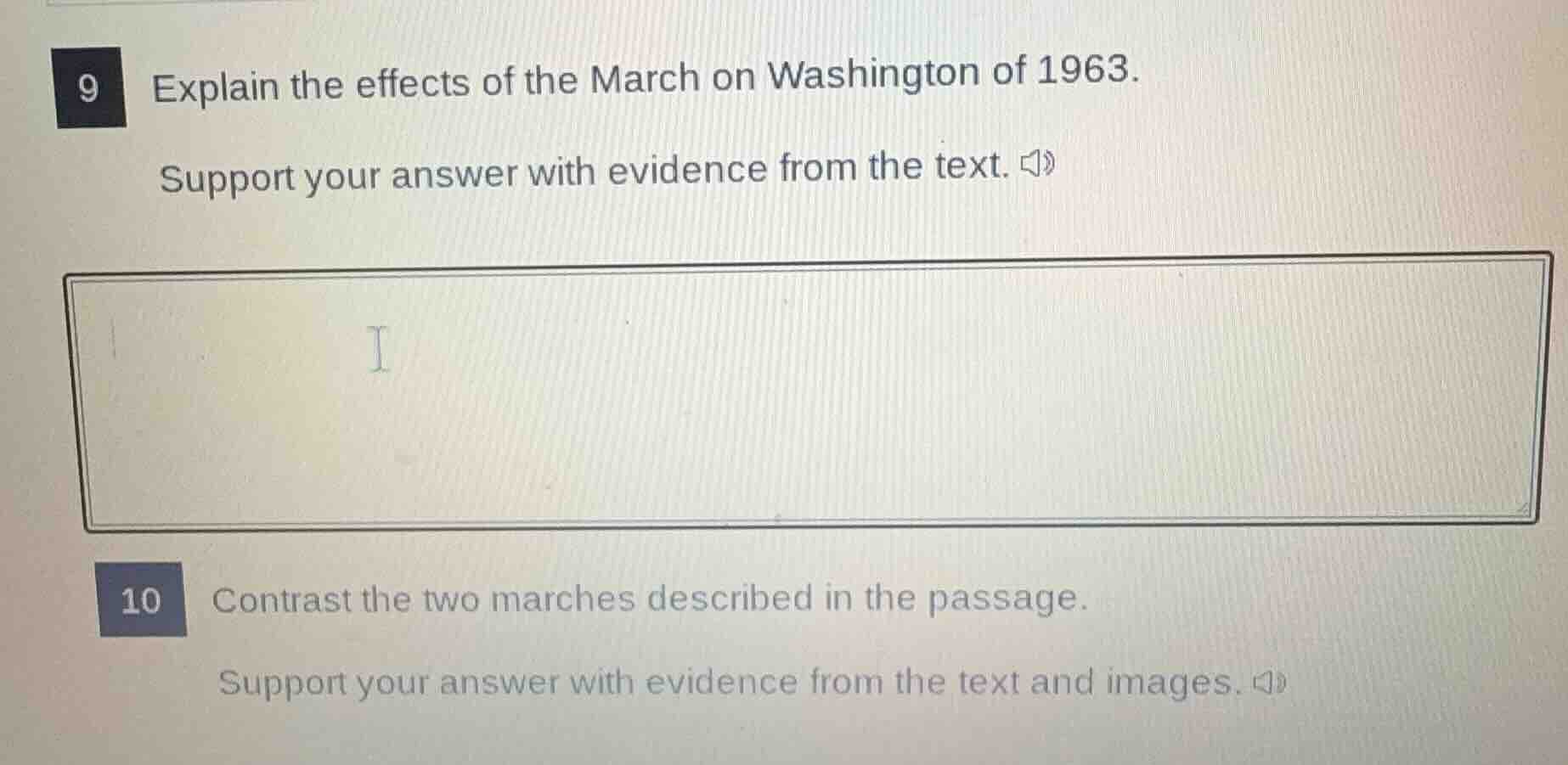
9 explain the effects of the march on washington of 1963. support your answer with evidence from the text. 10 contrast the two marches described in the passage. support your answer with evidence from the text and images.
Question 9
The March on Washington in 1963 had several key effects. It brought national attention to the civil rights struggle, with the "I Have a Dream" speech by Martin Luther King Jr. becoming iconic and rallying support for civil rights legislation. It also helped build momentum for the Civil Rights Act of 1964 and the Voting Rights Act of 1965 by showing the widespread support for racial equality. Evidence from texts often highlights the large turnout (around 250,000 people), the unity of different civil rights groups, and the subsequent policy changes.
To contrast the two marches, we analyze aspects like purpose, participants, outcomes, and visual cues (from images). For example, one march might focus on civil rights (like 1963’s push for equality), while another could have a different goal (e.g., later marches on voting rights, or marches with varying levels of public support/opposition). Images might show differences in crowd size, participant demographics, or symbols (e.g., signs, attire). Textual evidence (e.g., march goals, organizer statements) and visual elements (e.g., crowd diversity, protest symbols) clarify contrasts.

Snap & solve any problem in the app
Get step-by-step solutions on Sovi AI
Photo-based solutions with guided steps
Explore more problems and detailed explanations
The March on Washington of 1963 had profound effects: 1. Public Awareness and Support: It drew national and international attention to civil rights issues, with an estimated 250,000 people (including diverse racial/ethnic groups) participating, demonstrating broad support for racial equality. 2. Legislative Momentum: It accelerated the push for civil rights laws. The iconic "I Have a Dream" speech by MLK Jr. galvanized public sentiment, helping lead to the 1964 Civil Rights Act (ending legal segregation) and 1965 Voting Rights Act (protecting Black voting rights). 3. Cultural and Social Impact: It became a symbol of the civil rights movement, inspiring future activism and shaping public discourse on racial justice. Textual evidence (e.g., descriptions of the march’s scale, media coverage, and political responses) supports these effects.