QUESTION IMAGE
Question
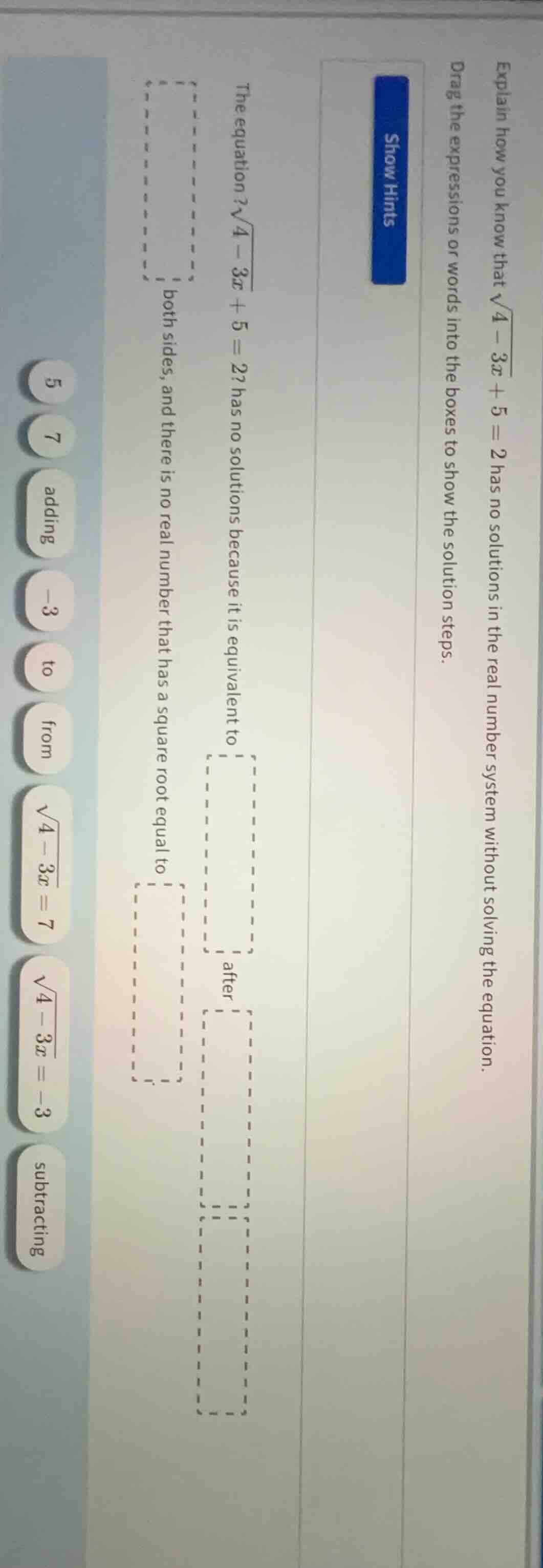
explain how you know that \\(\sqrt{4 - 3x} + 5 = 2\\) has no solutions in the real number system without solving the equation. drag the expressions or words into the boxes to show the solution steps. show hints the equation \\(\sqrt{4 - 3x} + 5 = 2\\) has no solutions because it is equivalent to \\(\underline{\quad\quad}\\) after \\(\underline{\quad\quad}\\) both sides, and there is no real number that has a square root equal to \\(\underline{\quad\quad}\\). options (drag items): 5, 7, adding, -3, to, from, \\(\sqrt{4 - 3x} = 7\\), \\(\sqrt{4 - 3x} = -3\\), subtracting
Step1: Isolate the square root
To start analyzing the equation \(\sqrt{4 - 3x}+5 = 2\), we first isolate the square root term. We do this by subtracting 5 from both sides of the equation.
\[
\sqrt{4 - 3x}+5-5=2 - 5
\]
Step2: Simplify both sides
Simplifying the left - hand side (LHS) and the right - hand side (RHS) of the equation, we get:
The LHS \(\sqrt{4 - 3x}+5 - 5=\sqrt{4 - 3x}\) and the RHS \(2-5=-3\). So the equation becomes \(\sqrt{4 - 3x}=-3\).
Step3: Analyze the square root function
For the square root function \(y = \sqrt{a}\) (where \(a = 4-3x\) in our case), the domain of the square root function in the real number system is \(a\geq0\), and the range of the square root function \(y=\sqrt{a}\) is \(y\geq0\) for all real numbers \(a\) in its domain. That is, the square root of a real number (when the number inside the square root is non - negative) is always non - negative. In our simplified equation \(\sqrt{4 - 3x}=-3\), the left - hand side \(\sqrt{4 - 3x}\) represents a square root, which must be greater than or equal to 0, but the right - hand side is \(- 3\), which is negative. Since a non - negative number (the square root) can never be equal to a negative number (\(-3\)), there is no real number \(x\) that satisfies the equation \(\sqrt{4 - 3x}=-3\), and thus the original equation \(\sqrt{4 - 3x}+5 = 2\) has no real solutions.
In terms of the drag - and - drop:
The equation \(\sqrt{4 - 3x}+5 = 2\) has no solutions because it is equivalent to \(\boldsymbol{\sqrt{4 - 3x}=-3}\) after \(\boldsymbol{subtracting}\) \(\boldsymbol{5}\) from both sides, and there is no real number that has a square root equal to \(\boldsymbol{-3}\).

Snap & solve any problem in the app
Get step-by-step solutions on Sovi AI
Photo-based solutions with guided steps
Explore more problems and detailed explanations
The equation \(\sqrt{4 - 3x}+5 = 2\) has no solutions because it is equivalent to \(\boldsymbol{\sqrt{4 - 3x}=-3}\) after \(\boldsymbol{subtracting}\) \(\boldsymbol{5}\) from both sides, and there is no real number that has a square root equal to \(\boldsymbol{-3}\).