QUESTION IMAGE
Question
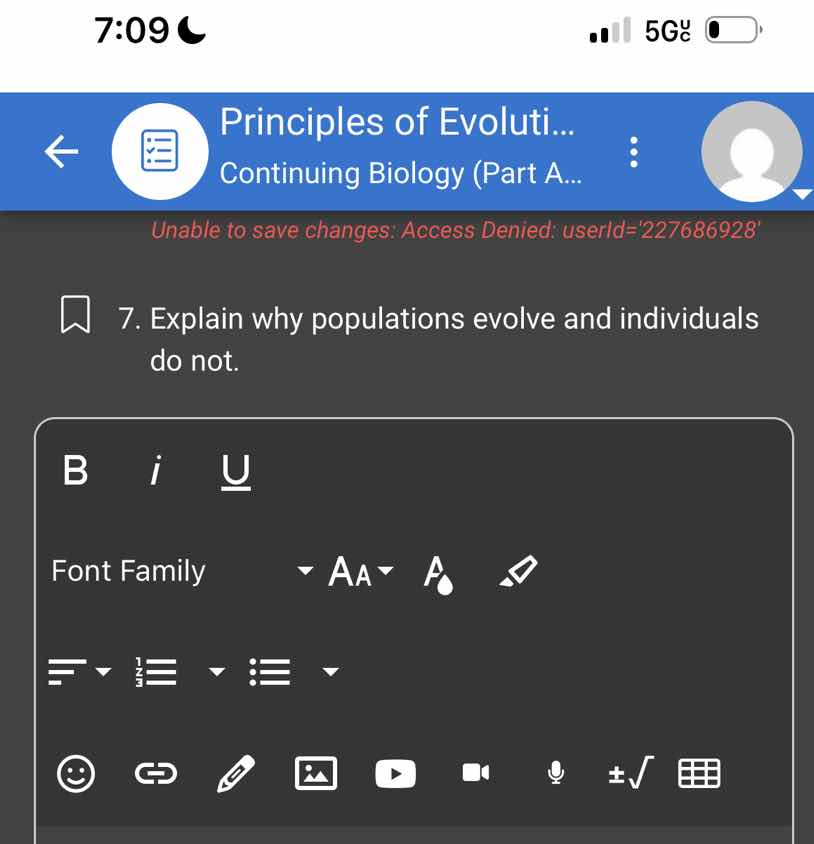
- explain why populations evolve and individuals do not.
Evolution involves changes in allele frequencies in a population over time. An individual's genetic makeup (genotype) is fixed at birth (except for rare mutations during their lifetime, which don't drive evolution on their own). Populations, however, consist of many individuals with varying genotypes. Through processes like natural selection (where certain traits that enhance survival/reproduction become more common), genetic drift (random changes in allele frequencies, especially in small populations), gene flow (movement of genes between populations), and mutations (which introduce new alleles), the overall genetic composition of a population changes across generations. So, evolution is a population - level phenomenon as it tracks changes in the collective gene pool, while individuals can't “evolve” in the sense of changing their species - defining genetic traits over their lifespan.

Snap & solve any problem in the app
Get step-by-step solutions on Sovi AI
Photo-based solutions with guided steps
Explore more problems and detailed explanations
Evolution is a change in allele frequencies in a population over time. An individual’s genotype is essentially fixed (barring rare, non - evolution - driving mutations during life), so no allele frequency change occurs within them. Populations, with diverse genotypes, undergo changes via natural selection (favorable traits become more common), genetic drift (random allele frequency shifts, e.g., in small populations), gene flow (gene movement between populations), and mutations (new alleles introduced). These processes alter the population’s gene pool across generations, making evolution a population - level process.