QUESTION IMAGE
Question
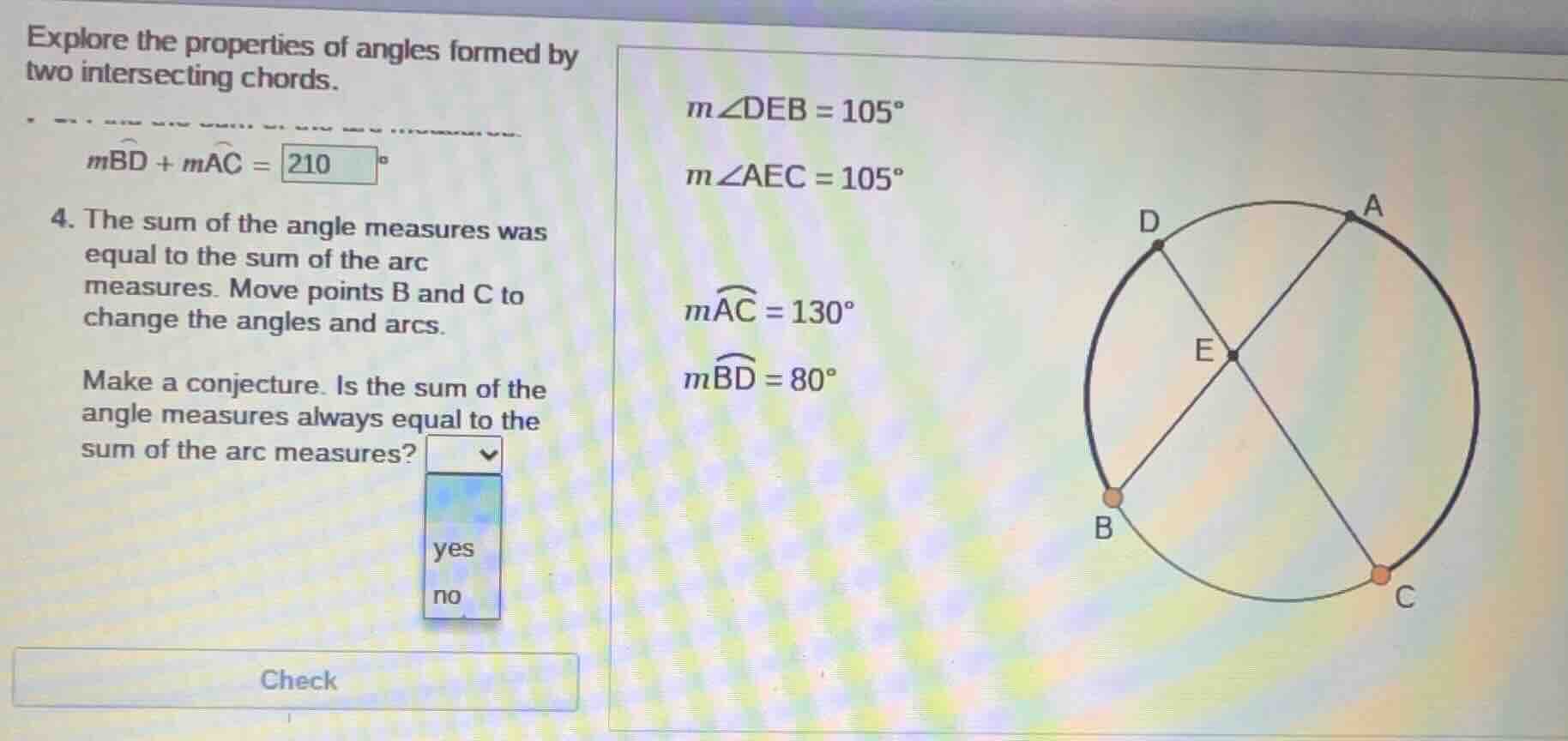
explore the properties of angles formed by two intersecting chords.
$m\overarc{bd} + m\overarc{ac} = \boxed{210}^\circ$
- the sum of the angle measures was equal to the sum of the arc measures. move points b and c to change the angles and arcs.
make a conjecture. is the sum of the angle measures always equal to the sum of the arc measures?
options: yes, no
$m\angle deb = 105^\circ$
$m\angle aec = 105^\circ$
$m\overarc{ac} = 130^\circ$
$m\overarc{bd} = 80^\circ$
(there is a circle with points d, a, c, b on it, and chords intersecting at e)
When two chords intersect inside a circle, the measure of an angle formed is half the sum of the measures of the intercepted arcs. For ∠DEB and ∠AEC (both 105°), the sum of their measures is \(105^{\circ}+ 105^{\circ}=210^{\circ}\). The sum of arcs \( \overset{\frown}{BD}\) and \( \overset{\frown}{AC}\) is \(80^{\circ}+130^{\circ} = 210^{\circ}\). By the theorem of angles formed by intersecting chords (\(m\angle=\frac{1}{2}(m\overset{\frown}{1}+m\overset{\frown}{2})\)), doubling the angle sum (since there are two vertical angles) gives the sum of the two intercepted arc sums. So the sum of the angle measures (of the vertical angles formed) is always equal to the sum of the arc measures (of the intercepted arcs).

Snap & solve any problem in the app
Get step-by-step solutions on Sovi AI
Photo-based solutions with guided steps
Explore more problems and detailed explanations
yes