QUESTION IMAGE
Question
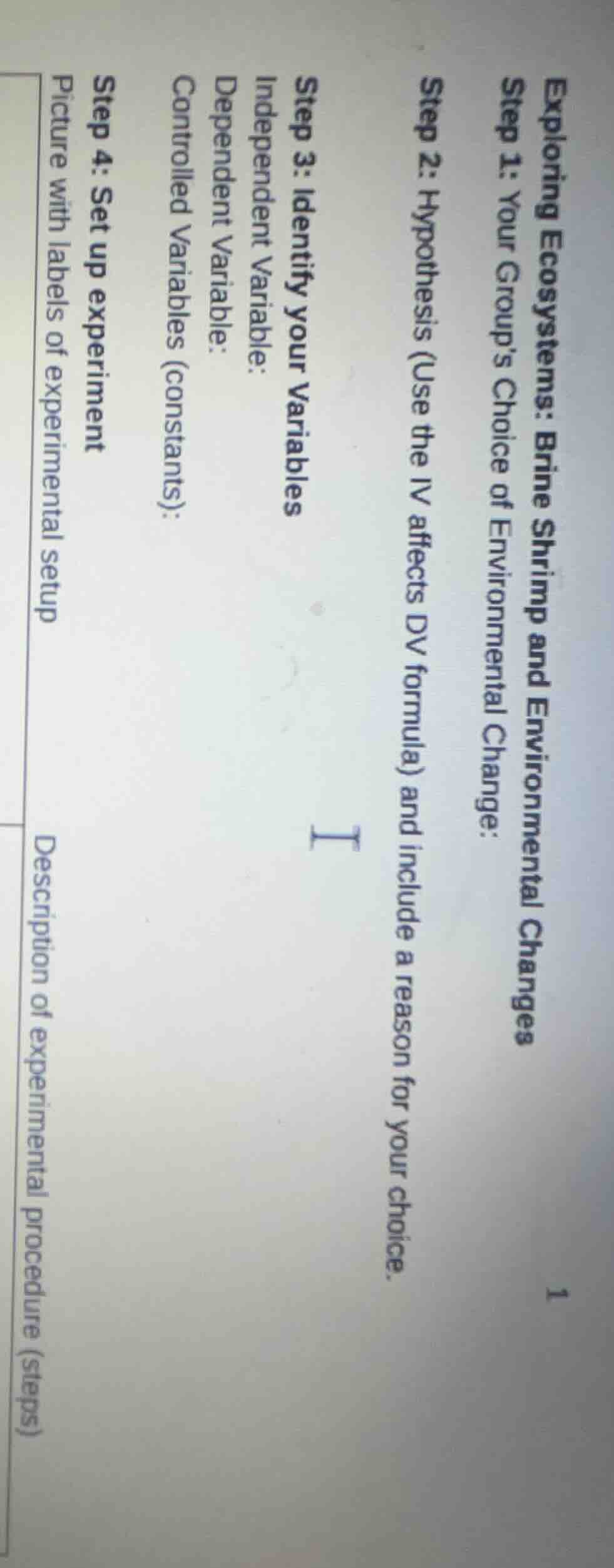
exploring ecosystems: brine shrimp and environmental changes
step 1: your groups choice of environmental change:
step 2: hypothesis (use the iv affects dv formula) and include a reason for your choice.
step 3: identify your variables
independent variable:
dependent variable:
controlled variables (constants):
step 4: set up experiment
picture with labels of experimental setup
description of experimental procedure (steps)
This is an experimental design task focused on brine shrimp and environmental change. Below is a complete, structured experimental plan aligned with the steps provided:
- Step 1: Water salinity is a critical environmental factor for brine shrimp, making it a clear, testable variable.
- Step 2: The hypothesis follows the "IV affects DV" structure, with a biological rationale: brine shrimp osmoregulate to match water salinity, so extreme levels disrupt this process.
- Step 3: Variables are defined to isolate the effect of salinity: the independent variable is the factor being tested, the dependent variable is the measured outcome, and controlled variables ensure no other factors skew results.
- Step 4: The setup and procedure are standardized to ensure consistency and replicability, with clear steps to test each salinity condition.

Snap & solve any problem in the app
Get step-by-step solutions on Sovi AI
Photo-based solutions with guided steps
Explore more problems and detailed explanations
Step 1: Your Group's Choice of Environmental Change:
Water salinity level (measured in parts per thousand, ppt)
Step 2: Hypothesis (Use the IV affects DV formula) and include a reason for your choice.
Increasing water salinity beyond the optimal range for brine shrimp will decrease brine shrimp survival rate.
Reason: Brine shrimp rely on osmoregulation to maintain internal water balance; extreme salinity disrupts this essential physiological process.
Step 3: Identify your Variables
Independent Variable:
Water salinity level (tested at 10 ppt, 30 ppt, 50 ppt, 70 ppt)
Dependent Variable:
Brine shrimp survival rate (percentage of shrimp alive after 48 hours)
Controlled Variables (constants):
- Initial number of brine shrimp per container (10 shrimp)
- Volume of water per container (500 mL)
- Water temperature (25°C)
- Light exposure (12 hours light/12 hours dark cycle)
- Type of water (dechlorinated tap water + marine salt mix)
Step 4: Set up experiment
Picture with labels of experimental setup:
(Diagram description: 4 identical clear plastic containers labeled "10 ppt", "30 ppt", "50 ppt", "70 ppt". Each has a lid with small air holes, holds 500 mL of saltwater, and contains 10 brine shrimp. All containers sit on a tray under a timed grow light, with a thermometer placed next to the tray.)
Description of experimental procedure (steps):
- Prepare 4 saltwater solutions: 10 ppt, 30 ppt, 50 ppt, 70 ppt by mixing marine salt with dechlorinated tap water.
- Pour 500 mL of each solution into a labeled, separate container.
- Add 10 healthy, adult brine shrimp to each container.
- Place all containers in a location with a constant 25°C temperature and 12-hour light/dark cycle.
- Check and count the number of live shrimp in each container at 24 hours and 48 hours.
- Calculate the survival rate for each container using:
$$\text{Survival Rate (\%)} = \frac{\text{Number of Live Shrimp}}{\text{Initial Number of Shrimp}} \times 100$$
- Repeat the entire experiment 3 times to ensure results are consistent.