QUESTION IMAGE
Question
- exports taxed • slave trade affected • control of commerce
1.15) ______ which of the following statements would be the best title for the above graphic?
a. the larger states refused to compromise.
b. the southern states wanted certain protections in a compromise.
c. the articles of confederation were abolished.
d. the southern states walked out of the constitutional convention.
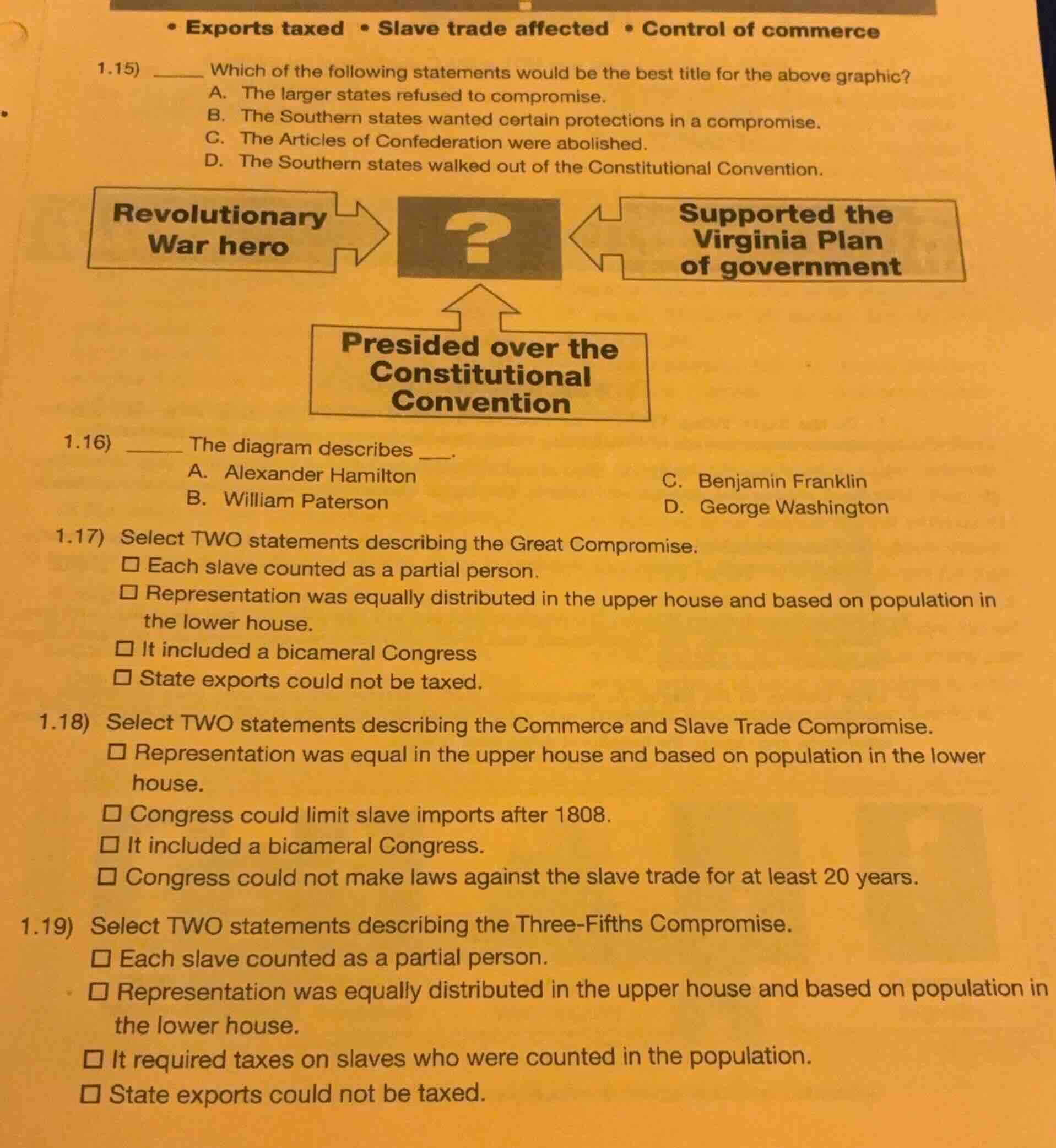
diagram with
evolutionary war hero\ and \supported the virginia plan of government\ and \presided over the constitutional convention\ pointing to a question mark
1.16) ____ the diagram describes __.
a. alexander hamilton c. benjamin franklin
b. william paterson d. george washington
1.17) select two statements describing the great compromise.
□ each slave counted as a partial person.
□ representation was equally distributed in the upper house and based on population in the lower house.
□ it included a bicameral congress
□ state exports could not be taxed.
1.18) select two statements describing the commerce and slave trade compromise.
□ representation was equal in the upper house and based on population in the lower house.
□ congress could limit slave imports after 1808.
□ it included a bicameral congress.
□ congress could not make laws against the slave trade for at least 20 years.
1.19) select two statements describing the three - fifths compromise.
□ each slave counted as a partial person.
□ representation was equally distributed in the upper house and based on population in the lower house.
□ it required taxes on slaves who were counted in the population.
□ state exports could not be taxed.
1.15: The listed points (export taxes, slave trade controls, commerce regulation) were protections Southern states sought in Constitutional Convention compromises.
1.16: George Washington was a Revolutionary War hero, supported the Virginia Plan, and presided over the Constitutional Convention.
1.17: The Great Compromise created a bicameral Congress, with equal Senate representation and population-based House representation.
1.18: The Commerce and Slave Trade Compromise banned Congress from restricting the slave trade until 1808 (20+ years) and allowed post-1808 limits.
1.19: The Three-Fifths Compromise counted each slave as 3/5 of a person for representation and taxation.

Snap & solve any problem in the app
Get step-by-step solutions on Sovi AI
Photo-based solutions with guided steps
Explore more problems and detailed explanations
1.15: B. The Southern states wanted certain protections in a compromise.
1.16: D. George Washington
1.17:
- Representation was equally distributed in the upper house and based on population in the lower house.
- It included a bicameral Congress
1.18:
- Congress could limit slave imports after 1808.
- Congress could not make laws against the slave trade for at least 20 years.
1.19:
- Each slave counted as a partial person.
- It required taxes on slaves who were counted in the population.