QUESTION IMAGE
Question
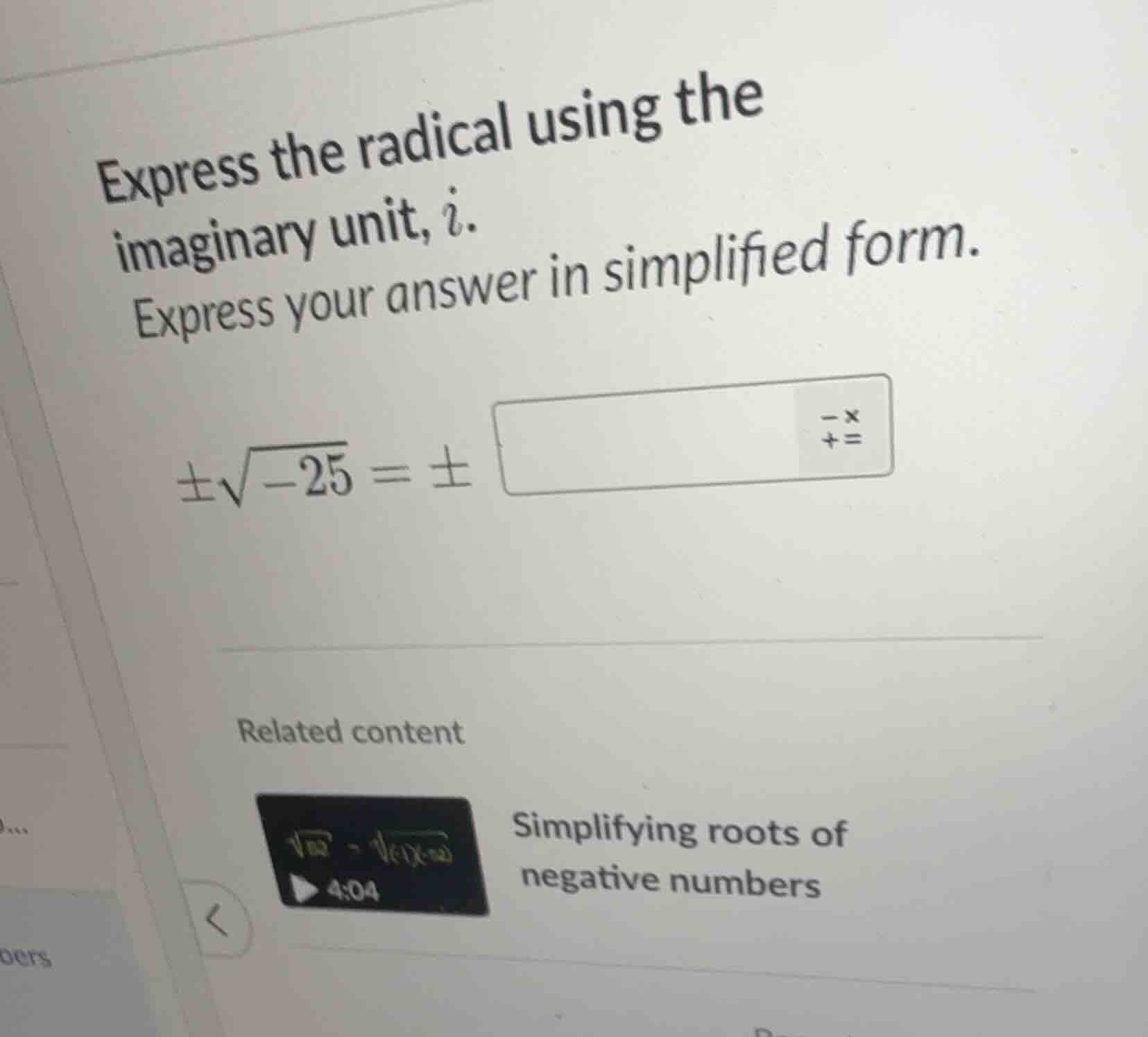
express the radical using the imaginary unit, i. express your answer in simplified form. ±√(-25) = ±
Step1: Recall the definition of \(i\)
The imaginary unit \(i\) is defined as \(i = \sqrt{-1}\). So we can rewrite \(\sqrt{-25}\) as \(\sqrt{25\times(-1)}\).
Step2: Use the property of square roots
Using the property \(\sqrt{ab}=\sqrt{a}\times\sqrt{b}\) (for \(a\geq0\) and \(b\geq0\), here we extend it to complex numbers), we have \(\sqrt{25\times(-1)}=\sqrt{25}\times\sqrt{-1}\).
Step3: Simplify the square roots
We know that \(\sqrt{25} = 5\) and \(\sqrt{-1}=i\), so \(\sqrt{25}\times\sqrt{-1}=5\times i = 5i\). And since we have \(\pm\sqrt{-25}\), the result is \(\pm5i\).

Snap & solve any problem in the app
Get step-by-step solutions on Sovi AI
Photo-based solutions with guided steps
Explore more problems and detailed explanations
\(5i\) (and also \(-5i\), but in the box for the simplified form of \(\pm\sqrt{-25}\) we write \(\pm5i\), so the answer inside the box is \(5i\) considering the \(\pm\) outside, but following the problem's request to express the radical (the part inside the \(\pm\)) in simplified form with \(i\), the answer is \(5i\) (with the \(\pm\) already given). So the final answer is \(\pm5i\), and the simplified form of the radical (the \(\sqrt{-25}\) part) is \(5i\) (with the \(\pm\) outside), so the answer to put in the box is \(5i\) (and the overall is \(\pm5i\)).