QUESTION IMAGE
Question
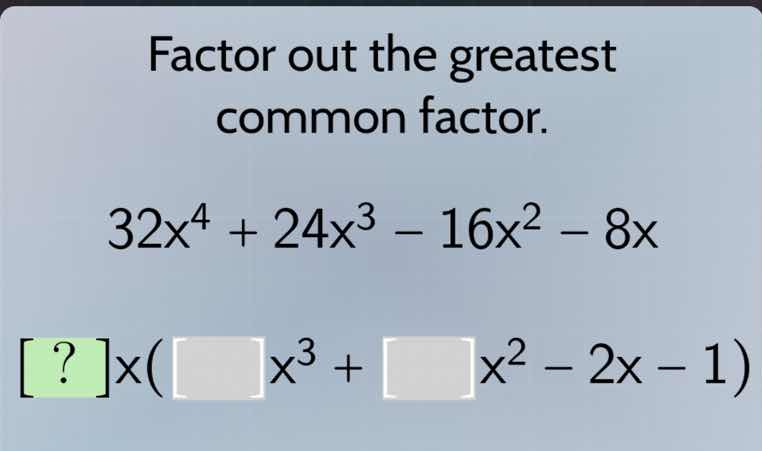
factor out the greatest common factor. 32x⁴ + 24x³ - 16x² - 8x ?x(□x³ + □x² - 2x - 1)
Step1: Find GCF of coefficients and variables
First, find the GCF of the coefficients \(32, 24, -16, -8\). The GCF of these numbers is \(8\). For the variable part, the lowest power of \(x\) is \(x^1\) (i.e., \(x\)). So the GCF of the terms is \(8x\). Wait, but let's check the given form. The given form has a factor of \(x\) outside, so let's factor out \(x\) first, then find the GCF of the remaining coefficients.
After factoring out \(x\) from each term: \(32x^4 = x \cdot 32x^3\), \(24x^3 = x \cdot 24x^2\), \(-16x^2 = x \cdot (-16x)\), \(-8x = x \cdot (-8)\). Now we need to find the GCF of \(32, 24, -16, -8\). The GCF of \(32,24,16,8\) is \(8\). Wait, but in the given box, after factoring out \(x\), the first box is a number, then inside the parentheses, the first term is \(\square x^3\), second is \(\square x^2\), etc. Wait, let's re-examine the original expression: \(32x^4 + 24x^3 - 16x^2 - 8x\). Let's factor out \(8x\) first? Wait, no, the given form is \([?]x(\square x^3 + \square x^2 - 2x - 1)\). So let's factor out \(x\) first, then factor out the GCF of the remaining coefficients.
After factoring out \(x\), we get \(x(32x^3 + 24x^2 - 16x - 8)\). Now we need to factor out the GCF from \(32x^3 + 24x^2 - 16x - 8\). The GCF of \(32,24,16,8\) is \(8\)? Wait, no, because in the parentheses, the third term is \(-2x\), so let's see: \(32x^3 \div 16 = 2x^3\)? Wait, no, let's check the coefficients. Let's divide each coefficient by the first box's number. Wait, the given parentheses has \(-2x\) and \(-1\). Let's see:
Original expression: \(32x^4 + 24x^3 - 16x^2 - 8x\)
Factor out \(x\): \(x(32x^3 + 24x^2 - 16x - 8)\)
Now, let's factor out a number from \(32x^3 + 24x^2 - 16x - 8\) such that when we divide \(-16x\) by that number, we get \(-2x\). So \(-16x \div (\text{number}) = -2x\) implies that the number is \(\frac{-16x}{-2x} = 8\)? Wait, no, \(-16x \div 8 = -2x\), yes! And \(-8 \div 8 = -1\), which matches the last term. Then \(32x^3 \div 8 = 4x^3\)? Wait, no, wait the first term in the parentheses is \(\square x^3\), second is \(\square x^2\). Wait, no, let's do it step by step.
Wait, the given form is \([?]x(\square x^3 + \square x^2 - 2x - 1)\). Let's let the first box (the [?]) be \(a\), the second box (inside parentheses, first \(\square\)) be \(b\), third be \(c\). So:
\(a x (b x^3 + c x^2 - 2x - 1) = a b x^4 + a c x^3 - 2a x^2 - a x\)
This should equal \(32x^4 + 24x^3 - 16x^2 - 8x\). So we can set up equations:
- Coefficient of \(x^4\): \(a b = 32\)
- Coefficient of \(x^3\): \(a c = 24\)
- Coefficient of \(x^2\): \(-2a = -16\)
- Coefficient of \(x\): \(-a = -8\)
Wait, from the coefficient of \(x\): \(-a = -8\) ⇒ \(a = 8\)? Wait, no, the coefficient of \(x\) in the expanded form from the given box is \(-2a x\) (since inside the parentheses is \(-2x\), multiplied by \(a x\) gives \(-2a x^2\)? Wait, I'm getting confused. Let's start over.
Original expression: \(32x^4 + 24x^3 - 16x^2 - 8x\)
Let's factor out \(x\) first: \(x(32x^3 + 24x^2 - 16x - 8)\)
Now, we need to factor out a number from \(32x^3 + 24x^2 - 16x - 8\) such that:
- \(32x^3 \div \text{number} = \square x^3\)
- \(24x^2 \div \text{number} = \square x^2\)
- \(-16x \div \text{number} = -2x\)
- \(-8 \div \text{number} = -1\)
From the third term: \(-16x \div \text{number} = -2x\) ⇒ \(\text{number} = (-16x) \div (-2x) = 8\). Wait, no: \(-16x \div 8 = -2x\), yes. And \(-8 \div 8 = -1\), which matches. Now check the first term: \(32x^3 \div 8 = 4x^3\)? But in the given parentheses, the first term is \(\square x^3\), second is \(\square x^2\). Wait, no,…

Snap & solve any problem in the app
Get step-by-step solutions on Sovi AI
Photo-based solutions with guided steps
Explore more problems and detailed explanations
The first box (?) is \(8\), the first \(\square\) inside the parentheses is \(4\), the second \(\square\) is \(3\). So:
\([8]x(4x^3 + 3x^2 - 2x - 1)\)
So the answers are: \(? = 8\), first \(\square = 4\), second \(\square = 3\).