QUESTION IMAGE
Question
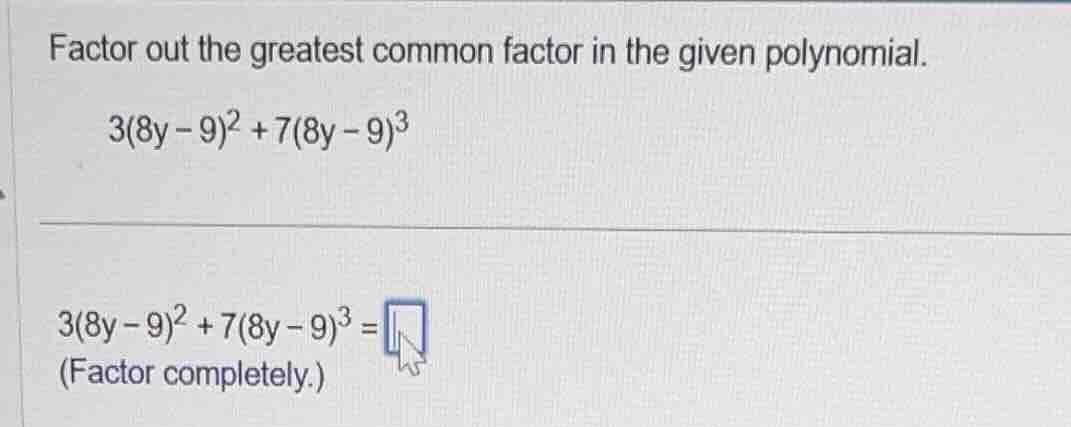
factor out the greatest common factor in the given polynomial.
3(8y - 9)² + 7(8y - 9)³
3(8y - 9)² + 7(8y - 9)³ =
(factor completely.)
Step1: Identify the GCF
The terms are \(3(8y - 9)^2\) and \(7(8y - 9)^3\). The greatest common factor (GCF) of the two terms is \((8y - 9)^2\) because it is the highest power of \((8y - 9)\) that divides both terms.
Step2: Factor out the GCF
Factor out \((8y - 9)^2\) from each term:
\[
\]
Step3: Simplify the bracket
Simplify the expression inside the bracket:
\[
\]
Wait, no, actually, let's correct that. Wait, when we factor out \((8y - 9)^2\), the first term is \(3(8y - 9)^2\), so factoring out \((8y - 9)^2\) gives 3, and the second term is \(7(8y - 9)^3\), factoring out \((8y - 9)^2\) gives \(7(8y - 9)\). So:
\[
\]
Wait, no, that's overcomplicating. Wait, actually, the initial factoring:
Wait, the GCF is \((8y - 9)^2\), so:
\(3(8y - 9)^2 + 7(8y - 9)^3 = (8y - 9)^2[3 + 7(8y - 9)]\)
Now simplify inside the brackets:
\(3 + 7(8y - 9) = 3 + 56y - 63 = 56y - 60\)
Then, factor 4 from 56y - 60: 56y - 60 = 4(14y - 15)
So overall:
\((8y - 9)^2\times4(14y - 15) = 4(8y - 9)^2(14y - 15)\)
Wait, but maybe I made a mistake. Wait, let's check again.
Wait, the original problem:
\(3(8y - 9)^2 + 7(8y - 9)^3\)
The GCF is \((8y - 9)^2\), so factor that out:
\(= (8y - 9)^2[3 + 7(8y - 9)]\)
Now, simplify \(3 + 7(8y - 9)\):
\(3 + 56y - 63 = 56y - 60\)
Then, 56y - 60 can be factored by 4: 56y - 60 = 4(14y - 15)
So the fully factored form is \(4(8y - 9)^2(14y - 15)\)? Wait, no, wait, maybe I messed up. Wait, no, actually, when we factor out \((8y - 9)^2\), the first term is 3, the second term is 7(8y - 9), so:
Wait, no, the first term is \(3(8y - 9)^2\), so when we factor out \((8y - 9)^2\), we get 3. The second term is \(7(8y - 9)^3 = 7(8y - 9)^2(8y - 9)\), so factoring out \((8y - 9)^2\) gives \(7(8y - 9)\). So:
\(3(8y - 9)^2 + 7(8y - 9)^3 = (8y - 9)^2[3 + 7(8y - 9)]\)
Now, simplify inside the brackets:
\(3 + 56y - 63 = 56y - 60\)
Then, 56y - 60 = 4(14y - 15)
So the expression becomes:
\((8y - 9)^2\times4(14y - 15) = 4(8y - 9)^2(14y - 15)\)
But wait, maybe the problem doesn't require factoring the linear term. Let's check the original problem again.
The problem says "Factor out the greatest common factor in the given polynomial" and then "Factor completely".
Wait, the GCF of the two terms is \((8y - 9)^2\), so factoring that out:
\(3(8y - 9)^2 + 7(8y - 9)^3 = (8y - 9)^2[3 + 7(8y - 9)]\)
Now, simplify the bracket:
\(3 + 7(8y - 9) = 3 + 56y - 63 = 56y - 60 = 4(14y - 15)\)
So then, the fully factored form is \(4(8y - 9)^2(14y - 15)\). But maybe I made a mistake in the initial step. Wait, no, let's do it again.
Wait, the two terms are \(3(8y - 9)^2\) and \(7(8y - 9)^3\). The GCF is the product of the GCF of the coefficients and the GCF of the variable parts. The coefficients are 3 and 7, which have a GCF of 1. The variable part: \((8y - 9)^2\) and \((8y - 9)^3\), so GCF is \((8y - 9)^2\). So the GCF is \(1\times(8y - 9)^2 = (8y - 9)^2\).
So factoring out \((8y - 9)^2\):
\(3(8y - 9)^2 + 7(8y - 9)^3 = (8y - 9)^2[3 + 7(8y - 9)]\)
Now, simplify inside the brackets:
\(3 + 7(8y - 9) = 3 + 56y - 63 = 56y - 60\)
Then, factor 4 from 56y - 60: 56y - 60 = 4(14y - 15)
So the expression becomes:
\((8y - 9)^2\times4(14y - 15) = 4(8y - 9)^2(14y - 15)\)
But maybe the proble…

Snap & solve any problem in the app
Get step-by-step solutions on Sovi AI
Photo-based solutions with guided steps
Explore more problems and detailed explanations
\(4(8y - 9)^2(14y - 15)\)
Wait, but let's verify with the substitution method. Let \(y = 1\). Then the original polynomial:
\(3(8(1) - 9)^2 + 7(8(1) - 9)^3 = 3(-1)^2 + 7(-1)^3 = 3(1) + 7(-1) = 3 - 7 = -4\)
Now the factored form: \(4(8(1) - 9)^2(14(1) - 15) = 4(-1)^2(14 - 15) = 4(1)(-1) = -4\). Correct.
Another test: \(y = 0\). Original polynomial: \(3(0 - 9)^2 + 7(0 - 9)^3 = 3(81) + 7(-729) = 243 - 5103 = -4860\)
Factored form: \(4(0 - 9)^2(0 - 15) = 4(81)(-15) = 324(-15) = -4860\). Correct.
So the correct factored form is \(4(8y - 9)^2(14y - 15)\). But wait, maybe the problem expects the answer as \((8y - 9)^2(3 + 7(8y - 9))\) which simplifies to \((8y - 9)^2(56y - 60)\), but factoring out 4 gives \(4(8y - 9)^2(14y - 15)\). So that's the complete factorization.