QUESTION IMAGE
Question
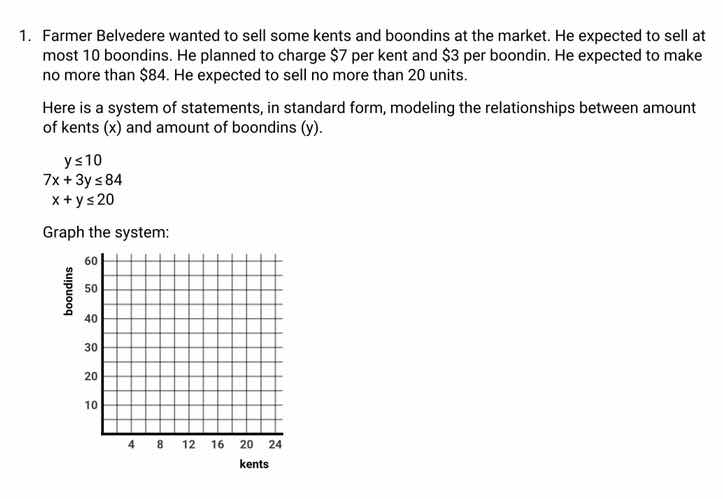
- farmer belvedere wanted to sell some kents and boondins at the market. he expected to sell at most 10 boondins. he planned to charge $7 per kent and $3 per boondin. he expected to make no more than $84. he expected to sell no more than 20 units.
here is a system of statements, in standard form, modeling the relationships between amount of kents (x) and amount of boondins (y).
( y leq 10 )
( 7x + 3y leq 84 )
( x + y leq 20 )
graph the system:
graph with boondins on y - axis (0 - 60) and kents on x - axis (0 - 24), grid lines present
Step1: Analyze \( y \leq 10 \)
This is a horizontal line \( y = 10 \). Since the inequality is \( \leq \), we draw a solid line at \( y = 10 \) and shade the region below (where \( y \) values are less than or equal to 10).
Step2: Analyze \( 7x + 3y \leq 84 \)
First, rewrite it in slope - intercept form (\( y=mx + b \)):
\( 3y\leq - 7x + 84 \)
\( y\leq-\frac{7}{3}x + 28 \)
The boundary line is \( y =-\frac{7}{3}x + 28 \). The slope is \( -\frac{7}{3}\) and the y - intercept is 28. Since the inequality is \( \leq \), we draw a solid line. To find two points on the line:
When \( x = 0 \), \( y=28 \); when \( y = 0 \), \( 7x=84\Rightarrow x = 12 \).
We shade the region below the line (since \( y\leq-\frac{7}{3}x + 28 \)).
Step3: Analyze \( x + y \leq 20 \)
Rewrite in slope - intercept form: \( y\leq - x+20 \)
The boundary line is \( y=-x + 20 \). The slope is - 1 and the y - intercept is 20. When \( x = 0 \), \( y = 20 \); when \( y = 0 \), \( x = 20 \).
Since the inequality is \( \leq \), we draw a solid line and shade the region below the line.
Step4: Find the feasible region
The feasible region is the intersection of the three shaded regions from the three inequalities. We find the intersection points of the boundary lines:
- Intersection of \( y = 10 \) and \( x + y=20 \): Substitute \( y = 10 \) into \( x + y=20 \), we get \( x=10 \). So the point is \( (10,10) \).
- Intersection of \( y = 10 \) and \( 7x + 3y=84 \): Substitute \( y = 10 \) into \( 7x+3y = 84 \), \( 7x+30 = 84\Rightarrow7x=54\Rightarrow x=\frac{54}{7}\approx7.71 \). So the point is \( (\frac{54}{7},10) \)
- Intersection of \( 7x + 3y=84 \) and \( x + y=20 \):
Subtract the second equation from the first: \( (7x + 3y)-(x + y)=84 - 20 \)
\( 6x+2y = 64\Rightarrow3x + y=32 \). But from \( x + y=20 \), we have \( y = 20 - x \). Substitute into \( 3x + y=32 \):
\( 3x+(20 - x)=32\Rightarrow2x=12\Rightarrow x = 6 \), then \( y=20 - 6 = 14 \). But \( y = 14 \) does not satisfy \( y\leq10 \), so we ignore this intersection as it is outside the \( y\leq10 \) region.
- Intersection of \( x = 0 \) and \( y = 10 \) (but we also consider the other boundaries). The feasible region is bounded by the three lines and the axes (in the first quadrant since \( x\geq0,y\geq0 \) as they represent the number of items).
To graph:
- Draw the line \( y = 10 \) (solid, horizontal).
- Draw the line \( 7x + 3y=84 \) (solid, with points (0,28) and (12,0)).
- Draw the line \( x + y=20 \) (solid, with points (0,20) and (20,0)).
- Shade the region that is below \( y = 10 \), below \( 7x + 3y = 84 \), below \( x + y=20 \) and in the first quadrant (\( x\geq0,y\geq0 \)).

Snap & solve any problem in the app
Get step-by-step solutions on Sovi AI
Photo-based solutions with guided steps
Explore more problems and detailed explanations
The graph is constructed by drawing the three solid lines \( y = 10 \), \( 7x+3y = 84 \), \( x + y=20 \) and shading the region that satisfies all three inequalities \( y\leq10 \), \( 7x + 3y\leq84 \), and \( x + y\leq20 \) in the first quadrant (where \( x\geq0,y\geq0 \)). The feasible region is a polygon - shaped area bounded by the intersection of these three half - planes.