QUESTION IMAGE
Question
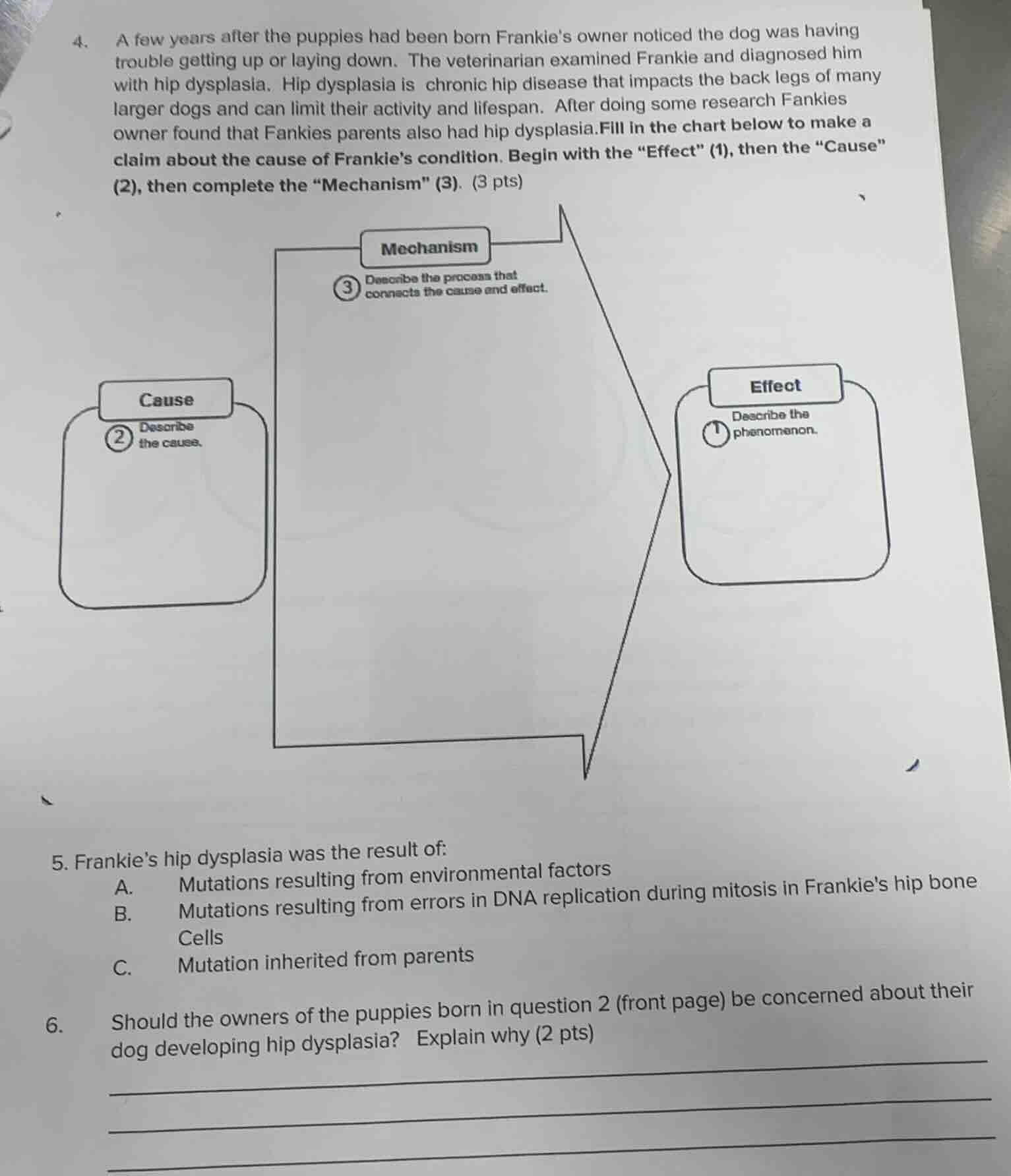
- a few years after the puppies had been born frankies owner noticed the dog was having trouble getting up or laying down. the veterinarian examined frankie and diagnosed him with hip dysplasia. hip dysplasia is chronic hip disease that impacts the back legs of many larger dogs and can limit their activity and lifespan. after doing some research fankies owner found that fankies parents also had hip dysplasia.fill in the chart below to make a claim about the cause of frankies condition. begin with the \effect\ (1), then the \cause\ (2), then complete the \mechanism\ (3). (3 pts)
- frankies hip dysplasia was the result of:
a. mutations resulting from environmental factors
b. mutations resulting from errors in dna replication during mitosis in frankies hip bone cells
c. mutation inherited from parents
- should the owners of the puppies born in question 2 (front page) be concerned about their dog developing hip dysplasia? explain why (2 pts)
Question 4
- Effect (1): The phenomenon is Frankie having trouble getting up or laying down (and being diagnosed with hip dysplasia).
- Cause (2): The cause is the inheritance of genes related to hip dysplasia from his parents (since his parents also had hip dysplasia).
- Mechanism (3): Genes related to hip dysplasia are passed from Frankie's parents to him during reproduction. These genes influence the development of his hip joint, leading to abnormal hip structure and function, which results in the symptoms of hip dysplasia (trouble moving, limited activity, etc.).
- Option A: The problem states Frankie’s parents had hip dysplasia, not environmental factors causing mutations. Eliminate A.
- Option B: Hip dysplasia is not caused by mitosis errors in Frankie’s hip bone cells (it is an inherited condition). Eliminate B.
- Option C: Since Frankie’s parents had hip dysplasia and he developed it, the mutation (gene) for hip dysplasia was inherited from his parents. This matches the context.
Hip dysplasia can be inherited (as seen with Frankie and his parents). The puppies share genes with Frankie (and potentially his parents, if from the same litter or related breeding). Inherited genetic traits for hip dysplasia can be passed to offspring, so the owners should be concerned because the puppies may have inherited the genes that cause hip dysplasia, increasing their risk of developing the condition.

Snap & solve any problem in the app
Get step-by-step solutions on Sovi AI
Photo-based solutions with guided steps
Explore more problems and detailed explanations
- Effect: Frankie has trouble getting up or laying down (diagnosed with hip dysplasia).
- Cause: Frankie inherited genes for hip dysplasia from his parents.
- Mechanism: Genes for hip dysplasia were passed from parents to Frankie. These genes disrupt normal hip development, causing joint abnormalities that limit movement.