QUESTION IMAGE
Question
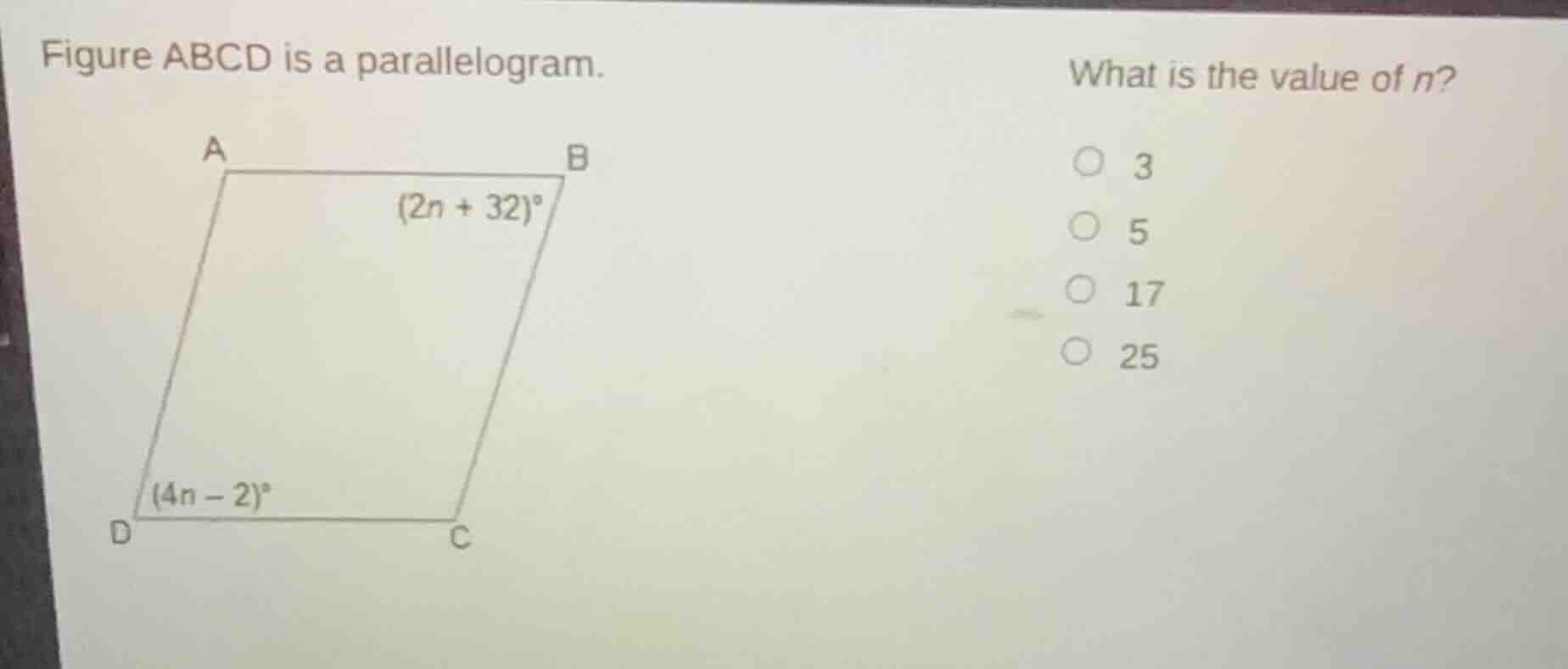
figure abcd is a parallelogram.
what is the value of n?
a, b, c, d form a parallelogram. angle at b is (2n + 32)°, angle at d is (4n - 2)°. options: 3, 5, 17, 25
Step1: Recall property of parallelogram
In a parallelogram, consecutive angles are supplementary? No, wait, actually, in a parallelogram, opposite angles are equal, and consecutive angles are supplementary. Wait, but here angle B and angle D: Wait, no, in parallelogram ABCD, AB is parallel to CD, and AD is parallel to BC. So angle B and angle D: Wait, no, angle A and angle B are consecutive, angle B and angle C are consecutive, etc. Wait, actually, in a parallelogram, opposite angles are equal. Wait, angle B and angle D? Wait, no, angle A and angle C are opposite, angle B and angle D are opposite? Wait, no, let's label the parallelogram: A---B, B---C, C---D, D---A. So AB is parallel to CD, AD is parallel to BC. So angle at B (angle B) and angle at D (angle D): Wait, no, angle B and angle D: Wait, no, angle A and angle B are adjacent, angle B and angle C are adjacent, angle C and angle D are adjacent, angle D and angle A are adjacent. Wait, actually, in a parallelogram, opposite angles are equal. So angle A = angle C, angle B = angle D? Wait, no, wait, let's check the diagram. The diagram shows angle at B is (2n + 32)°, angle at D is (4n - 2)°. Wait, in a parallelogram, opposite angles are equal. Wait, AB is parallel to CD, and AD is parallel to BC. So angle B and angle D: Wait, no, angle B is at vertex B, between AB and BC. Angle D is at vertex D, between AD and DC. Wait, actually, in a parallelogram, AB is parallel to CD, so AD is a transversal. So angle A and angle D are consecutive angles, so they are supplementary. Similarly, angle A and angle B are consecutive angles, supplementary. Wait, but maybe I made a mistake. Wait, the correct property: In a parallelogram, opposite angles are equal. So angle B and angle D: Wait, no, angle B is (2n + 32)°, angle D is (4n - 2)°. Wait, maybe angle B and angle D are equal? Wait, no, that can't be. Wait, maybe angle B and angle D are supplementary? No, wait, let's re-examine. Wait, in the parallelogram ABCD, AB || CD, and AD is a side. So angle at B (angle ABC) and angle at D (angle ADC): Wait, actually, in a parallelogram, opposite angles are equal. So angle ABC = angle ADC? Wait, no, angle ABC and angle ADC: Let's see, AB is parallel to CD, BC is parallel to AD. So angle ABC and angle ADC: Wait, maybe they are equal? Wait, let's check the given angles. The problem is to find n, so let's assume that angle B and angle D are equal? Wait, no, that would give 2n + 32 = 4n - 2. Let's solve that: 2n + 32 = 4n - 2 → 32 + 2 = 4n - 2n → 34 = 2n → n = 17. Wait, that's one of the options. So maybe angle B and angle D are equal? Wait, maybe in the parallelogram, angle B and angle D are opposite angles. Wait, maybe the diagram is labeled such that B and D are opposite? Wait, the parallelogram is A---B---C---D---A, so opposite vertices are A and C, B and D. So angle at B (angle ABC) and angle at D (angle ADC) are opposite angles, so they are equal. So that's the property: opposite angles in a parallelogram are equal. So set (2n + 32) equal to (4n - 2).
Step2: Solve the equation
Set 2n + 32 = 4n - 2.
Subtract 2n from both sides: 32 = 2n - 2.
Add 2 to both sides: 34 = 2n.
Divide both sides by 2: n = 17.

Snap & solve any problem in the app
Get step-by-step solutions on Sovi AI
Photo-based solutions with guided steps
Explore more problems and detailed explanations
17