QUESTION IMAGE
Question
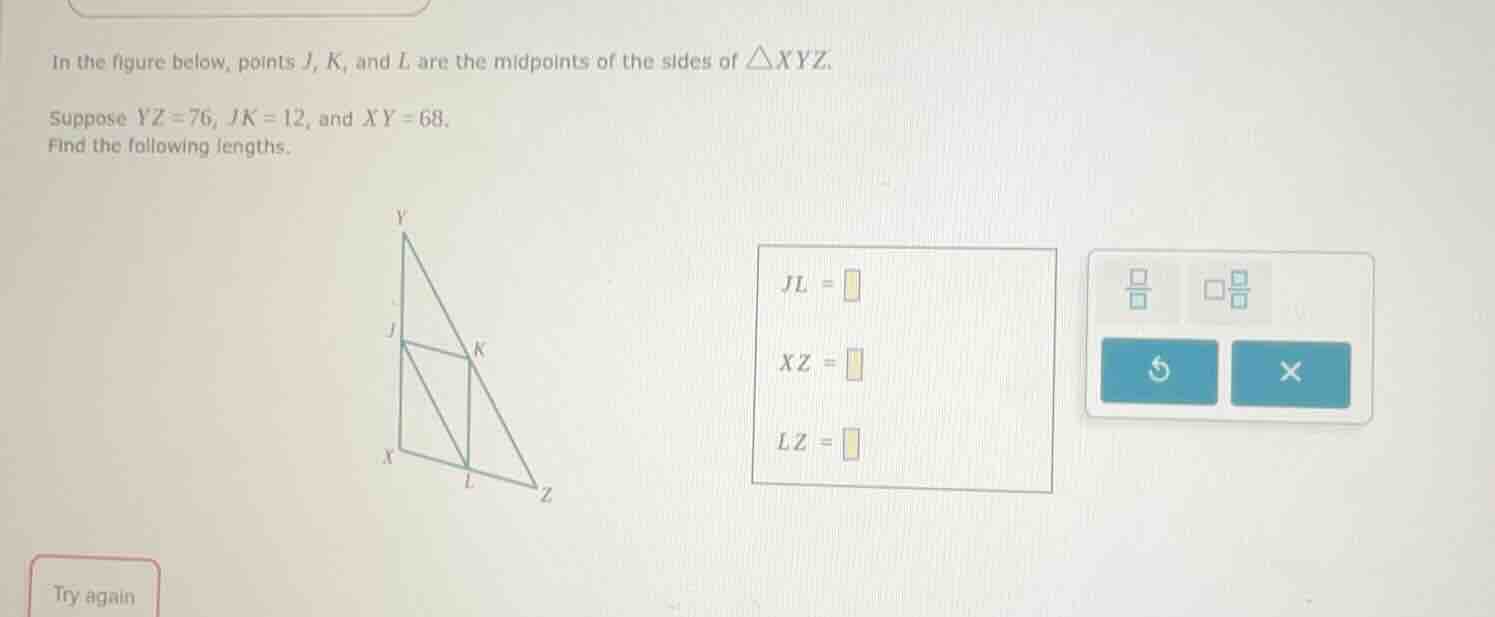
in the figure below, points j, k, and l are the midpoints of the sides of $\triangle xyz$. suppose $yz = 76$, $jk = 12$, and $xy = 68$. find the following lengths. $jl = \square$ $xz = \square$ $lz = \square$
Step1: Recall the Midline Theorem (Triangle Midsegment Theorem)
The Midline Theorem states that the segment connecting the midpoints of two sides of a triangle is parallel to the third side and half as long. Also, since \( J, K, L \) are midpoints, we can use properties of midsegments.
For \( JL \):
Since \( J \) is the midpoint of \( XY \) and \( L \) is the midpoint of \( XZ \), and \( K \) is the midpoint of \( YZ \)? Wait, no, let's look at the sides. Wait, \( J \) is midpoint of \( XY \), \( K \) midpoint of \( YZ \), \( L \) midpoint of \( XZ \). Wait, the segment \( JK \): by midline theorem, \( JK \) should be parallel to \( XZ \) and \( JK=\frac{1}{2}XZ \)? Wait, no, maybe \( JL \): since \( J \) is midpoint of \( XY \) and \( L \) is midpoint of \( XZ \), then \( JL \) is midline? Wait, no, let's re-examine.
Wait, the problem: \( J, K, L \) are midpoints of sides of \( \triangle XYZ \). So \( J \) is midpoint of \( XY \), \( K \) midpoint of \( YZ \), \( L \) midpoint of \( XZ \).
For \( JL \):
Wait, \( YZ = 76 \), \( JK = 12 \), \( XY = 68 \).
Wait, \( JL \): since \( L \) is midpoint of \( XZ \) and \( J \) is midpoint of \( XY \), no, wait, maybe \( JL \) is equal to \( \frac{1}{2}YZ \)? Wait, no. Wait, the midline theorem: the segment connecting midpoints of two sides is half the third side.
Wait, let's list the midpoints:
- \( J \): midpoint of \( XY \) (so \( XJ = JY = \frac{XY}{2} = \frac{68}{2} = 34 \))
- \( K \): midpoint of \( YZ \) (so \( YK = KZ = \frac{YZ}{2} = \frac{76}{2} = 38 \))
- \( L \): midpoint of \( XZ \) (so \( XL = LZ = \frac{XZ}{2} \))
Now, segment \( JK \): connects midpoints of \( XY \) and \( YZ \), so by midline theorem, \( JK \parallel XZ \) and \( JK = \frac{1}{2}XZ \). Wait, but \( JK = 12 \), so \( XZ = 2 \times JK = 2 \times 12 = 24 \)? Wait, no, that can't be. Wait, maybe I got the sides wrong. Wait, maybe \( JK \) is midline for \( XZ \), so \( JK = \frac{1}{2}XZ \), so \( XZ = 2 \times 12 = 24 \). Then \( JL \): since \( J \) is midpoint of \( XY \) and \( L \) is midpoint of \( XZ \), then \( JL \) is midline for \( YZ \), so \( JL = \frac{1}{2}YZ \). Since \( YZ = 76 \), then \( JL = \frac{76}{2} = 38 \).
Step1: Find \( JL \)
Since \( J \) is midpoint of \( XY \) and \( L \) is midpoint of \( XZ \), by midline theorem, \( JL \parallel YZ \) and \( JL = \frac{1}{2}YZ \). Given \( YZ = 76 \), so \( JL = \frac{76}{2} = 38 \). Wait, no, wait, maybe \( JL \) is midline for \( YZ \). Wait, \( YZ \) is a side, so midline connecting midpoints of \( XY \) and \( XZ \) would be parallel to \( YZ \) and half its length. So \( JL = \frac{1}{2}YZ = \frac{76}{2} = 38 \).
Step2: Find \( XZ \)
Segment \( JK \) connects midpoints of \( XY \) and \( YZ \), so by midline theorem, \( JK = \frac{1}{2}XZ \). Given \( JK = 12 \), so \( XZ = 2 \times JK = 2 \times 12 = 24 \). Wait, that seems small, but let's check.
Step3: Find \( LZ \)
Since \( L \) is midpoint of \( XZ \), \( LZ = \frac{XZ}{2} \). We found \( XZ = 24 \), so \( LZ = \frac{24}{2} = 12 \). Wait, no, that contradicts? Wait, maybe I mixed up the midline.
Wait, let's re-express:
- Midline theorem: In a triangle, the segment connecting the midpoints of two sides is parallel to the third side and half as long.
So:
- \( JK \): connects midpoints of \( XY \) (J) and \( YZ \) (K), so third side is \( XZ \). Thus, \( JK = \frac{1}{2}XZ \implies XZ = 2 \times JK = 2 \times 12 = 24 \).
- \( JL \): connects midpoints of \( XY \) (J) and \( XZ \) (L), so third side is \( YZ \). Thus, \( JL = \frac{1}{2}YZ = \frac{76}{2…

Snap & solve any problem in the app
Get step-by-step solutions on Sovi AI
Photo-based solutions with guided steps
Explore more problems and detailed explanations
\( JL = \boldsymbol{38} \)
\( XZ = \boldsymbol{24} \)
\( LZ = \boldsymbol{12} \)