QUESTION IMAGE
Question
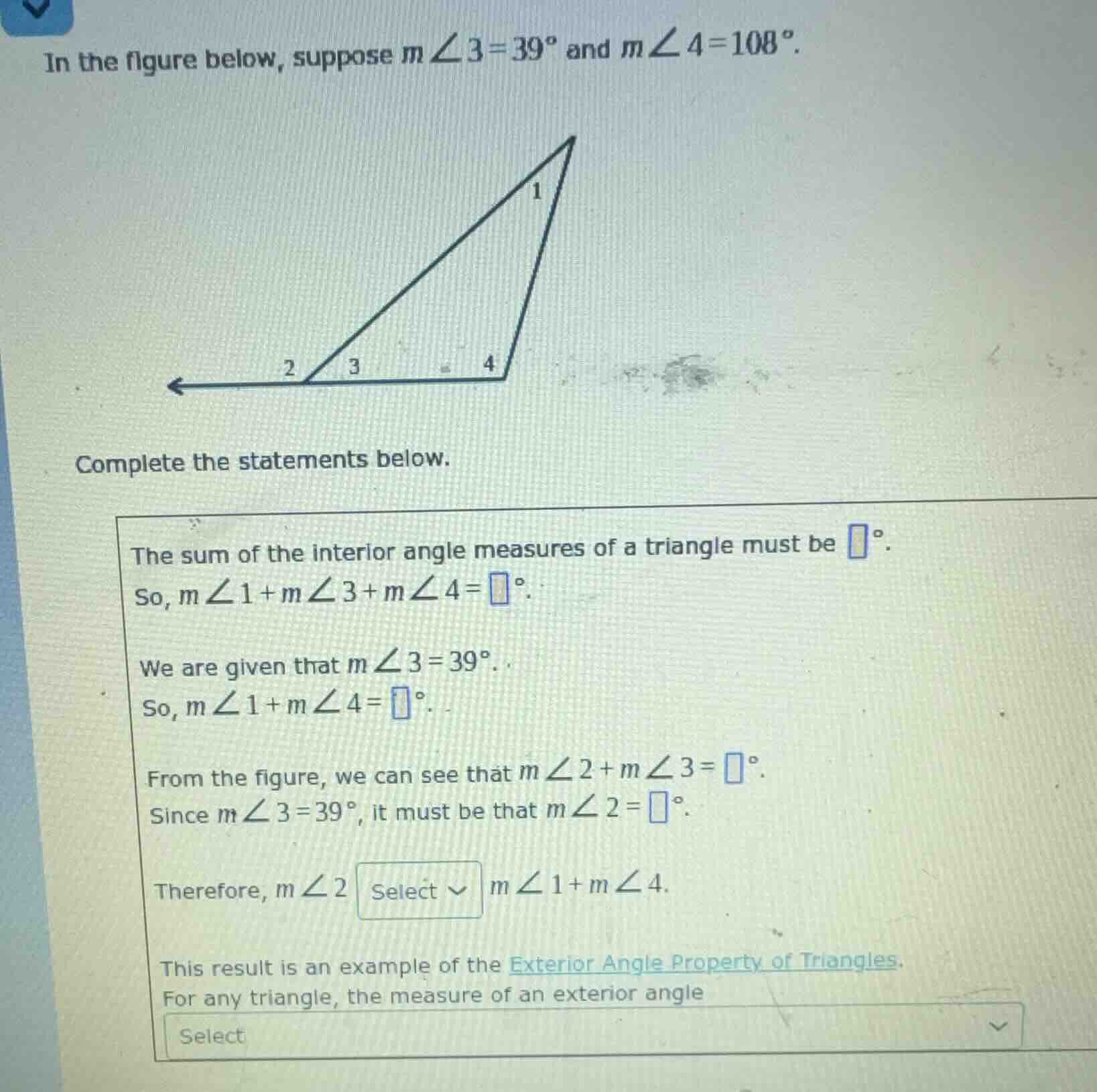
in the figure below, suppose ( mangle3 = 39^circ ) and ( mangle4 = 108^circ ).
complete the statements below.
the sum of the interior angle measures of a triangle must be ( square^circ ).
so, ( mangle1 + mangle3 + mangle4 = square^circ ).
we are given that ( mangle3 = 39^circ ).
so, ( mangle1 + mangle4 = square^circ ).
from the figure, we can see that ( mangle2 + mangle3 = square^circ ).
since ( mangle3 = 39^circ ), it must be that ( mangle2 = square^circ ).
therefore, ( mangle2 ) select ( mangle1 + mangle4 ).
this result is an example of the exterior angle property of triangles.
for any triangle, the measure of an exterior angle
select
Step1: Recall triangle interior angle sum
The sum of interior angles of a triangle is \(180^\circ\). So, the first blank is \(180\), and \(m\angle1 + m\angle3 + m\angle4 = 180^\circ\).
Step2: Subtract \(m\angle3\) from \(180^\circ\)
Given \(m\angle3 = 39^\circ\), we calculate \(m\angle1 + m\angle4 = 180^\circ - 39^\circ = 141^\circ\).
Step3: Recall linear pair angle sum
\(\angle2\) and \(\angle3\) form a linear pair, so their sum is \(180^\circ\). Thus, \(m\angle2 + m\angle3 = 180^\circ\).
Step4: Solve for \(m\angle2\)
Substitute \(m\angle3 = 39^\circ\) into \(m\angle2 + 39^\circ = 180^\circ\), we get \(m\angle2 = 180^\circ - 39^\circ = 141^\circ\).
Step5: Compare \(m\angle2\) and \(m\angle1 + m\angle4\)
Since \(m\angle2 = 141^\circ\) and \(m\angle1 + m\angle4 = 141^\circ\), \(m\angle2 = m\angle1 + m\angle4\).
Step6: Recall Exterior Angle Property
The Exterior Angle Property states that the measure of an exterior angle of a triangle is equal to the sum of the measures of the two non - adjacent interior angles.

Snap & solve any problem in the app
Get step-by-step solutions on Sovi AI
Photo-based solutions with guided steps
Explore more problems and detailed explanations
The sum of the interior angle measures of a triangle must be \(\boldsymbol{180}\)°.
So, \(m\angle1 + m\angle3 + m\angle4=\boldsymbol{180}\)°.
So, \(m\angle1 + m\angle4=\boldsymbol{141}\)°.
\(m\angle2 + m\angle3=\boldsymbol{180}\)°.
\(m\angle2=\boldsymbol{141}\)°.
Therefore, \(m\angle2\) \(\boldsymbol{=}\) \(m\angle1 + m\angle4\).
For any triangle, the measure of an exterior angle is equal to the sum of the measures of the two non - adjacent interior angles.