QUESTION IMAGE
Question
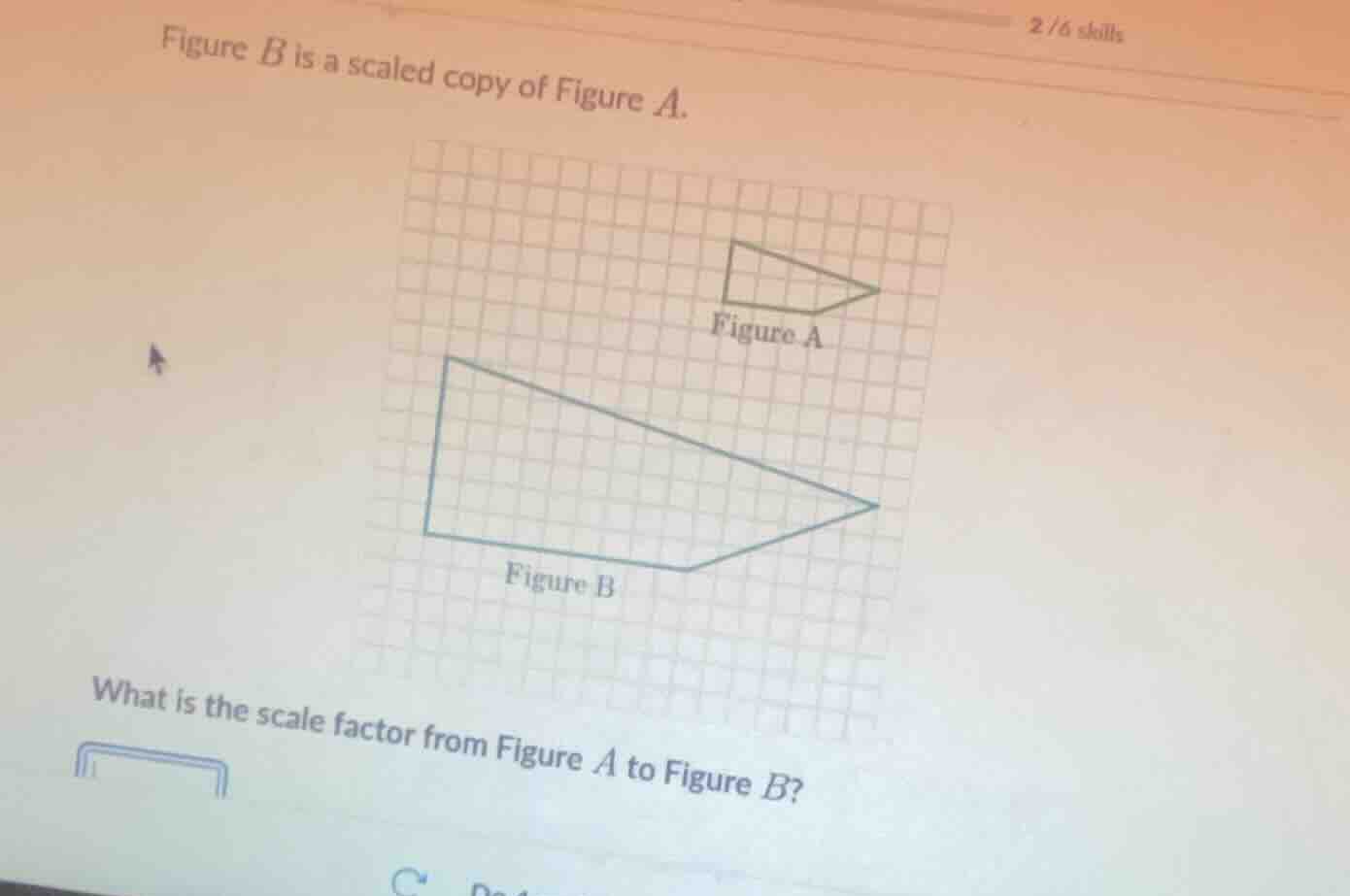
figure b is a scaled copy of figure a.
what is the scale factor from figure a to figure b?
Step1: Identify corresponding sides
Let's assume the height of Figure A (vertical side) is, say, 2 units (from grid), and the height of Figure B is 6 units (since it's a scaled copy, we check grid squares). Wait, alternatively, let's take a horizontal or vertical segment. Let's take the vertical side of Figure A: suppose in Figure A, the vertical side (left side) is 2 grid squares. In Figure B, the corresponding vertical side is 6 grid squares? Wait, no, maybe better to count the height. Wait, looking at the grid, let's count the number of grid squares for a corresponding side. Let's say the height (vertical length) of Figure A is 2 units (from the grid, the left vertical side of Figure A is 2 squares tall). Then Figure B's left vertical side is 6 squares tall? Wait, no, maybe 3? Wait, let's do it properly. Let's find a side in Figure A and the corresponding side in Figure B. Let's take the vertical side (the left side of the triangle-like figure). In Figure A, let's count the number of grid squares: from the bottom to the top of the vertical side, it's 2 squares. In Figure B, the corresponding vertical side is 6 squares? Wait, no, maybe 3. Wait, maybe the height of Figure A is 2, and Figure B is 6? No, wait, let's check the horizontal length. Wait, maybe the base or another side. Wait, actually, when Figure B is a scaled copy, the scale factor is (length of side in B) / (length of corresponding side in A). Let's assume that in Figure A, the vertical side (left) is 2 units (grid squares), and in Figure B, it's 6 units? No, that would be 3. Wait, maybe I made a mistake. Wait, let's look at the grid. Let's say Figure A has a vertical side of length 2 (from y=0 to y=2, for example), and Figure B has the same side of length 6? No, that can't be. Wait, maybe the vertical side of Figure A is 2, and Figure B is 6? No, 6/2=3. Wait, or maybe Figure A's vertical side is 2, Figure B's is 6? Wait, no, let's count again. Wait, maybe the height of Figure A is 2, and Figure B is 6? No, that's 3. Wait, maybe the scale factor is 3. Wait, let's confirm. Let's take the horizontal length of the base. In Figure A, the base (the bottom side) is, say, 3 units. In Figure B, the base is 9 units? No, 9/3=3. So scale factor is 3. Wait, maybe. Alternatively, let's check the height. If Figure A's height (vertical) is 2, Figure B's is 6, so 6/2=3. So scale factor is 3.
Step2: Calculate scale factor
Scale factor = (Length of side in B) / (Length of corresponding side in A)
Let’s say the length of a corresponding side in Figure A is \( l_A \) and in Figure B is \( l_B \).
If \( l_A = 2 \) and \( l_B = 6 \), then scale factor \( = \frac{l_B}{l_A} = \frac{6}{2} = 3 \).

Snap & solve any problem in the app
Get step-by-step solutions on Sovi AI
Photo-based solutions with guided steps
Explore more problems and detailed explanations
3