QUESTION IMAGE
Question
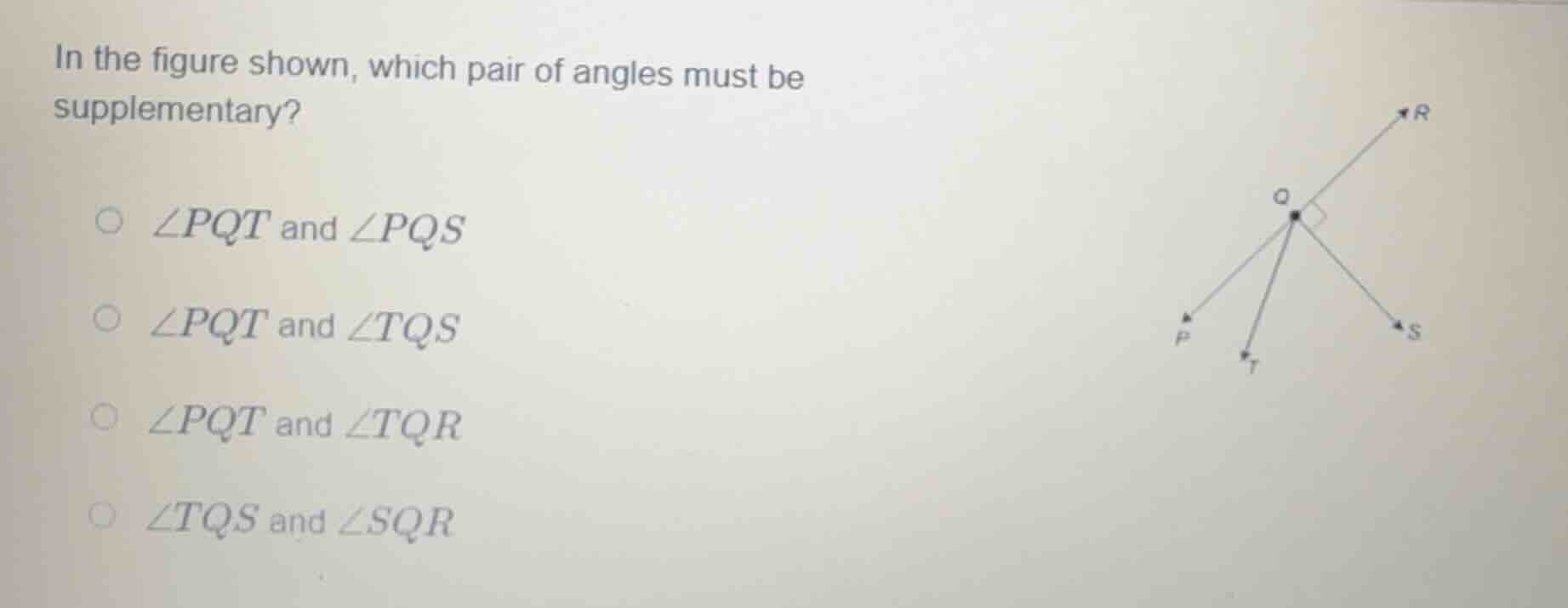
in the figure shown, which pair of angles must be supplementary?
∠pqt and ∠pqs
∠pqt and ∠tqs
∠pqt and ∠tqr
∠tqs and ∠sqr
Brief Explanations
To determine which pair of angles is supplementary (sum to \(180^\circ\)), we analyze each option:
- \(\angle PQT\) and \(\angle PQS\): These share a common side but do not form a linear pair or sum to \(180^\circ\) (no indication of a straight line or \(180^\circ\) relationship).
- \(\angle PQT\) and \(\angle TQS\): These are adjacent but likely sum to less than \(180^\circ\) (e.g., could be complementary or part of a smaller angle).
- \(\angle PQT\) and \(\angle TQR\): Notice \(\angle SQR\) is a right angle (\(90^\circ\)), and \(PR\) is a straight line (so \(\angle PQR = 180^\circ\)). \(\angle PQT + \angle TQS + \angle SQR = 180^\circ\), but more directly, \(\angle PQT + \angle TQR\): Since \(PR\) is straight, \(\angle PQR = 180^\circ\), and \(\angle TQR\) includes the right angle. Wait, re - evaluating: The key is that \(\angle PQT\) and \(\angle TQR\) form a linear pair along the straight line \(PR\)? Wait, no, let's look at the right angle. Wait, the correct pair: \(\angle PQT\) and \(\angle TQR\) – wait, no, let's check the last option: \(\angle TQS\) and \(\angle SQR\): \(\angle SQR\) is \(90^\circ\), \(\angle TQS\) is not necessarily \(90^\circ\). Wait, no, the correct pair is \(\angle PQT\) and \(\angle TQR\)? Wait, no, let's re - examine the diagram. The straight line is \(PR\), so \(\angle PQR = 180^\circ\). \(\angle PQR=\angle PQT+\angle TQS+\angle SQR\), but \(\angle SQR = 90^\circ\). Wait, maybe I made a mistake. Wait, the first option: \(\angle PQT\) and \(\angle PQS\) – no. Wait, the correct answer is \(\angle PQT\) and \(\angle TQR\)? Wait, no, let's think about supplementary angles (sum to \(180^\circ\)). A linear pair of angles is supplementary. Looking at the diagram, \(PR\) is a straight line, so \(\angle PQT\) and \(\angle TQR\) form a linear pair? Wait, no, \(\angle TQR\) has a right angle. Wait, maybe the correct pair is \(\angle PQT\) and \(\angle TQR\). Wait, no, let's check the options again. Wait, the third option is \(\angle PQT\) and \(\angle TQR\). Let's confirm: If \(PR\) is a straight line, then \(\angle PQR = 180^\circ\), and \(\angle PQR=\angle PQT+\angle TQR\) (assuming \(QT\) and \(QS\) are such that \(\angle TQS\) is part of it, but maybe the diagram shows that \(\angle SQR\) is \(90^\circ\), so \(\angle PQT+\angle TQR = 180^\circ\) (since \(\angle PQR = 180^\circ\)). Wait, maybe the correct answer is \(\angle PQT\) and \(\angle TQR\).

Snap & solve any problem in the app
Get step-by-step solutions on Sovi AI
Photo-based solutions with guided steps
Explore more problems and detailed explanations
\(\boldsymbol{\angle PQT}\) and \(\boldsymbol{\angle TQR}\) (the third option: \(\angle PQT\) and \(\angle TQR\))