QUESTION IMAGE
Question
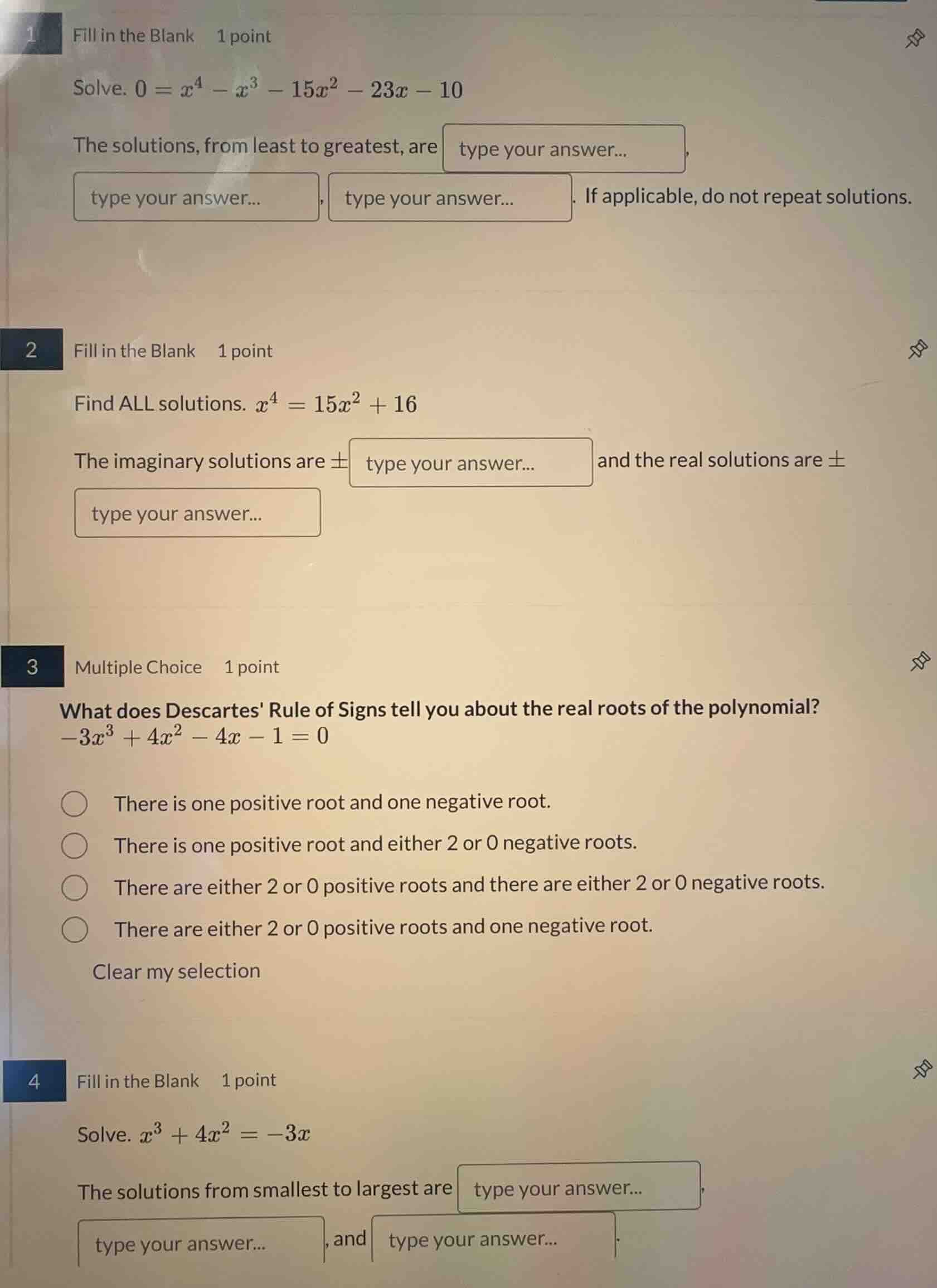
1 fill in the blank 1 point solve. $0 = x^4 - x^3 - 15x^2 - 23x - 10$ the solutions, from least to greatest, are type your answer..., type your answer..., type your answer.... if applicable, do not repeat solutions. 2 fill in the blank 1 point find all solutions. $x^4 = 15x^2 + 16$ the imaginary solutions are $pm$ type your answer... and the real solutions are $pm$ type your answer.... 3 multiple choice 1 point what does descartes rule of signs tell you about the real roots of the polynomial? $-3x^3 + 4x^2 - 4x - 1 = 0$ $\bigcirc$ there is one positive root and one negative root. $\bigcirc$ there is one positive root and either 2 or 0 negative roots. $\bigcirc$ there are either 2 or 0 positive roots and there are either 2 or 0 negative roots. $\bigcirc$ there are either 2 or 0 positive roots and one negative root. clear my selection 4 fill in the blank 1 point solve. $x^3 + 4x^2 = -3x$ the solutions from smallest to largest are type your answer..., type your answer..., and type your answer....
Question 1
Step1: Try rational roots
By Rational Root Theorem, possible roots are $\pm1,\pm2,\pm5,\pm10$. Test $x = -1$: $(-1)^4 - (-1)^3 - 15(-1)^2 - 23(-1) - 10 = 1 + 1 - 15 + 23 - 10 = 0$. So $x = -1$ is a root.
Step2: Factor out $(x + 1)$
Using polynomial division or synthetic division, divide $x^4 - x^3 - 15x^2 - 23x - 10$ by $(x + 1)$. We get $x^3 - 2x^2 - 13x - 10$.
Step3: Factor the cubic
Test $x = -1$ again on the cubic: $(-1)^3 - 2(-1)^2 - 13(-1) - 10 = -1 - 2 + 13 - 10 = 0$. So $x = -1$ is a root again. Divide the cubic by $(x + 1)$ to get $x^2 - 3x - 10$.
Step4: Factor the quadratic
Factor $x^2 - 3x - 10 = (x - 5)(x + 2)$.
Step5: Find all roots
The roots are from $(x + 1)^2(x - 5)(x + 2) = 0$. So roots are $x = -2, -1, -1, 5$. Removing duplicate, from least to greatest: $-2, -1, 5$. Wait, wait, wait, let's check again. Wait, when we factor $x^4 - x^3 - 15x^2 - 23x - 10$, after finding $x=-1$ twice? Wait no, let's do synthetic division properly.
First, for $x^4 - x^3 - 15x^2 - 23x - 10$ with root $x=-1$:
Coefficients: 1 | -1 | -15 | -23 | -10
Bring down 1. Multiply by -1: -1. Add to -1: -2. Multiply by -1: 2. Add to -15: -13. Multiply by -1: 13. Add to -23: -10. Multiply by -1: 10. Add to -10: 0. So quotient is $x^3 - 2x^2 - 13x - 10$.
Now factor $x^3 - 2x^2 - 13x - 10$. Try $x=-1$ again:
Coefficients: 1 | -2 | -13 | -10
Bring down 1. Multiply by -1: -1. Add to -2: -3. Multiply by -1: 3. Add to -13: -10. Multiply by -1: 10. Add to -10: 0. So quotient is $x^2 - 3x - 10$. Factor $x^2 - 3x - 10 = (x - 5)(x + 2)$. So the polynomial factors as $(x + 1)^2(x - 5)(x + 2)$. So roots are $x = -2, -1, -1, 5$. So unique roots (excluding repeat) from least to greatest: $-2, -1, 5$. Wait, but the problem says "do not repeat solutions", so the solutions are $-2, -1, 5$? Wait no, wait the original equation is degree 4, so there are 4 roots, but two are -1. So when listing from least to greatest, we have -2, -1, -1, 5. But the problem says "do not repeat solutions" if applicable. Wait, the problem says "If applicable, do not repeat solutions." So maybe they consider distinct roots? Wait, no, let's check the equation again. Wait, maybe I made a mistake in factoring. Let's use another method. Let's graph or check values. Wait, when $x=-2$: $(-2)^4 - (-2)^3 -15(-2)^2 -23(-2) -10 = 16 + 8 - 60 + 46 -10 = 0$. Correct. $x=-1$: 1 +1 -15 +23 -10=0. Correct. $x=5$: 625 - 125 - 375 - 115 -10=625-125=500; 500-375=125; 125-115=10; 10-10=0. Correct. So the roots are -2, -1, -1, 5. So from least to greatest, excluding repeats? Wait, the problem says "do not repeat solutions" if applicable. So maybe the solutions are -2, -1, 5? Wait, but the equation is quartic, so four roots, but two are -1. So maybe the answer is -2, -1, 5? Wait, no, the problem has three boxes? Wait the original problem says "the solutions, from least to greatest, are [box], [box], [box]". Wait, maybe I missed a root. Wait, let's factor again. Wait, $x^4 - x^3 -15x^2 -23x -10$. Let's try $x=5$: 625 - 125 - 375 - 115 -10=0. Correct. $x=-2$: 16 + 8 - 60 + 46 -10=0. Correct. $x=-1$: 1 +1 -15 +23 -10=0. Correct. So the roots are -2, -1, -1, 5. So three distinct roots, but four roots total. So the problem's boxes: maybe three? Wait, maybe I made a mistake in factoring. Wait, let's use grouping. $x^4 - x^3 -15x^2 -23x -10$. Let's write as $x^4 + x^3 - 2x^3 - 2x^2 -13x^2 -13x -10x -10$. Group: $x^3(x + 1) - 2x^2(x + 1) -13x(x + 1) -10(x + 1) = (x + 1)(x^3 - 2x^2 -13x -10)$. Then factor $x^3 - 2x^2 -13x -10$ as $(x + 1)(x^2 - 3x -10) = (x + 1)(x - 5)(x + 2)$. So overall, $(x + 1)^2(…
Step1: Rewrite the equation
Rewrite $x^4 = 15x^2 + 16$ as $x^4 - 15x^2 - 16 = 0$.
Step2: Let $y = x^2$
Substitute to get $y^2 - 15y - 16 = 0$.
Step3: Factor the quadratic
Factor $y^2 - 15y - 16 = (y - 16)(y + 1) = 0$.
Step4: Solve for y
$y = 16$ or $y = -1$.
Step5: Solve for x
For $y = 16$: $x^2 = 16 \implies x = \pm 4$. For $y = -1$: $x^2 = -1 \implies x = \pm i$. So imaginary solutions are $\pm i$ (so the box for imaginary is $i$) and real solutions are $\pm 4$ (so the box for real is $4$).
Descartes' Rule of Signs: For positive roots, count the number of sign changes in $f(x) = -3x^3 + 4x^2 - 4x - 1$. The coefficients are -3, +4, -4, -1. Sign changes: -3 to +4 (1), +4 to -4 (2), -4 to -1 (0). So number of positive roots is 2 or 0 (since we subtract 2 until non-negative). For negative roots, consider $f(-x) = -3(-x)^3 + 4(-x)^2 - 4(-x) - 1 = 3x^3 + 4x^2 + 4x - 1$. Coefficients: 3, +4, +4, -1. Sign change: +4 to -1? Wait no, 3 to 4 (no), 4 to 4 (no), 4 to -1 (1). So number of negative roots is 1 (since 1 - 2 is negative, so only 1). So the correct option is "There are either 2 or 0 positive roots and one negative root."

Snap & solve any problem in the app
Get step-by-step solutions on Sovi AI
Photo-based solutions with guided steps
Explore more problems and detailed explanations
-2, -1, 5