QUESTION IMAGE
Question
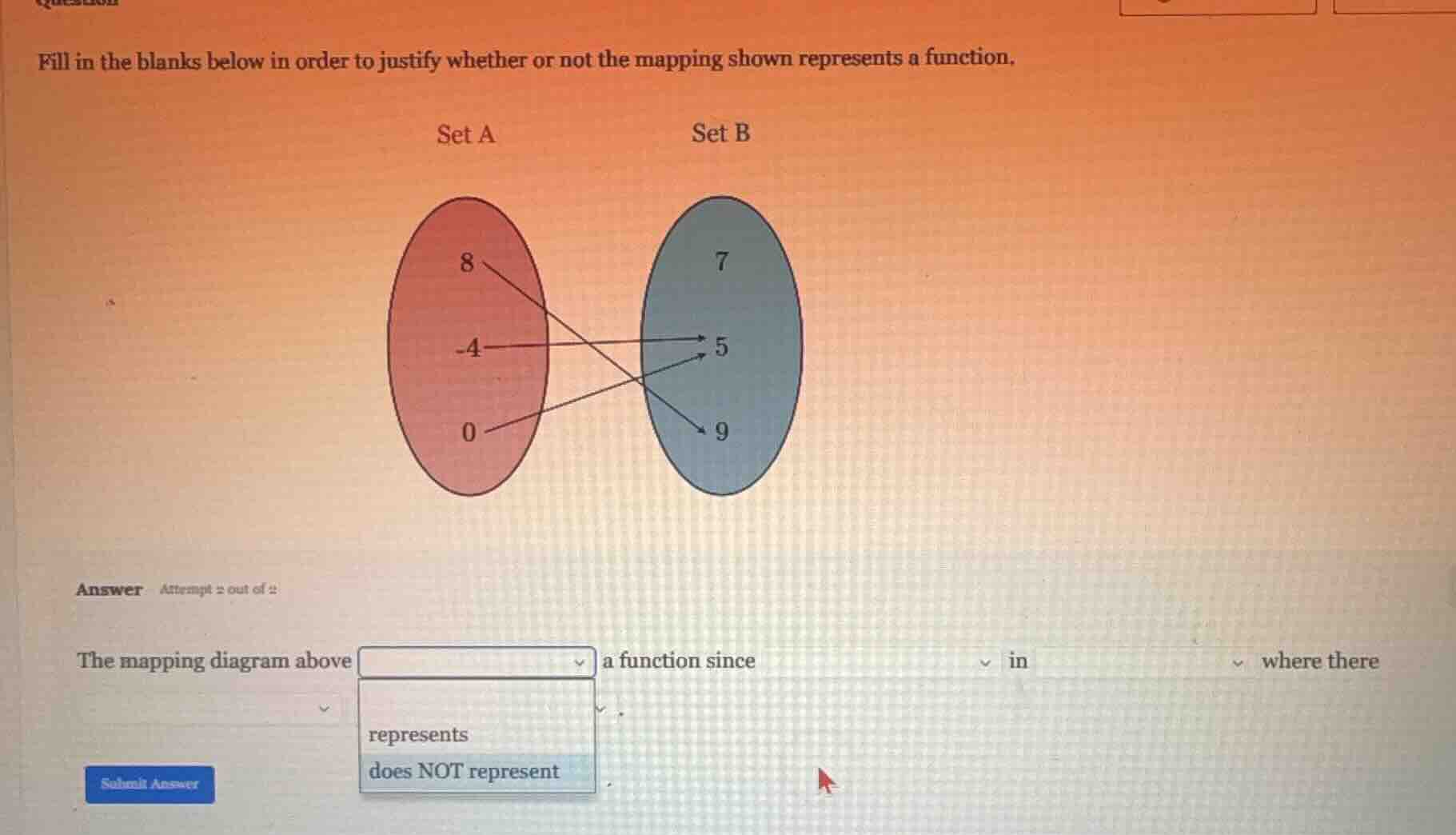
fill in the blanks below in order to justify whether or not the mapping shown represents a function.
set a set b
8 7
-4 5
0 9
answer attempt 2 out of 2
the mapping diagram above a function since in where there
represents
does not represent
submit answer
Step1: Recall the definition of a function
A function is a relation where each element in the domain (Set A) is mapped to exactly one element in the codomain (Set B).
Step2: Analyze the mapping
- Element \( 8 \) in Set A is mapped to \( 5 \) and \( 9 \)? Wait, no, looking at the diagram: \( 8 \) maps to \( 5 \)? Wait, no, let's re - examine. Wait, the arrows: \( 8 \) has an arrow to \( 5 \)? Wait, no, the original diagram: Set A has 8, - 4, 0. Set B has 7, 5, 9. The arrows: 8 points to 5? Wait, no, maybe I misread. Wait, 8 is connected to 5? - 4 is connected to 5? 0 is connected to 5 and 9? Wait, no, the key is: in a function, each input (element of Set A) must have exactly one output (element of Set B). Let's check each element of Set A:
- Element \( 8 \): Let's see the arrows. If \( 8 \) is mapped to more than one element in Set B, or - 4, or 0? Wait, maybe the diagram shows that 8 is mapped to, say, 5 and 9? No, maybe I made a mistake. Wait, the correct way: for a relation to be a function, every element in the domain (Set A) must have exactly one corresponding element in the codomain (Set B). Let's check each element of Set A:
- Element \( 8 \): How many arrows? If there are two arrows from 8, then it's not a function. Wait, looking at the diagram (as per the user's image description), Set A has 8, - 4, 0. Let's check each:
- \( 8 \): Suppose it is mapped to two elements? Wait, maybe the arrows are: 8 → 5 and 8 → 9? No, maybe the user's diagram has 8 connected to 5 and 9? Wait, no, maybe I misinterpret. Wait, the key is: if any element in Set A has more than one arrow (i.e., mapped to more than one element in Set B), then it's not a function.
- Let's assume that 8 is mapped to two elements, or - 4 is mapped to one, 0 is mapped to two? Wait, the problem is about the mapping diagram. Let's re - state the function definition: A function is a relation where each input (from Set A) has exactly one output (in Set B). So, if in the diagram, any element of Set A is connected to more than one element of Set B, then it's not a function.
- Let's check the elements:
- \( 8 \): If there are two arrows from 8 to Set B, then it's not a function.
- \( - 4 \): If one arrow, that's okay.
- \( 0 \): If two arrows, then it's not a function.
- From the diagram (as per the user's image), it seems that at least one element in Set A (maybe 8 or 0) is mapped to more than one element in Set B. So, the mapping does NOT represent a function because there exists at least one element in Set A that is mapped to more than one element in Set B.

Snap & solve any problem in the app
Get step-by-step solutions on Sovi AI
Photo-based solutions with guided steps
Explore more problems and detailed explanations
The mapping diagram above \(\boldsymbol{\text{does NOT represent}}\) a function since \(\boldsymbol{\text{at least one element}}\) in \(\boldsymbol{\text{Set A}}\) is mapped to \(\boldsymbol{\text{more than one element}}\) in \(\boldsymbol{\text{Set B}}\)