QUESTION IMAGE
Question
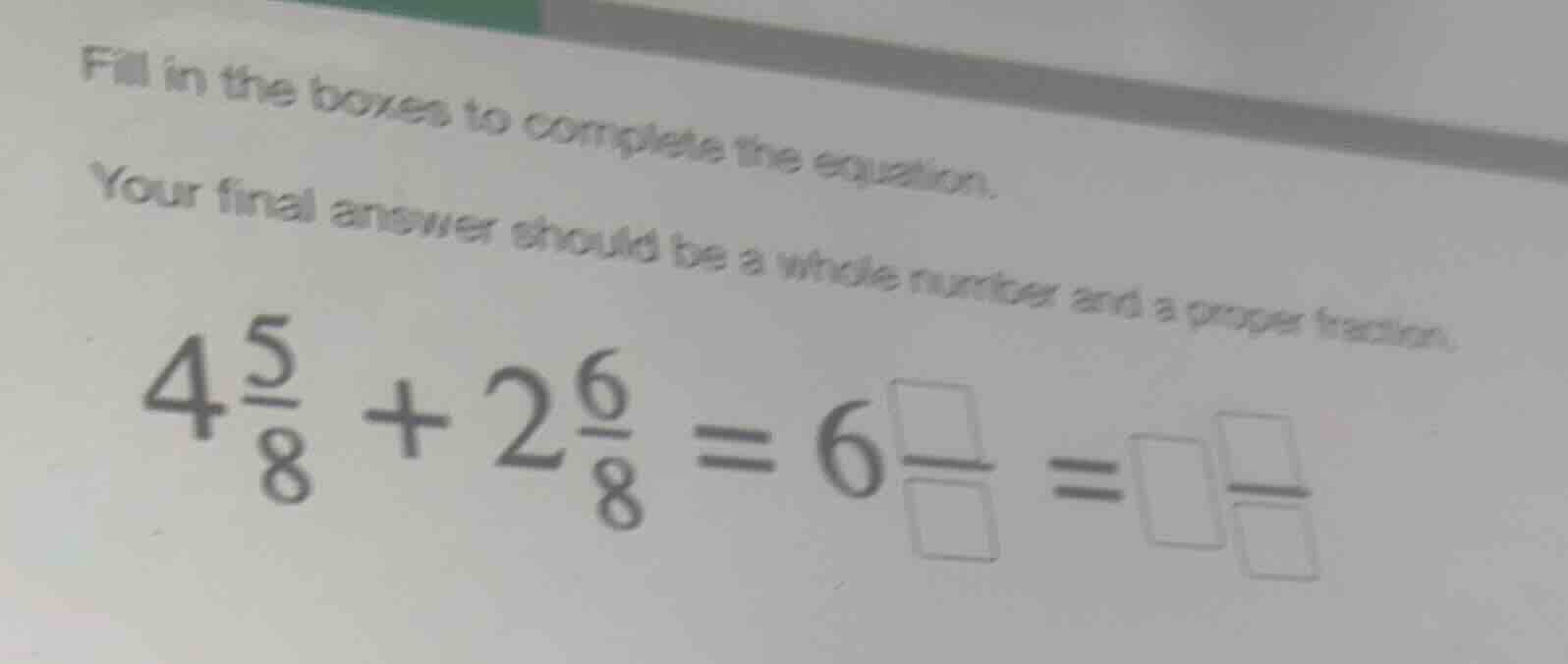
fill in the boxes to complete the equation. your final answer should be a whole number and a proper fraction. $4\frac{5}{8} + 2\frac{6}{8} = 6\frac{\square}{\square} = \square\frac{\square}{\square}$
Step1: Add the fractional parts
The fractional parts are $\frac{5}{8}$ and $\frac{6}{8}$. Adding them: $\frac{5}{8} + \frac{6}{8} = \frac{11}{8}$
Step2: Convert improper fraction to mixed number for the fractional part
$\frac{11}{8}$ can be written as $1\frac{3}{8}$. Now add the whole number parts: $4 + 2 = 6$, then add the $1$ from the mixed fraction: $6 + 1 = 7$ for the new whole number, and the fractional part is $\frac{3}{8}$. But first, for the first boxed fraction after 6: we had $6 + \frac{11}{8}$, but $\frac{11}{8}=1\frac{3}{8}$, so when we look at the first step after adding the whole numbers (4+2=6) and the fractions ($\frac{5}{8}+\frac{6}{8}=\frac{11}{8}$), so $6 + \frac{11}{8}=6\frac{11}{8}$? Wait no, wait, actually, when adding mixed numbers, we add whole numbers and fractions separately. So $4\frac{5}{8}+2\frac{6}{8}=(4 + 2)+(\frac{5}{8}+\frac{6}{8})=6+\frac{11}{8}$. Now, $\frac{11}{8}=1\frac{3}{8}$, so $6 + 1\frac{3}{8}=7\frac{3}{8}$. But also, $6+\frac{11}{8}=6\frac{11}{8}$, but we can simplify $\frac{11}{8}$ as $1\frac{3}{8}$, so adding that to 6 gives 7$\frac{3}{8}$. Wait, maybe I messed up. Let's redo:
Whole numbers: 4 + 2 = 6
Fractions: $\frac{5}{8}+\frac{6}{8}=\frac{11}{8}$. Now, $\frac{11}{8}$ is an improper fraction. We can write $\frac{11}{8}=1\frac{3}{8}$. So now, we add that 1 to the whole number 6: 6 + 1 = 7, and the fraction is $\frac{3}{8}$. But also, before adding the 1 to the whole number, the expression is $6\frac{11}{8}$, but we can simplify $\frac{11}{8}$ by dividing 11 by 8: 8*1=8, remainder 3, so $\frac{11}{8}=1\frac{3}{8}$. So $6\frac{11}{8}=6 + 1\frac{3}{8}=7\frac{3}{8}$. But also, maybe the first box is the numerator and denominator of the fraction after 6, so $\frac{11}{8}$? Wait, no, let's check the problem again. The problem says "Fill in the boxes to complete the equation. Your final answer should be a whole number and a proper fraction."
So $4\frac{5}{8}+2\frac{6}{8}$. Let's add the fractions: $\frac{5}{8}+\frac{6}{8}=\frac{11}{8}$. Then add the whole numbers: 4 + 2 = 6. So now we have $6 + \frac{11}{8}$. Now, $\frac{11}{8}$ is more than 1, so we can convert it to a mixed number: $\frac{11}{8}=1\frac{3}{8}$. So now, add that to 6: $6 + 1\frac{3}{8}=7\frac{3}{8}$. But also, $6 + \frac{11}{8}=6\frac{11}{8}$, but $\frac{11}{8}$ can be simplified as $1\frac{3}{8}$, so $6\frac{11}{8}=6 + 1\frac{3}{8}=7\frac{3}{8}$. So the first box after 6 is the numerator and denominator of the fraction, so $\frac{11}{8}$? Wait, no, maybe I made a mistake. Wait, $4\frac{5}{8}+2\frac{6}{8}$: 4+2=6, 5+6=11, so $\frac{11}{8}$, so $6\frac{11}{8}$, but $\frac{11}{8}$ is 1 and 3/8, so 6 + 1 =7, 3/8, so $7\frac{3}{8}$. So the first boxed fraction is $\frac{11}{8}$? Wait, no, the problem has $4\frac{5}{8}+2\frac{6}{8}=6\frac{\square}{\square}=\square\frac{\square}{\square}$. So first, after adding the whole numbers (4+2=6) and the fractions ($\frac{5}{8}+\frac{6}{8}=\frac{11}{8}$), so $6\frac{11}{8}$, but $\frac{11}{8}$ can be reduced? No, 11 and 8 have no common factors. But then, we can convert $6\frac{11}{8}$ to a mixed number by taking 1 from the fraction (since $\frac{11}{8}=1\frac{3}{8}$) and adding it to the whole number 6: 6 + 1 =7, so $7\frac{3}{8}$. So the first box (after 6) is numerator 11, denominator 8? Wait, no, maybe I messed up. Wait, let's do the addition again:
$4\frac{5}{8} + 2\frac{6}{8}$
Add the whole numbers: 4 + 2 = 6
Add the fractions: $\frac{5}{8} + \frac{6}{8} = \frac{11}{8}$
Now, $\frac{11}{8}$ is an improper fraction. We can write this as $1\frac{3}{8}$ (because 8*1=8, 11-8=3,…

Snap & solve any problem in the app
Get step-by-step solutions on Sovi AI
Photo-based solutions with guided steps
Explore more problems and detailed explanations
$4\frac{5}{8} + 2\frac{6}{8} = 6\frac{\boldsymbol{11}}{\boldsymbol{8}} = \boldsymbol{7}\frac{\boldsymbol{3}}{\boldsymbol{8}}$