QUESTION IMAGE
Question
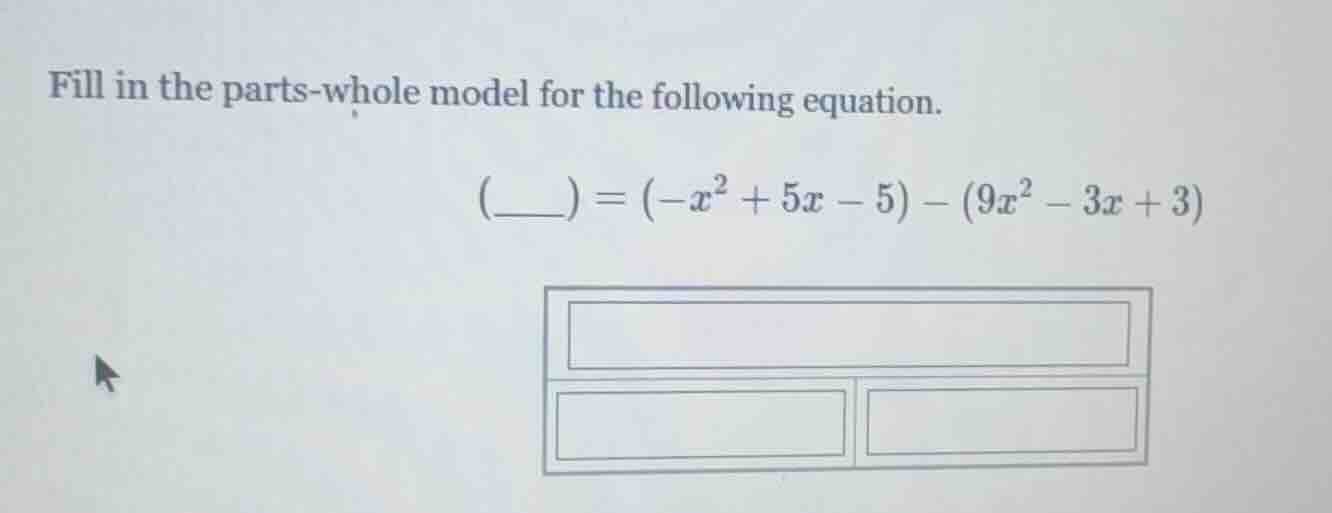
fill in the parts - whole model for the following equation.
\\((\\_\\_\\_\\_) = (-x^2 + 5x - 5) - (9x^2 - 3x + 3)\\)
there is a parts - whole model diagram with a large rectangle at the top and two small rectangles at the bottom
Step1: Distribute the negative sign
To subtract the polynomial \(9x^2 - 3x + 3\), we distribute the negative sign to each term inside the parentheses:
\((-x^2 + 5x - 5) - (9x^2 - 3x + 3)=-x^2 + 5x - 5 - 9x^2 + 3x - 3\)
Step2: Combine like terms
- For the \(x^2\) terms: \(-x^2-9x^2 = -10x^2\)
- For the \(x\) terms: \(5x + 3x = 8x\)
- For the constant terms: \(-5-3=-8\)
Putting it all together, we get: \(-10x^2 + 8x - 8\)

Snap & solve any problem in the app
Get step-by-step solutions on Sovi AI
Photo-based solutions with guided steps
Explore more problems and detailed explanations
The missing polynomial is \(\boldsymbol{-10x^2 + 8x - 8}\). In the parts - whole model, the top rectangle (the whole) is \(-10x^2 + 8x - 8\), and the two bottom rectangles (the parts) are \(-x^2 + 5x - 5\) and \(-(9x^2 - 3x + 3)\) (or expanded as \(-9x^2+3x - 3\)).