QUESTION IMAGE
Question
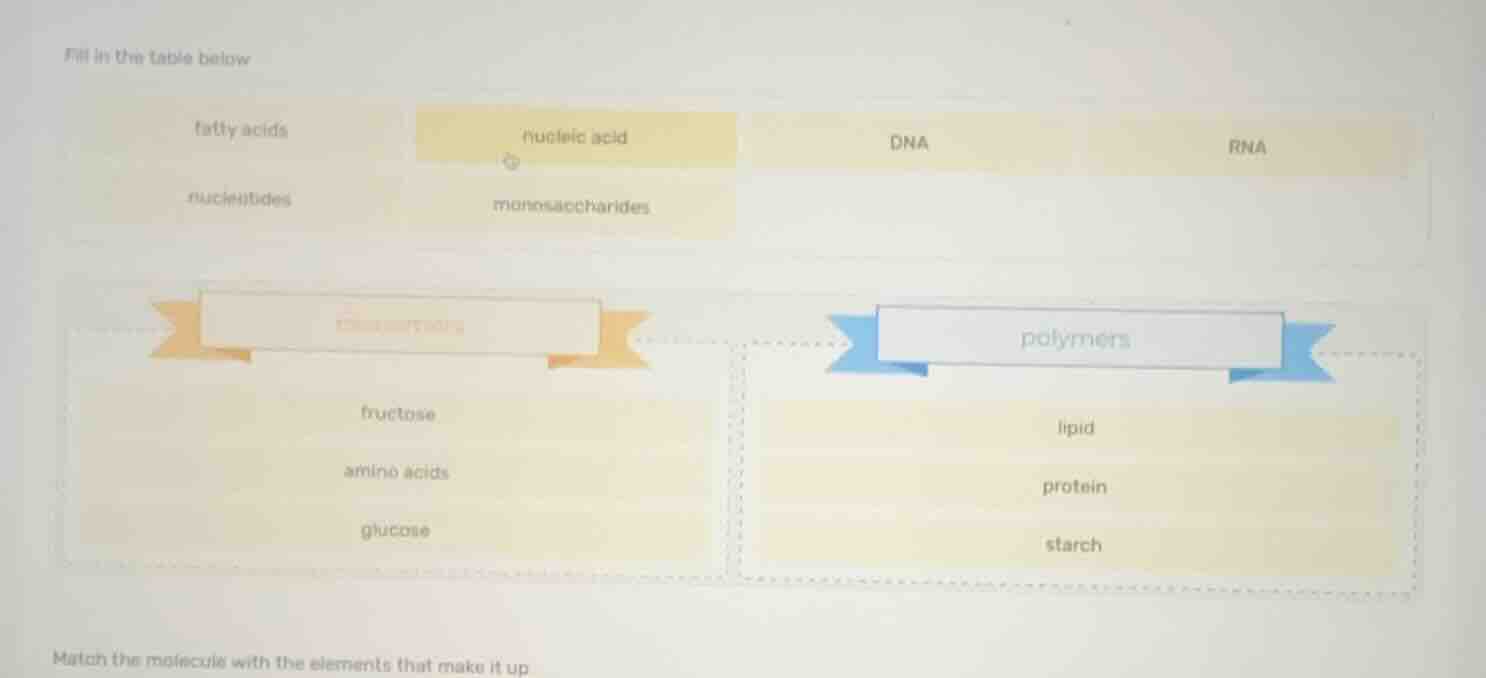
fill in the table below
fatty acids
nucleic acid
dna
rna
nucleotides
monosaccharides
polymers
fructose
lipid
amino acids
protein
glucose
starch
match the molecule with the elements that make it up
Brief Explanations
First, classify molecules into monomers (building blocks) and polymers (large molecules made of monomers):
- Monomers: These are the small, repeating subunits that form polymers.
- Fatty acids are subunits for lipids; nucleotides are subunits for nucleic acids; monosaccharides (fructose, glucose) are subunits for carbohydrates; amino acids are subunits for proteins.
- Polymers: These are large molecules formed by linking monomers.
- Lipids are formed from fatty acids; proteins from amino acids; starch (a carbohydrate) from monosaccharides; nucleic acids (DNA, RNA) from nucleotides.
Then, match each molecule to its constituent elements (standard biological composition):
- Carbohydrates (fructose, glucose, starch): Composed of carbon (C), hydrogen (H), oxygen (O)
- Lipids (fatty acids, lipid): Composed of carbon (C), hydrogen (H), oxygen (O) (some have phosphorus)
- Proteins (amino acids, protein): Composed of carbon (C), hydrogen (H), oxygen (O), nitrogen (N) (some have sulfur)
- Nucleic Acids (nucleotides, nucleic acid, DNA, RNA): Composed of carbon (C), hydrogen (H), oxygen (O), nitrogen (N), phosphorus (P)

Snap & solve any problem in the app
Get step-by-step solutions on Sovi AI
Photo-based solutions with guided steps
Explore more problems and detailed explanations
Monomers & Polymers Classification
| Monomers | Polymers |
|---|---|
| nucleotides | nucleic acid (DNA, RNA) |
| monosaccharides (fructose, glucose) | starch |
| amino acids | protein |
Molecule-Element Matching
- Fructose, Glucose, Starch: C, H, O
- Fatty Acids, Lipid: C, H, O
- Amino Acids, Protein: C, H, O, N
- Nucleotides, Nucleic Acid, DNA, RNA: C, H, O, N, P