QUESTION IMAGE
Question
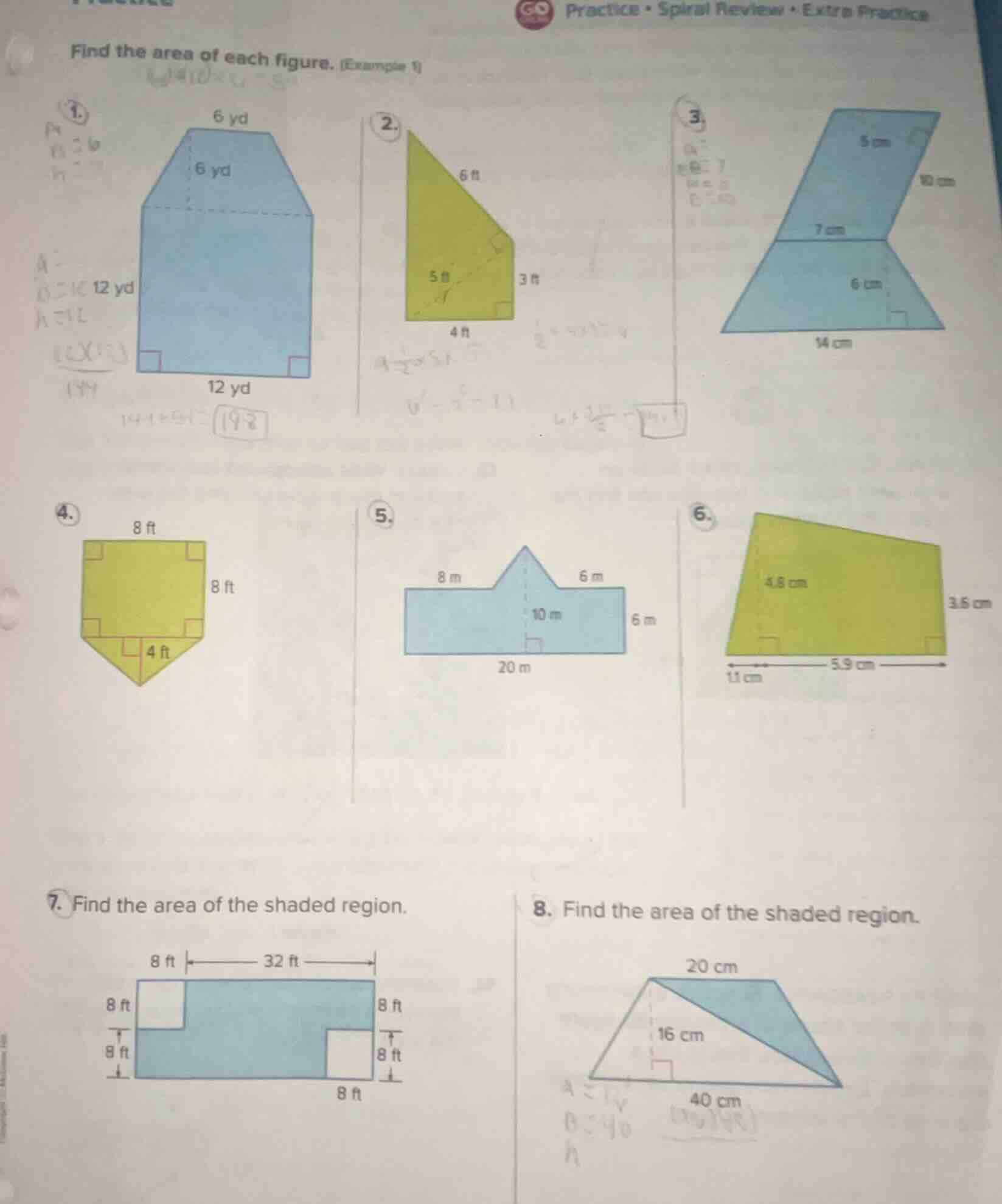
find the area of each figure. (example 1)
1.
2.
3.
4.
5.
6.
- find the area of the shaded region.
- find the area of the shaded region.
Let's solve problem 1 first:
The figure is composed of a trapezoid (or a hexagon? Wait, no, looking at the diagram: it's a rectangle and a trapezoid? Wait, no, the top part is a trapezoid with bases 6 yd and 12 yd, height 6 yd, and the bottom part is a square (or rectangle) with side 12 yd and height 12 yd? Wait, no, the diagram shows: the top figure is a trapezoid (bases 6 yd and 12 yd, height 6 yd) and the bottom is a rectangle (length 12 yd, height 12 yd). Wait, actually, the total figure is a combination of a trapezoid (top) and a rectangle (bottom).
Step 1: Area of the trapezoid
The formula for the area of a trapezoid is \( A = \frac{(a + b)h}{2} \), where \( a \) and \( b \) are the lengths of the two parallel sides (bases), and \( h \) is the height (the perpendicular distance between the bases).
Here, \( a = 6 \) yd, \( b = 12 \) yd, \( h = 6 \) yd.
So, area of trapezoid \( = \frac{(6 + 12) \times 6}{2} = \frac{18 \times 6}{2} = 54 \) square yards.
Step 2: Area of the rectangle
The formula for the area of a rectangle is \( A = l \times w \), where \( l \) is the length and \( w \) is the width.
Here, \( l = 12 \) yd, \( w = 12 \) yd.
So, area of rectangle \( = 12 \times 12 = 144 \) square yards.
Step 3: Total area
Add the area of the trapezoid and the area of the rectangle.
Total area \( = 54 + 144 = 198 \) square yards.
Step 1: Area of the parallelogram
The formula for the area of a parallelogram is \( A = base \times height \).
Here, \( base = 7 \) cm, \( height = 5 \) cm.
So, area of parallelogram \( = 7 \times 5 = 35 \) cm².
Step 2: Area of the trapezoid
The formula for the area of a trapezoid is \( A = \frac{(a + b)h}{2} \), where \( a = 7 \) cm (top base), \( b = 14 \) cm (bottom base), and \( h = 6 \) cm (height).
So, area of trapezoid \( = \frac{(7 + 14) \times 6}{2} = \frac{21 \times 6}{2} = 63 \) cm².
Step 3: Total area
Add the area of the parallelogram and the area of the trapezoid.
Total area \( = 35 + 63 = 98 \) cm².

Snap & solve any problem in the app
Get step-by-step solutions on Sovi AI
Photo-based solutions with guided steps
Explore more problems and detailed explanations
The area of the figure is \( \boxed{198} \) square yards.
Now problem 2:
The figure is a combination of a triangle and a rectangle? Wait, the diagram shows a right triangle? Wait, no, the figure has a right angle at the bottom, with base 4 ft, height 3 ft (the vertical side), and then a slanted side. Wait, maybe it's a trapezoid? Wait, the figure has sides: 4 ft (base), 3 ft (vertical), 5 ft (slant), 6 ft (hypotenuse). Wait, maybe it's a trapezoid with bases 3 ft and 6 ft? No, better to split it into a rectangle and a triangle. Wait, the bottom part is a rectangle with length 4 ft and height 3 ft, and the top part is a triangle with base 4 ft and height (6 - 3) = 3 ft? Wait, no, the area of a trapezoid: the formula for the area of a trapezoid is \( \frac{(a + b)h}{2} \), where \( a \) and \( b \) are the two parallel sides. Wait, the figure has two parallel sides: 3 ft and 6 ft? No, maybe it's a triangle and a rectangle. Wait, the area can also be calculated as the area of a trapezoid with bases 3 ft and 6 ft, and height 4 ft? Wait, no, let's check the coordinates. Wait, the figure is a trapezoid with bases 3 ft (the vertical side) and 6 ft (the slanted side? No, that's not parallel. Wait, maybe it's a right trapezoid? Wait, the right angle is at the bottom, so the two parallel sides are the vertical side (3 ft) and the top side (6 ft)? No, that's not parallel. Wait, maybe the figure is a triangle with base 4 ft and height (3 + 6) = 9 ft? No, that doesn't make sense. Wait, the correct way: the figure is a trapezoid with bases 3 ft and 6 ft, and height 4 ft? Wait, no, let's use the formula for the area of a trapezoid: \( A = \frac{(a + b)h}{2} \), where \( a \) and \( b \) are the lengths of the two parallel sides (the two sides that are parallel), and \( h \) is the distance between them (the height, which is perpendicular to both). Looking at the diagram, the two parallel sides are 3 ft (the vertical side) and 6 ft (the top side)? No, that's not parallel. Wait, maybe it's a triangle and a rectangle. The bottom part is a rectangle with length 4 ft and height 3 ft (area = 43 = 12). The top part is a triangle with base 4 ft and height (6 - 3) = 3 ft? Wait, no, the area of the triangle would be (43)/2 = 6. Then total area is 12 + 6 = 18? Wait, but let's check with the trapezoid formula. If we consider the two parallel sides as 3 ft and 6 ft, and the height (the horizontal distance) as 4 ft, then area is (3 + 6)*4/2 = 18. Yes, that works. So:
Step 1: Identify the trapezoid
Bases \( a = 3 \) ft, \( b = 6 \) ft, height \( h = 4 \) ft.
Step 2: Apply the trapezoid area formula
\( A = \frac{(3 + 6) \times 4}{2} = \frac{9 \times 4}{2} = 18 \) square feet.