QUESTION IMAGE
Question
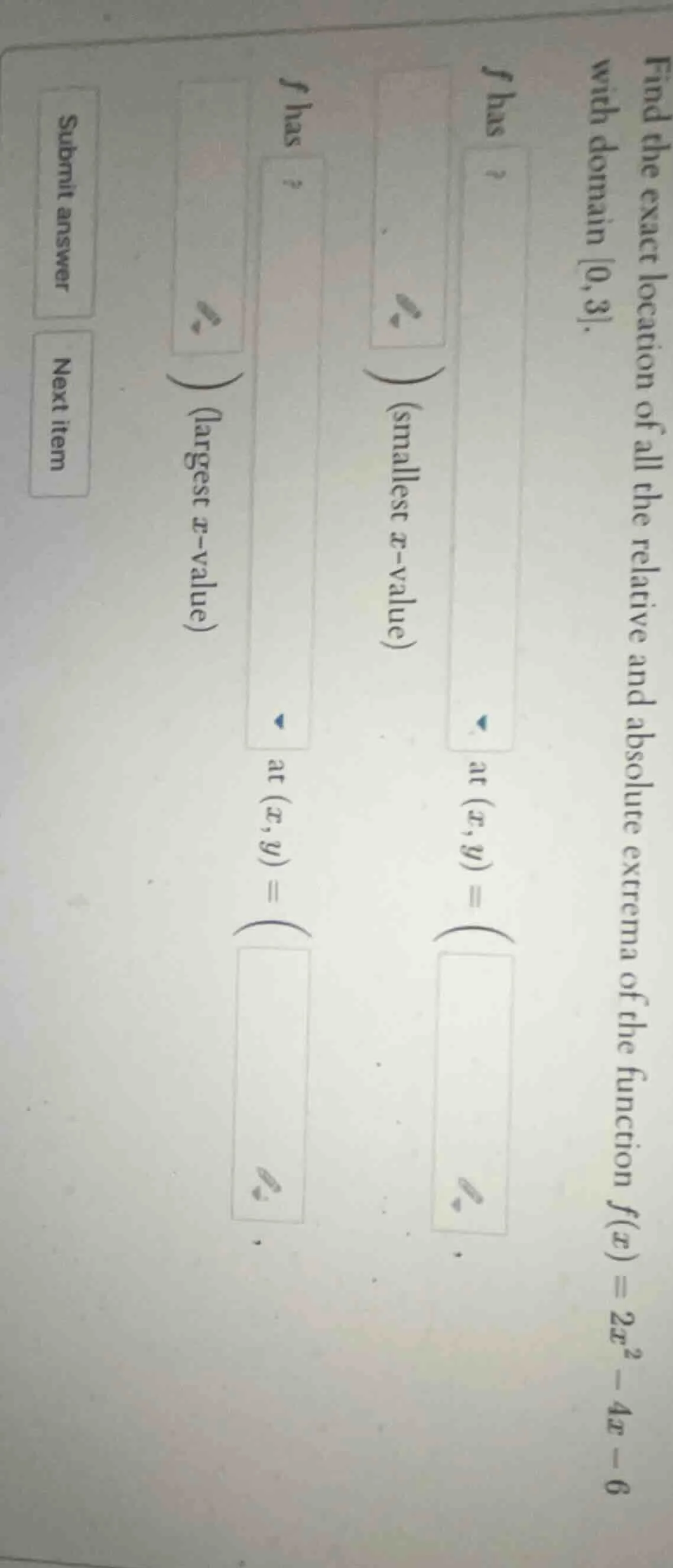
find the exact location of all the relative and absolute extrema of the function ( f(x) = 2x^2 - 4x - 6 ) with domain (0, 3).
( f ) has? (smallest ( x )-value) at ( (x, y) = (quad)
( f ) has? (largest ( x )-value) at ( (x, y) = (quad)
submit answer
next item
Step1: Identify the function type
The function \( f(x) = 2x^2 - 4x - 6 \) is a quadratic function. The general form of a quadratic function is \( f(x)=ax^2 + bx + c \), where \( a = 2 \), \( b=-4 \), \( c = -6 \). Since \( a=2>0 \), the parabola opens upwards, so the vertex is the minimum point.
Step2: Find the vertex (critical point)
The x - coordinate of the vertex of a quadratic function \( f(x)=ax^2+bx + c \) is given by \( x=-\frac{b}{2a} \).
Substitute \( a = 2 \) and \( b=-4 \) into the formula:
\( x=-\frac{-4}{2\times2}=\frac{4}{4} = 1 \)
To find the y - coordinate, substitute \( x = 1 \) into the function:
\( f(1)=2(1)^2-4(1)-6=2 - 4 - 6=-8 \)
So the vertex is at \( (1,-8) \).
Step3: Evaluate the function at the endpoints of the domain
The domain is \( [0,3] \).
- When \( x = 0 \):
\( f(0)=2(0)^2-4(0)-6=-6 \)
- When \( x = 3 \):
\( f(3)=2(3)^2-4(3)-6=2\times9-12 - 6=18-12 - 6 = 0 \)
Step4: Compare the values
- For the minimum:
We have \( f(1)=-8 \), \( f(0)=-6 \), \( f(3)=0 \). The smallest value is \( -8 \) at \( x = 1 \). Since the parabola opens upwards, the vertex is the absolute minimum (and also the relative minimum in the interval \( [0,3] \)).
- For the maximum:
Among \( f(0)=-6 \), \( f(1)=-8 \), \( f(3)=0 \), the largest value is \( 0 \) at \( x = 3 \).

Snap & solve any problem in the app
Get step-by-step solutions on Sovi AI
Photo-based solutions with guided steps
Explore more problems and detailed explanations
- \( f \) has a relative minimum (and absolute minimum) at \( (x,y)=(1, - 8) \) (smallest \( x \) - value for minimum).
- \( f \) has an absolute maximum at \( (x,y)=(3,0) \) (largest \( x \) - value for maximum).
For the "smallest \( x \) - value" part (minimum): The function has a relative minimum (and absolute minimum) at \( (1,-8) \).
For the "largest \( x \) - value" part (maximum): The function has an absolute maximum at \( (3,0) \).