QUESTION IMAGE
Question
find the graph of this system of linear inequalities. \\(\
\\)
Step1: Rewrite inequalities in slope - intercept form
For the first inequality \(-x + 3y>6\), we solve for \(y\):
Add \(x\) to both sides: \(3y>x + 6\)
Divide both sides by 3: \(y>\frac{1}{3}x + 2\)
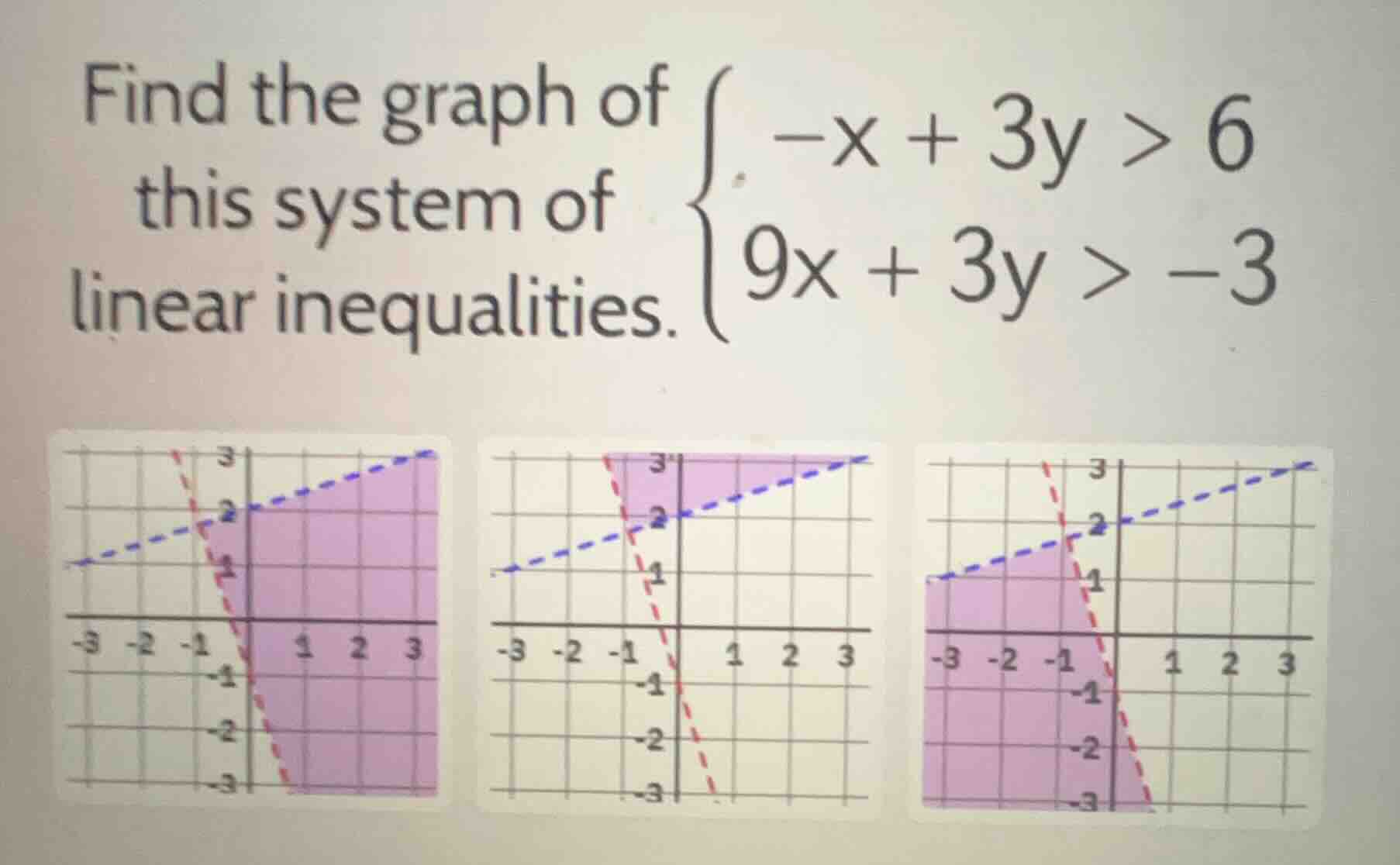
The boundary line is \(y=\frac{1}{3}x + 2\) (dashed line since the inequality is strict, \(>\)) and we shade above the line.
For the second inequality \(9x+3y>-3\), we solve for \(y\):
Subtract \(9x\) from both sides: \(3y>-9x - 3\)
Divide both sides by 3: \(y>-3x - 1\)
The boundary line is \(y = - 3x-1\) (dashed line since the inequality is strict, \(>\)) and we shade above the line.
Step2: Analyze the intersection of the shaded regions
We need to find the region that is above both \(y=\frac{1}{3}x + 2\) and \(y=-3x - 1\).
Let's check the slope - intercept form of the lines. The first line has a slope of \(\frac{1}{3}\) and a \(y\) - intercept of 2. The second line has a slope of \(-3\) and a \(y\) - intercept of \(-1\).
Now, let's analyze the three given graphs:
- The first graph: Check the shading. The region should be above both lines. The first graph's shading seems to be consistent with the region above \(y=\frac{1}{3}x + 2\) and above \(y=-3x - 1\).
- The second graph: The shading is not in the region that is above both lines.
- The third graph: The shading is in the region below \(y=\frac{1}{3}x + 2\) in some parts, so it is incorrect.

Snap & solve any problem in the app
Get step-by-step solutions on Sovi AI
Photo-based solutions with guided steps
Explore more problems and detailed explanations
The first graph (the one with the purple region that is above the line \(y = \frac{1}{3}x+2\) and above the line \(y=-3x - 1\))