QUESTION IMAGE
Question
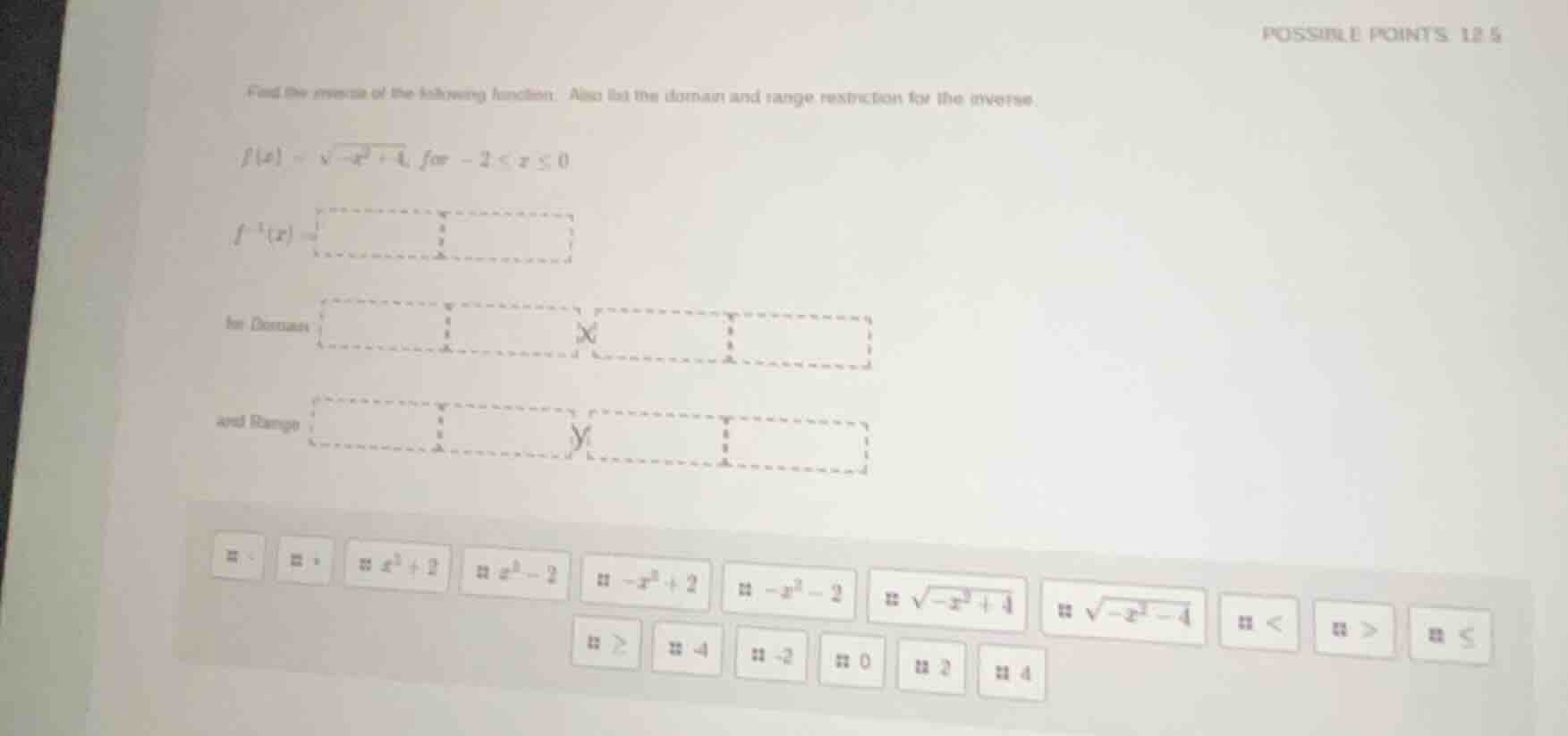
find the inverse of the following function. also list the domain and range restriction for the inverse.
$f(x) = \sqrt{-x^2 + 4}$, for $-2 \leq x \leq 0$
$f^{-1}(x) = \boxed{\quad}$
for domain $\boxed{\quad} \quad \boxed{\quad} \quad \boxed{\quad}$
and range $\boxed{\quad} \quad \boxed{\quad} \quad \boxed{\quad}$
options: $x^2 + 2$, $x^2 - 2$, $-x^2 + 2$, $-x^2 - 2$, $\sqrt{-x^2 + 4}$, $\sqrt{-x^2 - 4}$, $<$, $>$, $\leq$, $\geq$, $-4$, $-2$, $0$, $2$, $4$
Step1: Let \( y = f(x)=\sqrt{-x^{2}+4} \) for \( -2\leq x\leq0 \)
We start by replacing \( f(x) \) with \( y \). So we have \( y=\sqrt{-x^{2}+4} \), and the domain of the original function is \( -2\leq x\leq0 \).
Step2: Swap \( x \) and \( y \)
To find the inverse, we swap \( x \) and \( y \). So we get \( x = \sqrt{-y^{2}+4} \)
Step3: Solve for \( y \)
First, square both sides to get rid of the square root: \( x^{2}=-y^{2}+4 \)
Then, rearrange the equation to solve for \( y^{2} \): \( y^{2}=4 - x^{2} \)
Take the square root of both sides. But we need to consider the domain of the original function (\( -2\leq x\leq0 \)) to determine the sign of \( y \) in the inverse function. The original function \( f(x)=\sqrt{-x^{2}+4} \) for \( -2\leq x\leq0 \) has a range. Let's find the range of \( f(x) \): when \( x = - 2 \), \( y=\sqrt{-(-2)^{2}+4}=\sqrt{0} = 0 \); when \( x = 0 \), \( y=\sqrt{-0^{2}+4}=2 \). So the range of \( f(x) \) is \( 0\leq y\leq2 \). When we find the inverse, the domain of the inverse function is the range of the original function (\( 0\leq x\leq2 \)) and the range of the inverse function is the domain of the original function (\( - 2\leq y\leq0 \)). So when we solve \( y^{2}=4 - x^{2} \), we take the negative square root (because the original \( x \) values are non - positive, so the inverse function should give non - positive \( y \) values) \( y=-\sqrt{4 - x^{2}}=-\sqrt{-x^{2}+4} \)? Wait, no, let's re - do the solving.
Wait, from \( x^{2}=-y^{2}+4 \), we can rewrite it as \( y^{2}=4 - x^{2}\), so \( y=\pm\sqrt{4 - x^{2}} \). But the original function has \( x\in[-2,0] \), so when we find the inverse, the range of the inverse function is the domain of the original function, i.e., \( y\in[-2,0] \). So we take the negative square root? Wait, no, let's check with the original function. Let's take \( x=-2 \), \( y = 0 \); \( x = 0 \), \( y = 2 \). So the original function is increasing on \( [-2,0] \) (we can check the derivative or test points: for \( x_1=-2,x_2 = - 1 \), \( f(-2)=0,f(-1)=\sqrt{-1 + 4}=\sqrt{3}\approx1.732 \), so as \( x \) increases from - 2 to 0, \( y \) increases from 0 to 2). So the inverse function should be a function where when \( x \) is in the range of \( f(x) \) (i.e., \( 0\leq x\leq2 \)), \( y \) is in \( [-2,0] \) and is a decreasing function? Wait, maybe I made a mistake in the sign. Let's start over.
Original function: \( y=\sqrt{-x^{2}+4} \), \( -2\leq x\leq0 \)
Square both sides: \( y^{2}=-x^{2}+4\Rightarrow x^{2}=4 - y^{2}\Rightarrow x = \pm\sqrt{4 - y^{2}} \)
But since \( x\in[-2,0] \), \( x \) is non - positive, so \( x=-\sqrt{4 - y^{2}} \)
Now swap \( x \) and \( y \) to get the inverse function: \( y =-\sqrt{4 - x^{2}}=-\sqrt{-x^{2}+4} \)? Wait, no, \( 4 - y^{2}=-x^{2}+4 \), so \( x^{2}=4 - y^{2}\), so \( x =-\sqrt{4 - y^{2}} \) (because \( x\leq0 \)). Then the inverse function \( f^{-1}(x)=-\sqrt{4 - x^{2}} \)? Wait, but let's check the domain and range.
The domain of \( f(x) \) is \( [-2,0] \), so the range of \( f^{-1}(x) \) is \( [-2,0] \)
The range of \( f(x) \): when \( x=-2 \), \( y = 0 \); when \( x = 0 \), \( y = 2 \), so the range of \( f(x) \) is \( [0,2] \), so the domain of \( f^{-1}(x) \) is \( [0,2] \)
Now, let's simplify \( f^{-1}(x) \). We have \( y =-\sqrt{4 - x^{2}} \), but we can also rewrite \( 4 - x^{2}=-x^{2}+4 \), so \( f^{-1}(x)=-\sqrt{-x^{2}+4} \)? Wait, no, let's check the options. Wait, the options have \( -x^{2}+2 \)? No, maybe I made a mistake. Wait, the original function is \( y = \sqrt{-x^{2}+4}\), let's consider the graph. The orig…

Snap & solve any problem in the app
Get step-by-step solutions on Sovi AI
Photo-based solutions with guided steps
Explore more problems and detailed explanations
The inverse function \( f^{-1}(x)=-\sqrt{-x^{2}+4} \)
Domain of \( f^{-1}(x) \): \( 0\leq x\leq2 \)
Range of \( f^{-1}(x) \): \( -2\leq y\leq0 \)