QUESTION IMAGE
Question
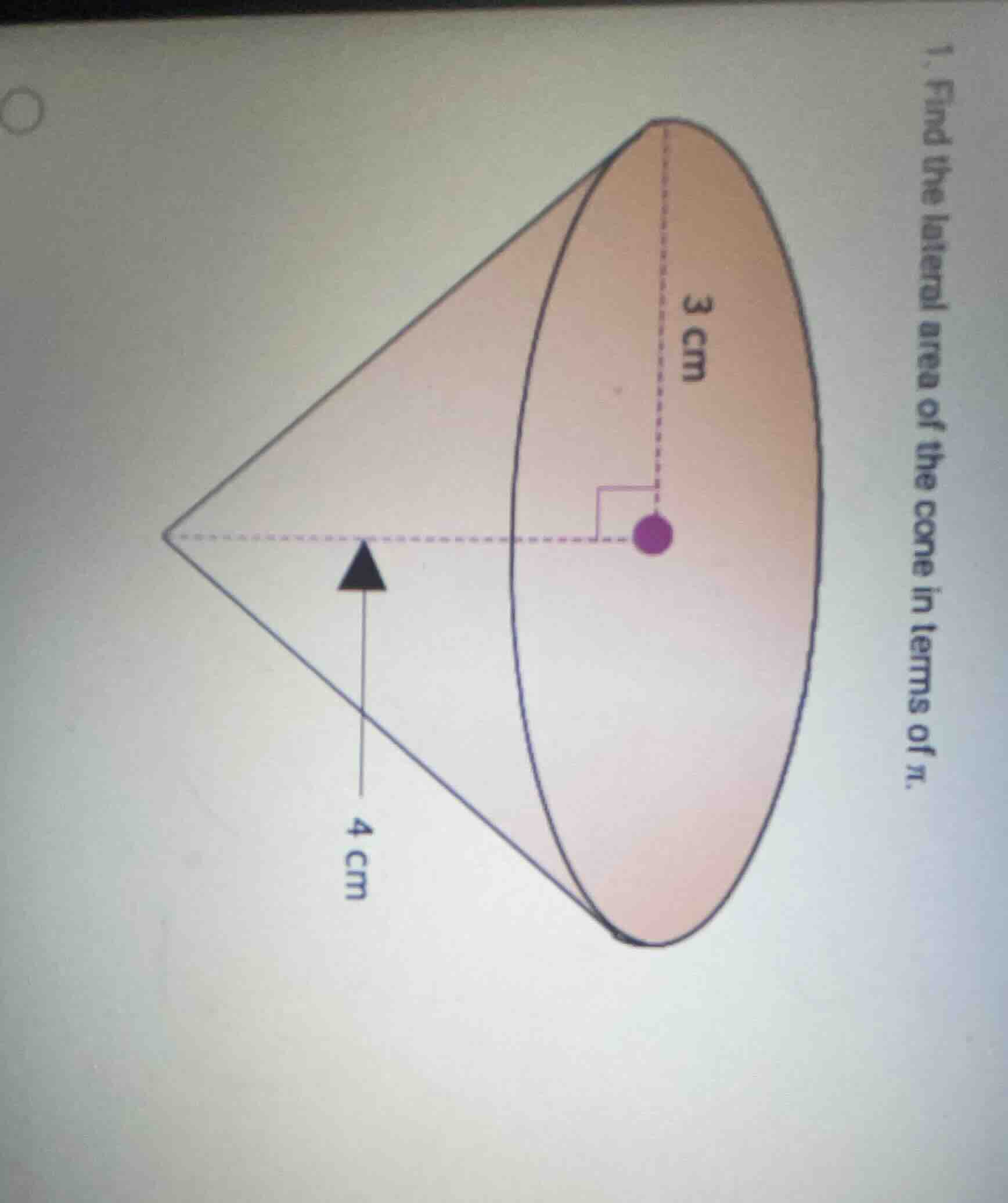
- find the lateral area of the cone in terms of π. (with a cone diagram showing radius 3 cm and height 4 cm)
Step1: Identify cone radius and slant height
Radius \( r = 3 \, \text{cm} \), slant height \( l = 4 \, \text{cm} \)? No, wait—wait, the lateral area formula is \( \pi r l \). Wait, no, wait: the slant height is the length of the side of the cone, which in the diagram is the 4 cm? Wait, no, let's confirm: lateral area of cone is \( \pi r l \), where \( l \) is slant height. The diagram shows radius 3 cm, slant height 5 cm? Wait no, wait the triangle: if radius is 3 (base of right triangle) and height... no, wait the arrow is 4 cm—wait, no, the slant height is the hypotenuse? Wait no, the diagram's arrow is 4 cm, radius 3 cm: slant height \( l = \sqrt{3^2 + 4^2} = 5 \)? Wait no, wait the problem says "lateral area of the cone"—the lateral area is \( \pi r l \). If radius \( r = 3 \), slant height \( l = 5 \), then it's \( 15\pi \). Yes, that makes sense.
Step2: Calculate lateral area
Use formula \( \text{Lateral Area} = \pi r l \)
Substitute \( r = 3 \), \( l = 5 \): \( \pi \times 3 \times 5 = 15\pi \)

Snap & solve any problem in the app
Get step-by-step solutions on Sovi AI
Photo-based solutions with guided steps
Explore more problems and detailed explanations
15π cm²