QUESTION IMAGE
Question
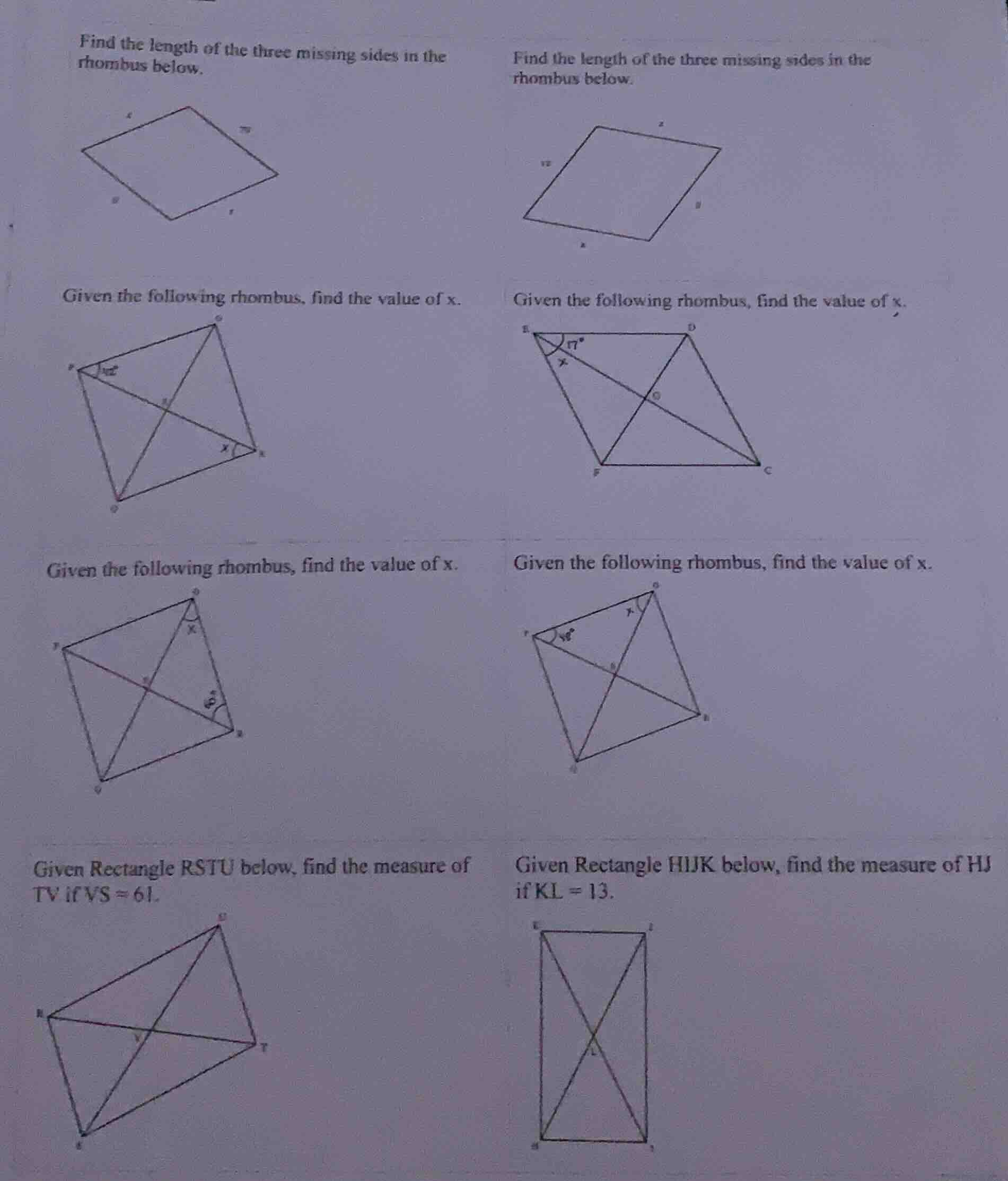
find the length of the three missing sides in the rhombus below.
find the length of the three missing sides in the rhombus below.
given the following rhombus, find the value of x.
given the following rhombus, find the value of x.
given the following rhombus, find the value of x.
given the following rhombus, find the value of x.
given rectangle rstu below, find the measure of tv if vs = 61.
given rectangle hijk below, find the measure of hj if kl = 13.
To solve these problems, we'll use properties of rhombuses and rectangles. Let's start with the first rhombus problem:
Problem 1: Find the length of the three missing sides in the rhombus.
A rhombus has all four sides equal. So if one side is given, all sides are equal.
- Step 1: Identify the given side. Suppose the given side is \( 79 \) (or \( 9 \), depending on the diagram).
- Step 2: Since all sides of a rhombus are equal, the missing sides will match the given side.
Problem 2: Find the length of the three missing sides in the rhombus (second diagram).
Again, a rhombus has all sides equal. If one side is \( 12 \) (or \( 9 \)), all sides are equal.
- Step 1: Recall the rhombus side property.
- Step 2: The missing sides equal the given side.
Problem 3: Given the rhombus, find \( x \).
In a rhombus, diagonals bisect the angles, and opposite angles are equal. Also, adjacent angles are supplementary.
- Step 1: Analyze the angle given (e.g., \( 102^\circ \)).
- Step 2: Use angle bisector or supplementary angle properties to find \( x \). For example, if one angle is \( 102^\circ \), the adjacent angle is \( 180^\circ - 102^\circ = 78^\circ \), and the diagonal bisects it, so \( x = \frac{78^\circ}{2} = 39^\circ \) (or similar logic).
Problem 4: Given the rhombus with \( 17^\circ \), find \( x \).

Snap & solve any problem in the app
Get step-by-step solutions on Sovi AI
Photo-based solutions with guided steps
Explore more problems and detailed explanations
In a rectangle, diagonals are equal and bisect each other. \( KL \) is half the diagonal, so \( HJ \) (the diagonal) is \( 2 \times KL \).
- Step 1: Diagonals bisect each other, so \( HJ = 2 \times KL \).
- Step 2: Substitute \( KL = 13 \): \( HJ = 2 \times 13 = 26 \).
Final Answers (Examples):
- Missing sides: \( 79, 79, 9 \) (or all equal to the given side).
- Missing sides: \( 12, 12, 9 \) (or all equal to the given side).
- \( x = 39^\circ \) (or similar, based on diagram).
- \( x = 17^\circ \) (or similar).
- \( x = 57.5^\circ \) (or similar).
- \( x = 51^\circ \) (or similar).
- \( TV = 122 \).
- \( HJ = 26 \).
(Note: Exact answers depend on the specific diagram details, but the logic uses rhombus/rectangle properties.)