QUESTION IMAGE
Question
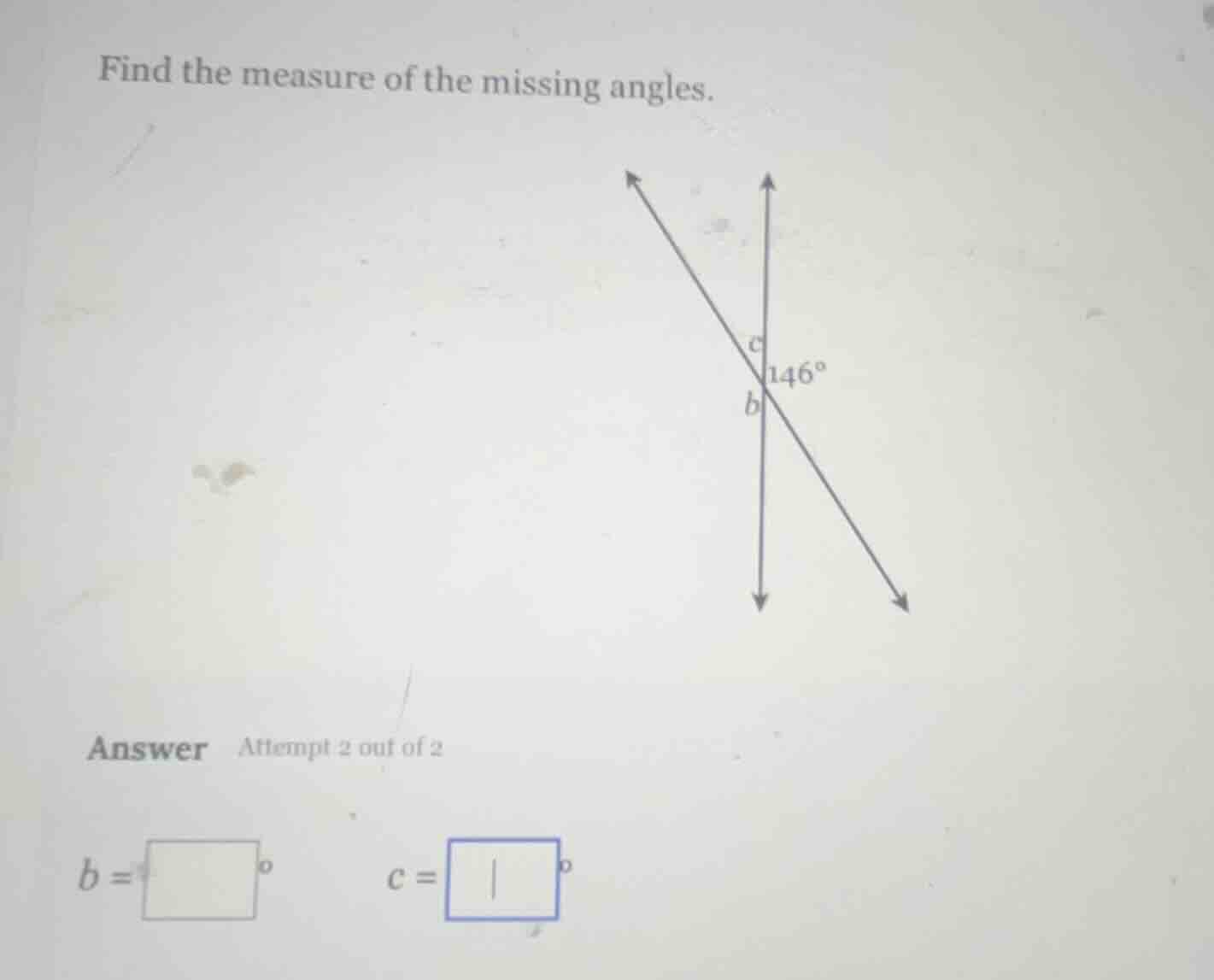
find the measure of the missing angles.
answer attempt 2 out of 2
b = \boxed{\space}^\circ \quad c = \boxed{1}^\circ
Step1: Find angle \( b \)
Angles on a straight line sum to \( 180^\circ \). The given angle is \( 146^\circ \), so \( b + 146^\circ = 180^\circ \). Solving for \( b \), we get \( b = 180^\circ - 146^\circ = 34^\circ \). Wait, no, actually, \( b \) and the \( 146^\circ \) angle: Wait, looking at the diagram, the vertical line and the slanted line. Wait, \( b \) and the \( 146^\circ \) angle: Wait, maybe \( b \) is supplementary? Wait, no, actually, the vertical line is straight, so the angle adjacent to \( 146^\circ \) (which is \( c \)) and \( 146^\circ \) are supplementary? Wait, no, let's re-examine. The vertical line is a straight line, so the angle \( b \) and the \( 146^\circ \) angle: Wait, maybe \( b \) is equal to \( 180^\circ - 146^\circ \)? No, wait, the vertical line is a straight angle (180 degrees). The slanted line intersects it, creating angles. So the angle labeled \( 146^\circ \) and angle \( c \) are adjacent and form a linear pair? Wait, no, the vertical line is straight, so the angle between the vertical line and the slanted line: Let's see, the vertical line is up and down, the slanted line crosses it. So the angle \( 146^\circ \) and angle \( b \): Wait, maybe \( b \) is vertical to the angle that's supplementary? Wait, no, let's correct. The angle \( b \) and the \( 146^\circ \) angle: Wait, actually, the vertical line is a straight line, so the sum of \( b \) and \( 146^\circ \) is 180? No, wait, maybe \( b \) is equal to \( 180 - 146 = 34 \)? No, wait, no, the vertical line is straight, so the angle \( b \) and the angle adjacent to \( 146^\circ \) (which is \( c \)): Wait, maybe I mixed up. Let's start over.
The vertical line is a straight line, so the angle formed by the slanted line and the vertical line: the angle labeled \( 146^\circ \) and angle \( c \) are adjacent and form a linear pair? Wait, no, the vertical line is straight, so the sum of \( c \) and \( 146^\circ \) is \( 180^\circ \)? Wait, no, the vertical line is up and down, so the angle between the vertical line and the slanted line: the angle \( 146^\circ \) is on one side, and \( c \) is on the other. So \( c + 146^\circ = 180^\circ \), so \( c = 180 - 146 = 34^\circ \). Then, angle \( b \) and the \( 146^\circ \) angle: since \( b \) and the angle \( c \) are vertical angles? Wait, no, vertical angles are equal. Wait, the vertical line and the slanted line intersect, so vertical angles: angle \( b \) and the angle opposite to \( c \)? Wait, maybe I made a mistake. Let's look again. The diagram: vertical line (up and down), slanted line crossing it. The angle between the slanted line and the upper part of the vertical line is \( c \), and the angle between the slanted line and the lower part of the vertical line is \( b \). The angle between the slanted line and the right part (next to \( 146^\circ \)): Wait, the \( 146^\circ \) angle is between the slanted line and the vertical line (lower part? No, upper? Wait, the vertical line has an arrow up and down. The slanted line has an arrow up-left and down-right. So the angle between the slanted line (down-right) and the vertical line (down) is \( 146^\circ \)? No, that can't be. Wait, maybe the \( 146^\circ \) angle is adjacent to \( b \), so \( b + 146^\circ = 180^\circ \), so \( b = 180 - 146 = 34^\circ \). Then, angle \( c \) is equal to \( b \) because they are vertical angles? Wait, no, vertical angles are equal. Wait, no, angle \( c \) and the angle adjacent to \( 146^\circ \): Wait, maybe \( c \) is equal to \( 180 - 146 = 34^\circ \), and \( b \) is equal to \( 146^\circ \)? Wait, t…

Snap & solve any problem in the app
Get step-by-step solutions on Sovi AI
Photo-based solutions with guided steps
Explore more problems and detailed explanations
\( b = 146^\circ \), \( c = 34^\circ \)