QUESTION IMAGE
Question
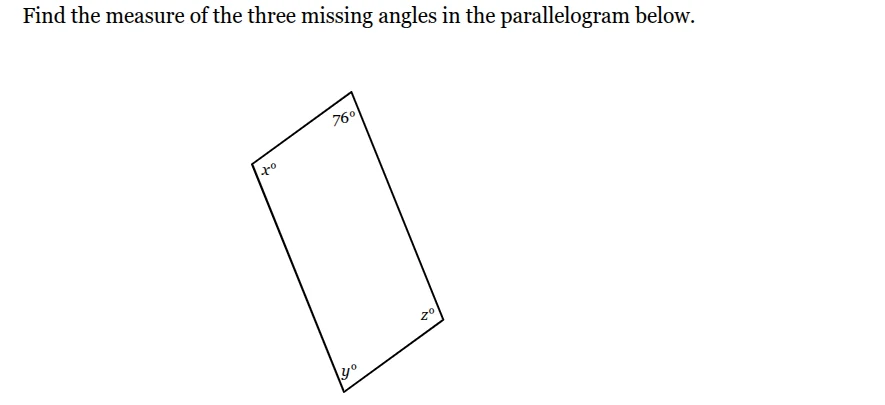
find the measure of the three missing angles in the parallelogram below.
image of a parallelogram with one angle labeled 76°, and the other three angles labeled x°, y°, z°
Step1: Recall properties of parallelograms
In a parallelogram, opposite angles are equal, and consecutive angles are supplementary (sum to \(180^\circ\)).
Step2: Find angle \(x\)
Angle \(x\) and the \(76^\circ\) angle are consecutive angles? Wait, no, wait. Wait, in the parallelogram, let's identify the angles. Let's see, the angle given is \(76^\circ\), and angle \(x\) is adjacent? Wait, no, actually, in a parallelogram, opposite angles are equal. Wait, let's label the parallelogram. Let's say the vertices are, in order, \(A\) (with \(x^\circ\)), \(B\) (with \(76^\circ\)), \(C\) (with \(z^\circ\)), \(D\) (with \(y^\circ\)). Then, \(AB\) is adjacent to \(BC\), so angle at \(A\) ( \(x\)) and angle at \(B\) ( \(76^\circ\)) are consecutive, so they should be supplementary? Wait, no, consecutive angles in a parallelogram are supplementary. Wait, but also, opposite angles are equal. So angle \(x\) is opposite to angle \(z\), and angle \(76^\circ\) is opposite to angle \(y\). Wait, maybe I got the labels wrong. Let's re-examine the diagram. The diagram shows a parallelogram with one angle \(76^\circ\), and the other angles labeled \(x\), \(y\), \(z\). Let's assume that the angle \(76^\circ\) and angle \(x\) are consecutive. Wait, no, in a parallelogram, consecutive angles are supplementary. So if one angle is \(76^\circ\), then the consecutive angle is \(180 - 76 = 104^\circ\). Also, opposite angles are equal. So let's figure out which angles are opposite. Let's say the angle \(76^\circ\) is at the top, then the angle opposite to it (at the bottom) is also \(76^\circ\)? Wait, no, that can't be. Wait, no, in a parallelogram, opposite angles are equal, and consecutive angles are supplementary. So if angle \(A = 76^\circ\), then angle \(C = 76^\circ\), and angle \(B = angle D = 180 - 76 = 104^\circ\). Wait, maybe the diagram has the \(76^\circ\) angle, and \(x\) is opposite to \(z\), and \(76^\circ\) is opposite to \(y\)? Wait, maybe the labels are such that \(76^\circ\) and \(y\) are opposite, and \(x\) and \(z\) are opposite. Wait, let's look at the diagram again. The diagram shows a parallelogram with the top angle \(76^\circ\), left angle \(x\), bottom angle \(y\), right angle \(z\). So, in a parallelogram, left angle (\(x\)) and right angle (\(z\)) are opposite, so \(x = z\). Top angle (\(76^\circ\)) and bottom angle (\(y\)) are opposite, so \(y = 76^\circ\). Then, consecutive angles: top angle (\(76^\circ\)) and left angle (\(x\)) are consecutive, so they are supplementary. So \(76 + x = 180\), so \(x = 180 - 76 = 104^\circ\). Then, since \(x = z\) (opposite angles), \(z = 104^\circ\), and \(y = 76^\circ\) (opposite to \(76^\circ\)). Wait, maybe that's the case. Let's confirm.
So, step by step:
- In a parallelogram, opposite angles are equal.
- Consecutive angles are supplementary (sum to \(180^\circ\)).
Given one angle is \(76^\circ\). Let's assume that \(76^\circ\) and \(x\) are consecutive angles. Then:
Step1: Find \(x\) (consecutive to \(76^\circ\))
Since consecutive angles are supplementary:
\(x + 76 = 180\)
\(x = 180 - 76 = 104^\circ\)
Step2: Find \(y\) (opposite to \(76^\circ\))
Opposite angles are equal, so \(y = 76^\circ\)
Step3: Find \(z\) (opposite to \(x\))
Opposite angles are equal, so \(z = x = 104^\circ\)
Wait, but let's check again. Let's make sure about the labels. The diagram has the \(76^\circ\) angle, and then \(x\), \(y\), \(z\). Let's say the angles are arranged as: top angle \(76^\circ\), left angle \(x\), bottom angle \(y\), right angle \(z\). Then, left angle \(x\) and right angle \(z\)…

Snap & solve any problem in the app
Get step-by-step solutions on Sovi AI
Photo-based solutions with guided steps
Explore more problems and detailed explanations
\(x = 104^\circ\), \(y = 76^\circ\), \(z = 104^\circ\)