QUESTION IMAGE
Question
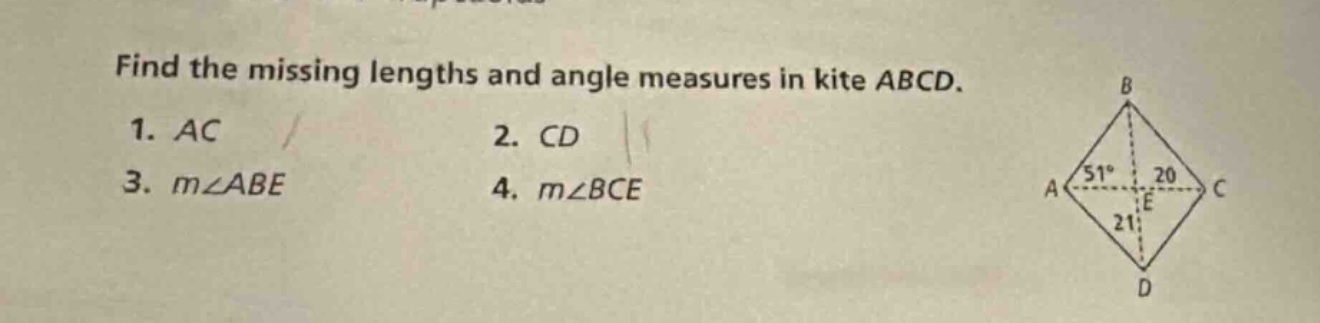
find the missing lengths and angle measures in kite abcd.
- ac
- cd
- ( mangle abe )
- ( mangle bce )
Step1: Find AC
In a kite, the diagonals are perpendicular, and one diagonal is bisected. Here, \( AE = EC \) (since diagonals of a kite bisect each other? Wait, no, in a kite, one diagonal is bisected. Wait, actually, in a kite, one diagonal is the perpendicular bisector of the other. Wait, looking at the diagram, \( E \) is the intersection of diagonals. In a kite, one diagonal (the axis of symmetry) bisects the other. So if \( EC = 20 \), then \( AE = 20 \), so \( AC = AE + EC = 20 + 20 = 40 \).
Step2: Find CD
In a kite, adjacent sides are equal. So \( CD = BC \)? Wait, no, in a kite, two distinct pairs of adjacent sides are equal. So \( AB = AD \) and \( BC = CD \)? Wait, no, actually, in a kite, \( AB = BC \) and \( AD = CD \)? Wait, no, the definition is two pairs of adjacent sides are equal. So \( AB = AD \) and \( BC = CD \)? Wait, looking at the diagram, \( DE = 21 \), \( EC = 20 \). Wait, \( CD \) is a side, and triangle \( CDE \) is a right triangle (since diagonals in a kite are perpendicular). So \( CD = \sqrt{DE^2 + EC^2} \)? Wait, no, wait, \( DE = 21 \), \( EC = 20 \), so \( CD = \sqrt{21^2 + 20^2} \)? Wait, no, wait, in the kite, \( AD = CD \)? Wait, no, \( AB = BC \) and \( AD = CD \)? Wait, actually, in a kite, one diagonal is the perpendicular bisector, so triangles \( ABE \) and \( ADE \) are congruent, and triangles \( BCE \) and \( DCE \) are congruent. So \( CD = BC \)? Wait, no, \( CD \) is equal to \( AD \)? Wait, no, let's check the right triangles. \( DE = 21 \), \( EC = 20 \), so \( CD = \sqrt{DE^2 + EC^2} \)? Wait, no, \( DE \) is 21, \( EC \) is 20, so \( CD = \sqrt{21^2 + 20^2} = \sqrt{441 + 400} = \sqrt{841} = 29 \). Wait, because \( 21^2 = 441 \), \( 20^2 = 400 \), sum is 841, square root is 29. So \( CD = 29 \).
Step3: Find \( m\angle ABE \)
In triangle \( ABE \), we know \( \angle BAE = 51^\circ \), and since diagonals are perpendicular, \( \angle AEB = 90^\circ \). So \( m\angle ABE = 90^\circ - 51^\circ = 39^\circ \).
Step4: Find \( m\angle BCE \)
In triangle \( BCE \), \( \angle BEC = 90^\circ \) (diagonals are perpendicular), \( EC = 20 \), \( BE \) is some length, but wait, in triangle \( BCE \), since it's a right triangle, and we know that in a kite, the diagonal \( BD \) bisects the angles at \( B \) and \( D \). Wait, no, the diagonal that is the axis of symmetry bisects the angles. Wait, actually, in triangle \( BCE \), it's a right triangle, so \( m\angle BCE = 90^\circ \)? No, wait, no. Wait, \( \angle BEC = 90^\circ \), so \( m\angle BCE = 90^\circ - m\angle CBE \). But we know that in triangle \( ABE \), \( m\angle ABE = 39^\circ \), and since \( AB = BC \) (kite sides), triangles \( ABE \) and \( CBE \) are congruent? Wait, no, \( AB = BC \), \( BE \) is common, \( AE = EC \), so triangles \( ABE \) and \( CBE \) are congruent (SSS). So \( \angle ABE = \angle CBE = 39^\circ \), so in triangle \( BCE \), \( m\angle BCE = 90^\circ - 39^\circ = 51^\circ \)? Wait, no, wait, let's re-examine. Wait, in triangle \( ABE \), angles are \( 51^\circ \) (at \( A \)), \( 90^\circ \) (at \( E \)), so \( 39^\circ \) at \( B \). Then, since \( AB = BC \), \( AE = EC \), \( BE = BE \), so triangle \( ABE \cong \triangle CBE \) (SSS). Therefore, \( \angle BCE = \angle BAE = 51^\circ \)? Wait, no, \( \angle BAE = 51^\circ \), \( \angle BCE \) would be equal to \( \angle BAE \)? Wait, no, in triangle \( BCE \), angle at \( C \) is \( \angle BCE \), angle at \( B \) is \( \angle CBE = 39^\circ \), angle at \( E \) is \( 90^\circ \), so \( \angle BCE = 180 - 90 - 39 = 51^\circ \). Yes, that mak…

Snap & solve any problem in the app
Get step-by-step solutions on Sovi AI
Photo-based solutions with guided steps
Explore more problems and detailed explanations
s:
- \( AC = 40 \)
- \( CD = 29 \)
- \( m\angle ABE = 39^\circ \)
- \( m\angle BCE = 51^\circ \)