QUESTION IMAGE
Question
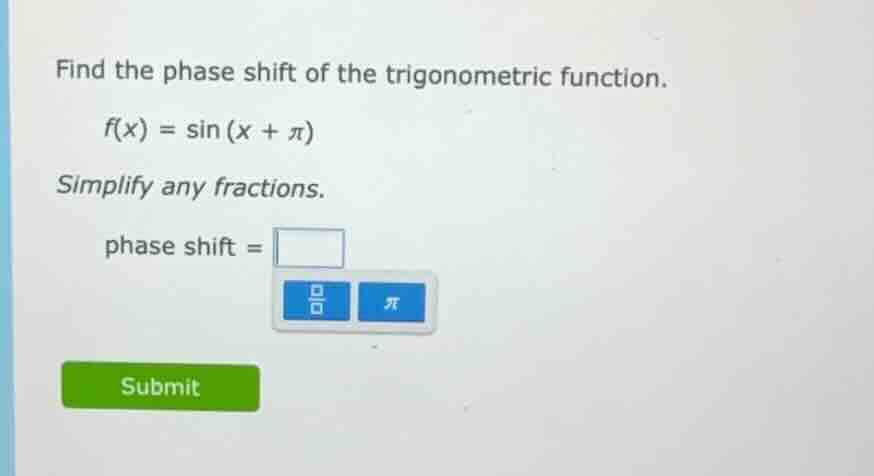
find the phase shift of the trigonometric function.
$f(x) = \sin(x + \pi)$
simplify any fractions.
phase shift =
submit
Step1: Recall the phase shift formula for sine function
The general form of a sine function is \( f(x) = A\sin(B(x - C)) + D \), where the phase shift is \( C \). If the function is written as \( f(x)=\sin(x + \pi) \), we can rewrite it in the form \( f(x)=\sin(1\times(x - (-\pi))) \).
Step2: Identify the phase shift
Comparing with the general form \( f(x) = A\sin(B(x - C)) + D \), here \( B = 1 \) and \( C=-\pi \)? Wait, no, wait. Wait, the standard form for phase shift: when we have \( \sin(x + h) \), it is equivalent to \( \sin(1\times(x - (-h))) \), so the phase shift is \( -h \)? Wait, no, let's correct. The general form is \( y = A\sin(Bx - C)+D \), then the phase shift is \( \frac{C}{B} \). So if we rewrite \( f(x)=\sin(x+\pi) \) as \( f(x)=\sin(1\times x+ \pi) \), then comparing to \( y = A\sin(Bx - C)+D \), we have \( Bx - C= x+\pi \), so \( B = 1 \), and \( -C=\pi \), so \( C = -\pi \). Then the phase shift is \( \frac{C}{B}=\frac{-\pi}{1}=-\pi \)? Wait, no, maybe I mixed up. Wait, the correct formula: for \( y = \sin(B(x - C)) \), the phase shift is \( C \). So if we have \( y=\sin(x + \pi)=\sin(1\times(x - (-\pi))) \), so here \( C = -\pi \)? Wait, no, that can't be. Wait, let's take an example. The function \( \sin(x) \) has phase shift 0. The function \( \sin(x + \pi) \) is a horizontal shift. Let's think about the graph. The standard \( \sin(x) \) has a peak at \( x=\frac{\pi}{2} \). For \( \sin(x + \pi) \), when does \( x+\pi=\frac{\pi}{2} \)? Solving for \( x \), we get \( x=\frac{\pi}{2}-\pi=-\frac{\pi}{2} \). So the peak is at \( x = -\frac{\pi}{2} \), while for \( \sin(x) \) it's at \( x=\frac{\pi}{2} \). So the shift is \( -\pi \)? Wait, no, the distance between \( \frac{\pi}{2} \) and \( -\frac{\pi}{2} \) is \( -\pi \) (shift to the left by \( \pi \)). Wait, the phase shift for \( \sin(x + h) \) is a shift to the left by \( h \) units. So if \( h>0 \), shift left by \( h \); if \( h < 0 \), shift right by \( |h| \). So in the function \( \sin(x + \pi) \), we can write it as \( \sin(1\times(x - (-\pi))) \), but the phase shift is the horizontal shift. The formula for phase shift when the function is \( y = \sin(Bx + C) \) is \( -\frac{C}{B} \). Let's use that formula. So for \( y=\sin(x+\pi) \), \( B = 1 \), \( C=\pi \). Then phase shift is \( -\frac{C}{B}=-\frac{\pi}{1}=-\pi \). Wait, but that would mean a shift to the left by \( \pi \) (since phase shift is negative, it's a shift to the left; positive is shift to the right). Wait, let's check with a point. For \( \sin(x) \), when \( x = 0 \), \( y = 0 \). For \( \sin(x+\pi) \), when \( x = -\pi \), \( y=\sin(0)=0 \). So the point \( (0,0) \) on \( \sin(x) \) is shifted to \( (-\pi, 0) \) on \( \sin(x+\pi) \). So the shift is \( -\pi \) (shift left by \( \pi \)). So the phase shift is \( -\pi \)? But the problem is asking for phase shift. Wait, maybe the formula is different. Wait, the general form is \( y = A\sin(B(x - C)) + D \), so the phase shift is \( C \). So if we write \( \sin(x + \pi)=\sin(1\times(x - (-\pi))) \), then \( C = -\pi \), so phase shift is \( -\pi \). But let's confirm with the formula \( \text{Phase shift}=\frac{C}{B} \) where \( y = A\sin(Bx - C)+D \). So if we have \( y=\sin(x+\pi)=\sin(1\times x+ \pi) \), then \( Bx - C = x+\pi \implies -C=\pi \implies C = -\pi \). Then phase shift is \( \frac{C}{B}=\frac{-\pi}{1}=-\pi \). So the phase shift is \( -\pi \)? Wait, but maybe the problem considers the phase shift as the value of \( C \) in the form \( \sin(x - C) \), but here it's \( \sin(x + \pi)=\sin(x - (-\pi)) \), so the phase shi…

Snap & solve any problem in the app
Get step-by-step solutions on Sovi AI
Photo-based solutions with guided steps
Explore more problems and detailed explanations
\(-\pi\)