QUESTION IMAGE
Question
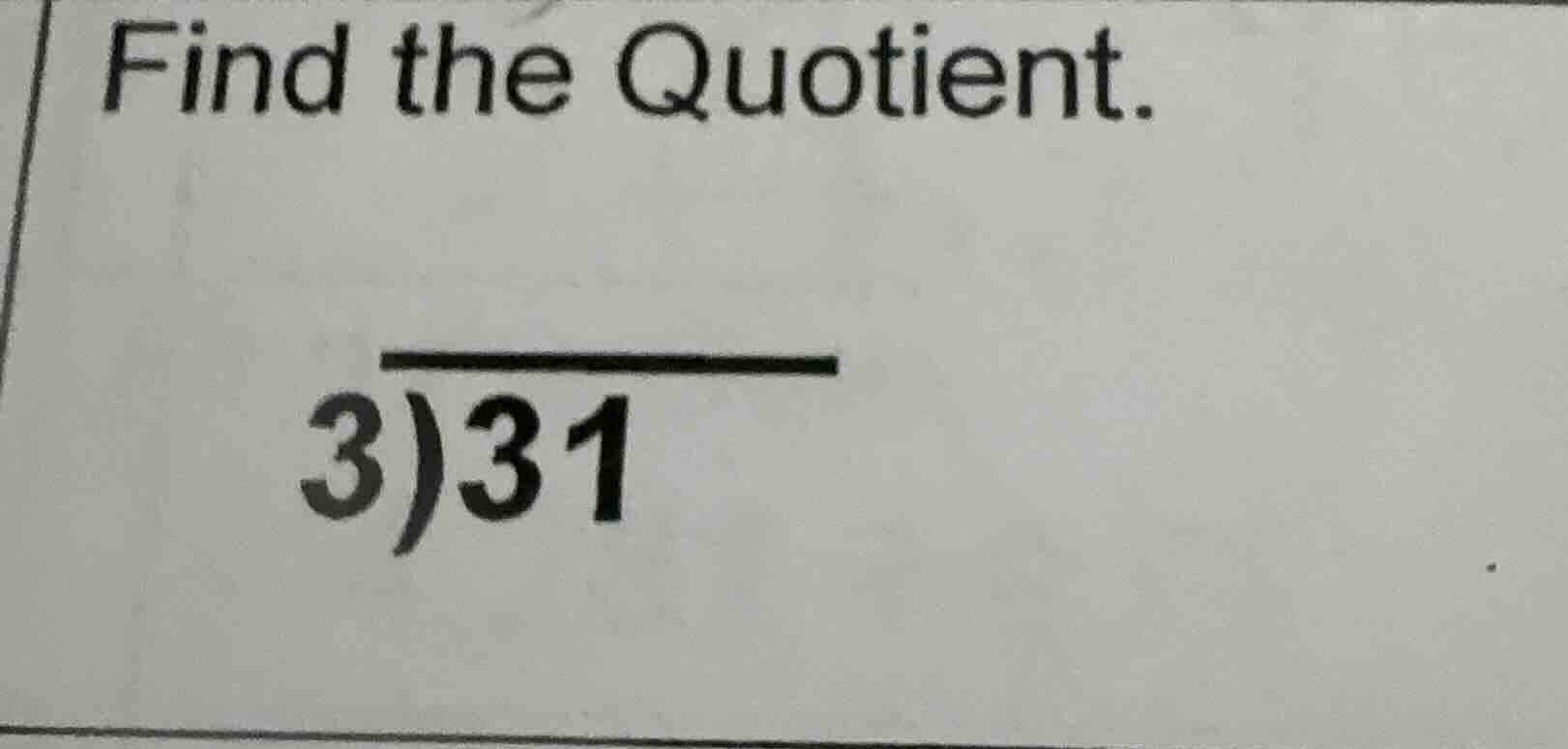
find the quotient.
\overline{3)31}
Step1: Divide 3 into 3 (tens place)
3 ÷ 3 = 1, write 1 above the tens place.
Step2: Multiply 1 by 3
1 × 3 = 3, subtract 3 from 3 (tens place), result is 0.
Step3: Bring down 1 (units place)
Now we have 1.
Step4: Divide 3 into 1 (can't, so write 0 above units place? Wait, no, actually, 3 goes into 31 ten times? Wait, no, 3×10=30, which is less than 31. 3×10=30, subtract 30 from 31, remainder 1. So the quotient is 10 with a remainder of 1. Wait, but if we do long division:
3 ) 31
- 30 (3×10)
----
1
So the quotient is 10 (and remainder 1). Wait, maybe I made a mistake earlier. Let's redo:
First digit: 3 (divisor) into 3 (first digit of dividend) is 1. Multiply 1×3=3, subtract from 3, get 0. Bring down 1. Now we have 1. 3 into 1 is 0, but we can write it as a decimal or just the whole number quotient. Wait, the problem is 31 divided by 3. So 3×10=30, which is the largest multiple of 3 less than 31. So the quotient is 10, remainder 1.
Wait, maybe the initial steps:
Step1: Divide 3 into 31
How many times does 3 go into 31? 3×10=30, which is less than 31. 3×11=33, which is more than 31. So 10 times. So quotient is 10, remainder 1.
But in long division:
10
------
3 | 31
30
------
1
So the quotient is 10 (with remainder 1).

Snap & solve any problem in the app
Get step-by-step solutions on Sovi AI
Photo-based solutions with guided steps
Explore more problems and detailed explanations
The quotient of \( 31 \div 3 \) is \( 10 \) (with a remainder of \( 1 \)). If we consider the quotient as a mixed number or decimal, it's \( 10\frac{1}{3} \) or approximately \( 10.333... \), but since the problem is likely asking for the whole number quotient (with remainder), the quotient is \( 10 \).