QUESTION IMAGE
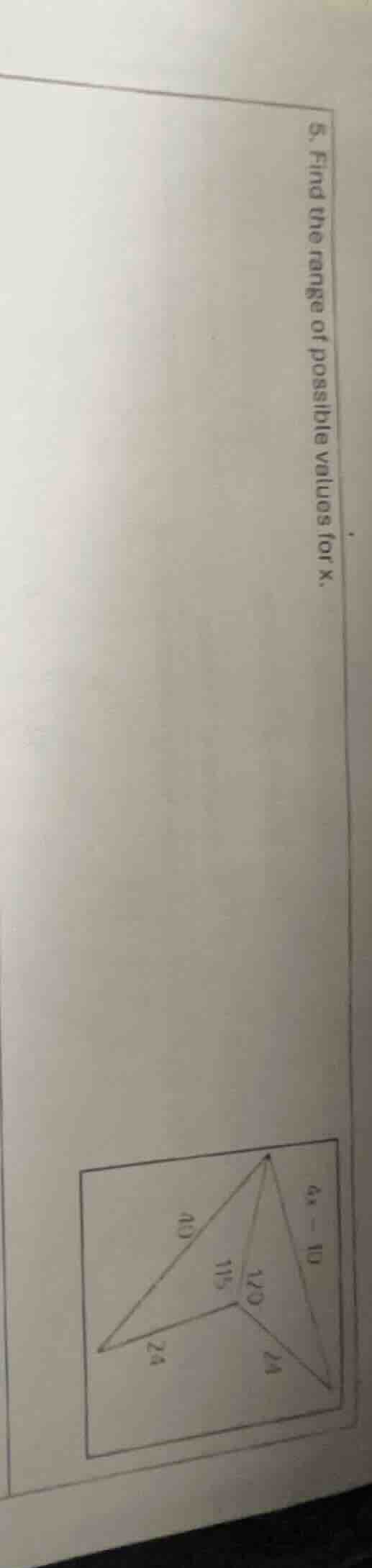
Question
- find the range of possible values for x.
Step1: Apply the Hinge Theorem
The Hinge Theorem states that if two sides of one triangle are congruent to two sides of another triangle, and the included angle of the first is larger than the included angle of the second, then the third side of the first triangle is longer than the third side of the second. Here, the two triangles share two pairs of congruent sides (24 and 24, the other pair is congruent as part of the figure), with included angles 120° and 115°. So:
$4x - 10 > 40$
Step2: Solve the inequality for lower bound
Isolate the variable $x$:
$4x > 40 + 10$
$4x > 50$
$x > \frac{50}{4}$
$x > 12.5$
Step3: Ensure side length is positive
The side length $4x - 10$ must be positive:
$4x - 10 > 0$
$4x > 10$
$x > 2.5$
Since $12.5 > 2.5$, the stricter lower bound is $x > 12.5$.
Step4: Set upper bound (triangle inequality)
The side $4x - 10$ must be less than the sum of the other two sides of its triangle (24 + 24, as the maximum possible length for a side in a triangle is less than the sum of the other two sides):
$4x - 10 < 24 + 24$
$4x - 10 < 48$
Step5: Solve for upper bound
Isolate $x$:
$4x < 48 + 10$
$4x < 58$
$x < \frac{58}{4}$
$x < 14.5$

Snap & solve any problem in the app
Get step-by-step solutions on Sovi AI
Photo-based solutions with guided steps
Explore more problems and detailed explanations
The range of possible values for $x$ is $12.5 < x < 14.5$ (or $\frac{25}{2} < x < \frac{29}{2}$)