QUESTION IMAGE
Question
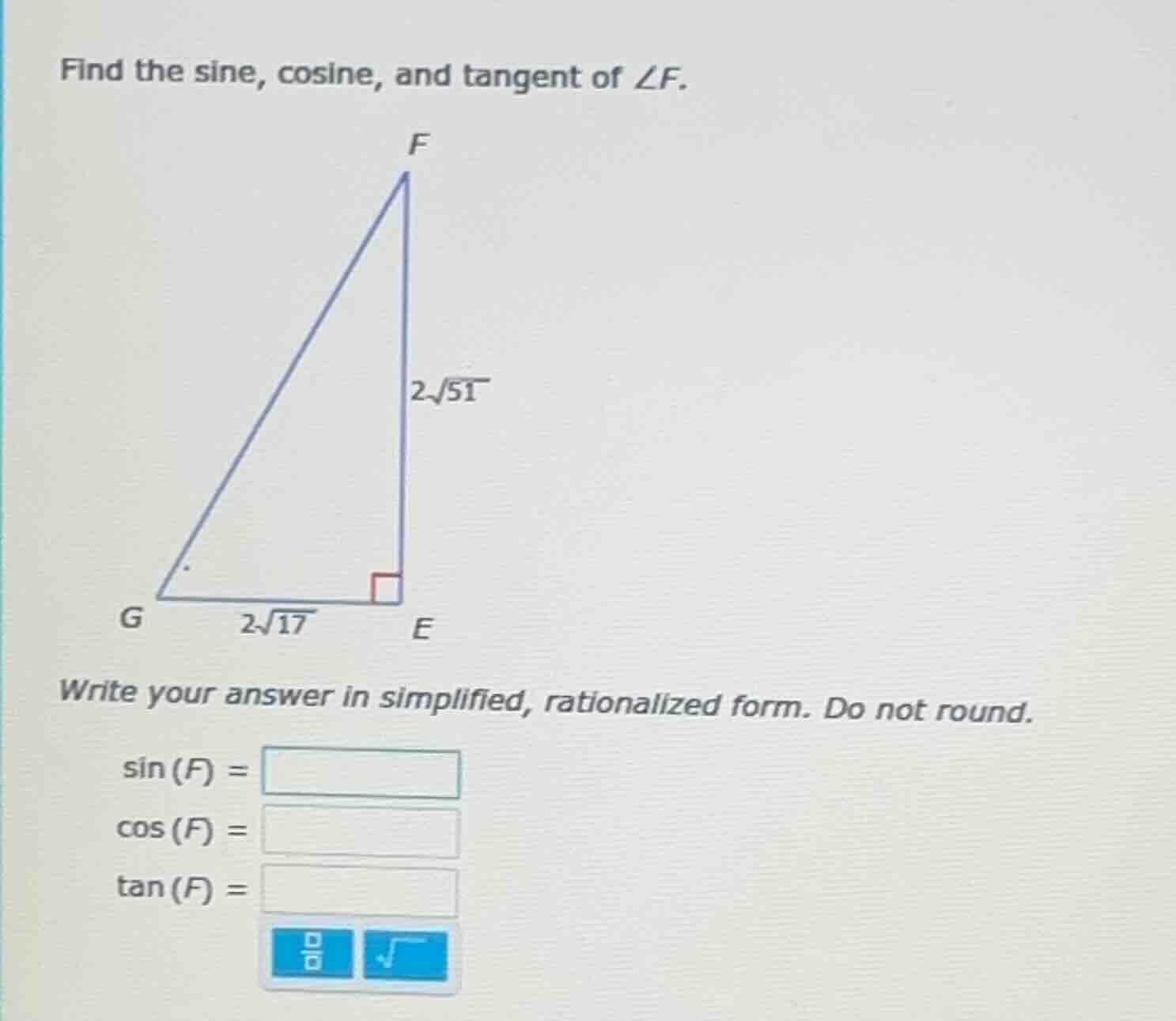
find the sine, cosine, and tangent of $\angle f$.
triangle image with right angle at e, ge = $2\sqrt{17}$, fe = $2\sqrt{51}$
write your answer in simplified, rationalized form. do not round.
$\sin(f) = \square$
$\cos(f) = \square$
$\tan(f) = \square$
Step1: Find the hypotenuse \( FG \)
In right triangle \( FGE \), by Pythagorean theorem \( FG^2 = GE^2 + FE^2 \).
Given \( GE = 2\sqrt{17} \), \( FE = 2\sqrt{51} \).
So \( FG^2=(2\sqrt{17})^2+(2\sqrt{51})^2 = 4\times17 + 4\times51 = 68 + 204 = 272 \), then \( FG=\sqrt{272}=4\sqrt{17} \).
Step2: Calculate \( \sin(F) \)
\( \sin(F)=\frac{\text{opposite to } \angle F}{\text{hypotenuse}}=\frac{GE}{FG} \).
Substitute \( GE = 2\sqrt{17} \), \( FG = 4\sqrt{17} \), we get \( \sin(F)=\frac{2\sqrt{17}}{4\sqrt{17}}=\frac{1}{2} \). Wait, no, wait: Wait, opposite to \( \angle F \) is \( GE \)? Wait, no, in right triangle \( FGE \), right angle at \( E \), so angle at \( F \): the sides: adjacent to \( F \) is \( FE \), opposite is \( GE \), hypotenuse \( FG \). Wait, let's recheck:
Wait, angle \( F \): vertex at \( F \), so the sides: \( FE \) is one leg (adjacent to \( F \)), \( GE \) is the other leg (opposite to \( F \)), \( FG \) is hypotenuse.
So \( \sin(F)=\frac{\text{opposite}}{\text{hypotenuse}}=\frac{GE}{FG}=\frac{2\sqrt{17}}{4\sqrt{17}}=\frac{1}{2} \)? Wait, but let's recalculate \( FG \):
\( (2\sqrt{17})^2 = 417=68 \), \( (2\sqrt{51})^2=451=204 \), sum is \( 68+204=272 \), \( \sqrt{272}=\sqrt{16*17}=4\sqrt{17} \), correct. Then \( GE=2\sqrt{17} \), \( FG=4\sqrt{17} \), so \( \sin(F)=\frac{2\sqrt{17}}{4\sqrt{17}}=\frac{1}{2} \). Wait, but let's check \( \cos(F) \):
Step3: Calculate \( \cos(F) \)
\( \cos(F)=\frac{\text{adjacent to } \angle F}{\text{hypotenuse}}=\frac{FE}{FG} \).
Substitute \( FE = 2\sqrt{51} \), \( FG = 4\sqrt{17} \). Wait, but \( 2\sqrt{51} \) and \( 4\sqrt{17} \): let's simplify \( \frac{2\sqrt{51}}{4\sqrt{17}}=\frac{\sqrt{51}}{2\sqrt{17}}=\frac{\sqrt{3\times17}}{2\sqrt{17}}=\frac{\sqrt{3}}{2} \). Ah, I made a mistake earlier: opposite to \( F \) is \( GE \) (length \( 2\sqrt{17} \)), adjacent is \( FE \) (length \( 2\sqrt{51} \)), hypotenuse \( FG=4\sqrt{17} \).
So correcting Step2: \( \sin(F)=\frac{GE}{FG}=\frac{2\sqrt{17}}{4\sqrt{17}}=\frac{1}{2} \)? Wait, no, \( 2\sqrt{17} \) divided by \( 4\sqrt{17} \) is \( 1/2 \), but then \( \cos(F)=\frac{FE}{FG}=\frac{2\sqrt{51}}{4\sqrt{17}}=\frac{\sqrt{51}}{2\sqrt{17}}=\frac{\sqrt{3\times17}}{2\sqrt{17}}=\frac{\sqrt{3}}{2} \). Then \( \tan(F)=\frac{\text{opposite}}{\text{adjacent}}=\frac{GE}{FE}=\frac{2\sqrt{17}}{2\sqrt{51}}=\frac{\sqrt{17}}{\sqrt{51}}=\frac{\sqrt{17}}{\sqrt{3\times17}}=\frac{1}{\sqrt{3}}=\frac{\sqrt{3}}{3} \) (rationalized).
Wait, let's redo:
- Find hypotenuse \( FG \):
\( FG = \sqrt{(2\sqrt{17})^2 + (2\sqrt{51})^2} = \sqrt{417 + 451} = \sqrt{68 + 204} = \sqrt{272} = \sqrt{16*17} = 4\sqrt{17} \). Correct.
- \( \sin(F) \): opposite side to \( F \) is \( GE = 2\sqrt{17} \), hypotenuse \( FG = 4\sqrt{17} \), so \( \sin(F) = \frac{2\sqrt{17}}{4\sqrt{17}} = \frac{1}{2} \). Wait, but that seems too simple. Wait, but let's check with the sides: \( FE = 2\sqrt{51} \), \( GE = 2\sqrt{17} \), \( FG = 4\sqrt{17} \). So ratio of \( GE \) to \( FG \) is \( 2\sqrt{17}/4\sqrt{17}=1/2 \), correct.
- \( \cos(F) \): adjacent side to \( F \) is \( FE = 2\sqrt{51} \), hypotenuse \( FG = 4\sqrt{17} \). Wait, \( FE = 2\sqrt{51} = 2\sqrt{3*17} = 2\sqrt{3}\sqrt{17} \), \( FG = 4\sqrt{17} \). So \( \cos(F) = \frac{2\sqrt{3}\sqrt{17}}{4\sqrt{17}} = \frac{\sqrt{3}}{2} \). Correct.
- \( \tan(F) \): opposite over adjacent = \( GE / FE = 2\sqrt{17} / (2\sqrt{51}) = \sqrt{17}/\sqrt{51} = \sqrt{17}/(\sqrt{3}\sqrt{17}) = 1/\sqrt{3} = \sqrt{3}/3 \) (rationalized).
Wait, so:
\( \sin(F) = \frac{1}{2} \), \( \cos(F) = \frac{\sqrt{3}}{2} \), \( \tan(F) = \frac{\sqrt…

Snap & solve any problem in the app
Get step-by-step solutions on Sovi AI
Photo-based solutions with guided steps
Explore more problems and detailed explanations
\( \sin(F) = \boldsymbol{\frac{1}{2}} \)
\( \cos(F) = \boldsymbol{\frac{\sqrt{3}}{2}} \)
\( \tan(F) = \boldsymbol{\frac{\sqrt{3}}{3}} \)